

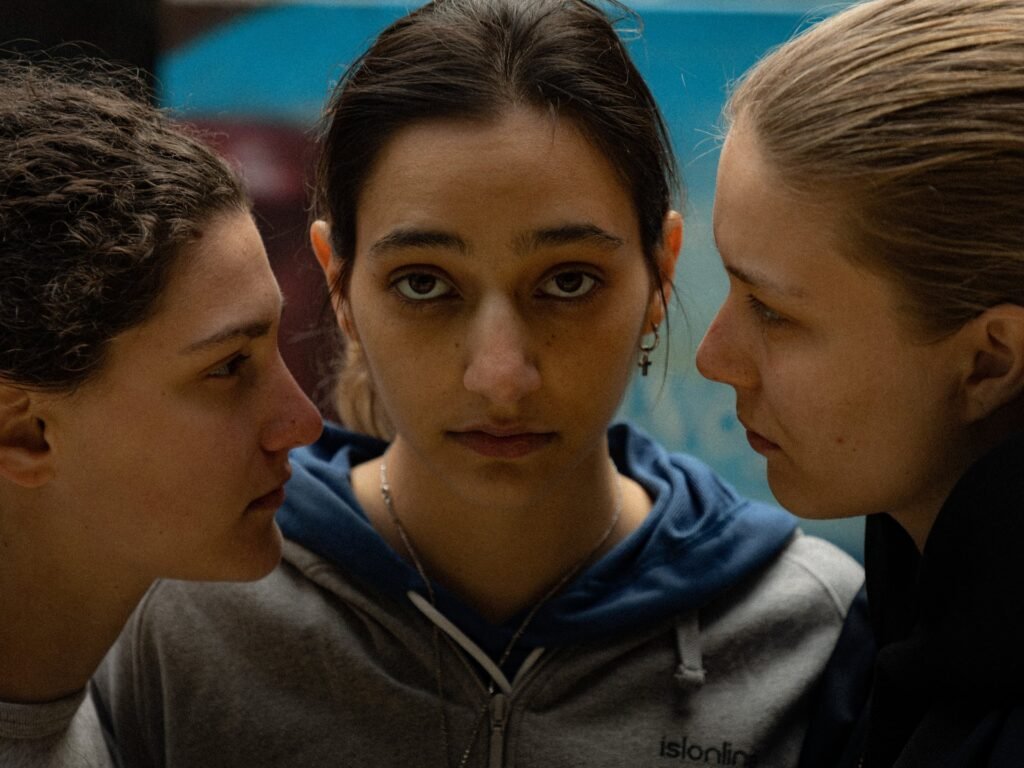
Living in a monotonous Slovenian town, the lives and perspectives of early-twenties friends Mihrije (Sarah Al Saleh), Sina (Mina Milovanović), and Jasna (Mia Skrbinac) are changed drastically upon meeting a charming and glamorous trans woman named Fantasy (Alina Juhart). Each member of the trio begins to actively battle their patriarchal environment in different ways—ones by leaning into it, others by rebelling. Mihrije, in particular, becomes enchanted by Fantasy herself and perhaps what Fantasy represents.
Fantasy world-premiered at the 78th Locarno Film Festival (6-16 August 2025) in the Concorso Cineasti del Presente before competing days later in the main competition at Sarajevo Film Festival. Kukla, who makes her feature film debut with Fantasy, sat down with Purple Hour at Sarajevo Film Festival (15-22 August 2025) to discuss her unique work.
*****
Purple Hour: The main trio of girls represent different archetypes in the sense that I have friends, especially Balkan friends, who I feel very much align with these characters, especially in the context of exploration and trying to find oneself. It really feels like these are depictions that, especially in the Balkans, will resonate immensely.
Kukla: When I was writing these characters, I was mostly thinking about the power dynamics within the group. They’re really inspired by the cultural norms of their traditional background. Sina is very much a product of her family who is traditional. She tries to fit in, in every way possible. For all three characters, I took huge inspiration from “sworn virgins”, a phenomenon from rural parts of Albania and Montenegro where a woman had to take over a male identity. This occurred if there was no man, either because of blood revenge or just if not enough men were born in the family—and there, the highest value is to be born a man. Many of them experienced even hormonal changes.
I was actually so shocked that, in interviews, so many of them expressed their hate for their own femininity. They really hated to be born a woman. In those very patriarchal tribes, the highest recognition they received from their fathers was for their masculinity. It was very interesting to explore this topic of female masculinity. I wanted to somehow reincarnate them into the present time, so as to transcend them into a contemporary environment. The characters in the film come from traditional families but the cultures are quite different. Both Serbian and Albanian cultures are very, very patriarchal, but I wanted them to fight the stereotypes, prejudice, expectations, and the mold they have been born into in opposite ways. In the Balkans, Sina means “female son”.
In the film, Fantasy reiterates that there is a lot of fetishisation of her identity. You straddle the line between curiosity and fascination when it comes to the trio of girls.
That was a huge assignment for me because I felt a deep responsibility. I know how fast you can dive into a fetish or a project. But also, Fantasy has the name “Fantasy” because I was thinking, what is a woman if not the fantasy of a woman, regardless if she is trans or cis? It’s like Simone de Beauvoir said, “One is not born, but rather becomes, a woman”. I wanted to explore womanhood in that sense. That is why it was also so important to me for the trans character to be played by a trans person—to be on the right ground. My main goal was to be respectful, authentic, and to carry out the multi-dimensional experience of being a woman.
The gracious intentions very much come through in the film. Could you speak about this intentional casting and finding the right people for all of the roles?
Through Sisters [the short film upon which Fantasy was based], I already found the three main characters. In that film, Fantasy was played by a different person. But Fantasy is also a love story, and I was really searching for somebody who has chemistry with Sarah, the actress [for Mihrije]. It was very important for me for all of the characters, and not just the trans character, to find people who have the same essence as the character—people with some synchronicities who I feel like really knew the character and could co-create them.
It was a very extensive process. I didn’t search for acting experience but for acting talent and the essence of the character. And, as I mentioned, I wanted a trans woman to play a trans woman. I think that male actors have been playing women enough in antique times. We don’t need that anymore. It’s also so important to just get visibility, especially in the Balkans. Alina was part of a music talent [television] show before, but I didn’t know her. Then. When we were shooting in a small Macedonian town that I thought was going to be very conservative and traditional, everybody accepted her really well because they saw her in the talent show. I just saw how important visibility is and how influential involvement in pop culture is as well.
In the film’s Macedonia scenes, when Fantasy must return to her hometown, the dynamic is so complex because we see her family treating her so intensely like a son—it’s a shock to the viewer. What were you thinking in crafting this careful homecoming?
That is such a scene full of pain to me, because I cannot imagine how it is to be in those shoes. But when I was writing it, I knew it had to be there. I felt like it was something she does just to save herself from danger, because travelling in the Balkans as her actual self could be dangerous from her—but it’s interesting to me how similar she becomes to Mihrije here. When they’re travelling together, they look so similar. It’s maybe a place without any gender in a way, or not performing anything, but it is still a defence mechanism.
When the father dies, it’s not just the father dying, but also the role of the son that’s dying. [Fantasy is] is grieving the part of herself that is left with somebody who is close to her. You know how many times it happens like that—when a parent dies, you can also have freedom. Because of something a few weeks before shooting, Alina also had a very similar moment in her life where she had to strip herself of her actual identity and adjust to the environment. It was a very interesting thing that happened in real life while we were preparing for the film. That’s what so tragic about that scene. You can be yourself everywhere else except at home, and it’s something that so many people experience.
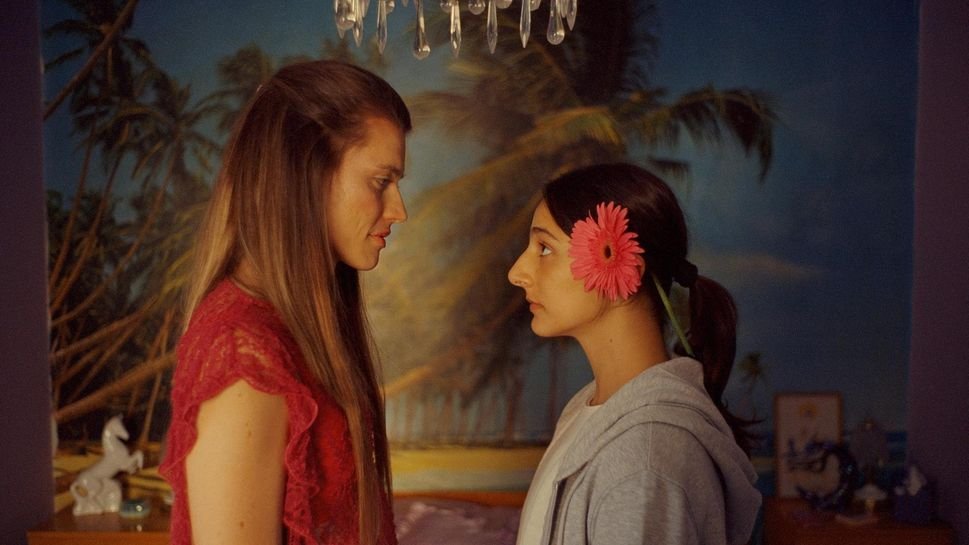
The film has a number of speculative visual aspects, like the floating buildings in a few scenes that evoke a utopic vision while still being grounded in reality.
All of the magical realism elements come as an intrusion into living in a concrete prison. Wherever you look, there’s a fucking wall. It came as some sort of light coming through the cracks. It was such a personal thing to me, too. When I was small, I hated my super boring industrial town. Whenever I looked at the buildings, I just imagined them exploding. I also cannot write in this classical way. Sometimes I’m doing something, and I see something that involves a cascade of images. It comes as some sort of vision, and I have to write it down. I really believe that we are just mediums for ideas and visions and sparks. The images in the film are actually just my memories from childhood or from my environment. In the Balkans, there are just so many guys really lifting weights in front of the blocks of flats. I didn’t make that up.
Ther’s a joy in watching the club scenes in the film, which contribute to the distinct visual style. When you were working with your collaborators on sound and music, what were the specific things you were thinking about?
I started with music videos, so film and music had such an influence on my life. I also wanted to touch the hybrid space between music video and film. I wanted to walk the fine line between fantasy and reality, but it’s also just my natural form of expression—I see using videos all the time in my head when I think about the world. Maybe I was a bit fed up with this social realism style in the Balkans and broader in this space. I really don’t see the world like that. The music is important to me as well because it’s not a passive element that just supports emotions. It sometimes acts as an additional character or disruption. There are some songs that are actually a political or social commentary. My friends and I have been lip-syncing for our entire lives—it’s such a huge part of queer culture that I wanted to express.
The topic of categorising films as queer is a conversation I’ve had with many filmmakers. I ask as I’ve spoken with filmmakers who are much more uncertain about embracing the label of queer for their film, even when it’s given by a warm audience that loves their work—and this is also a very understandable perspective. Do you feel like you have a particular relationship with this label?
Making this film was so difficult, and this is such a low-budget film for this little region. I spent so much time, money, and effort on this that I didn’t really think about the reception. The queer world is my world, so when people say, “Oh, this is a queer film,” I’m like, wait, what does this mean? To me, it’s a normal film. That’s my world. I would love for this film to be played at queer festivals, but I can’t wait for the day that we’re past this. It’s the same as the “female question”. I can’t wait for the day when it doesn’t matter if I made the film or a cis or trans guy or whoever made it. I think it’s important for queer films to be both at queer festivals—that’s where an important audience is—and also at more so-called mainstream festivals like Sarajevo.
This film is for the unheard ones and unseen ones. I don’t have any illusion that this film will be a commercial success in my country. It could be, but I know who I made this film for. However, in Locarno, it was so interesting to me because I expected young people to resonate with the film, but there were ordinary old ladies stopping us on the streets with tears in their eyes. I was thinking, wow, this could actually change something. It was also sometimes mothers of queer kids. Queer people should be present in the mainstream as well. They have to work hand in hand. As much as it is a queer film, Fantasy is a multilayered film about identity and diaspora. I cannot see it solely as a queer film.
At first, I didn’t even realise how rare this film is for the Balkans. When Fantasy speaks about being with a married man—that’s actual reality. That’s also why I wanted that part to be very blunt. There’s so much homophobia and transphobia in the Balkans. Yet, for all of my gay and trans friends, their inboxes are full of romantic messages from those people. It’s so classic and hypocritical. It’s a very traditional, patriarchal environment, but film and pop culture do have an effect on people. I make music videos for very big names in the Balkans, and I’m really aware how I can be subversive and have a message through these videos that are, in essence, commercial projects.
Thank you for answering that question.
It’s a question I really think about a lot of the time. It’s like as you said. I see this often with filmmakers who are labelled as queer: if somebody makes two queer films, they’re suddenly a queer director who only deals with that. It’s as if that’s a niche, but it shouldn’t be. It’s life.
*****
Watch the trailer for Fantasy here:


