

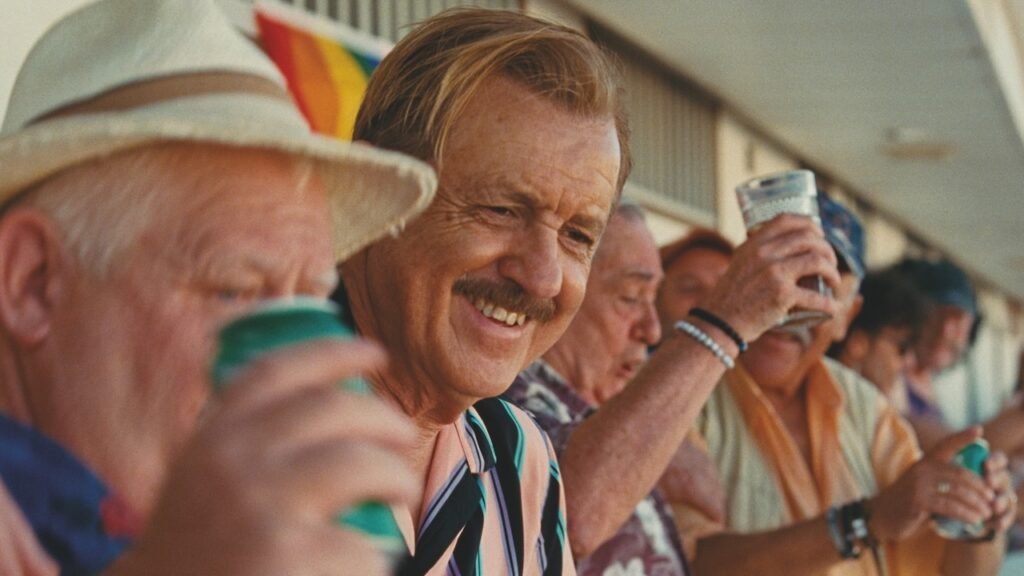
On the outside, Vicente (Silver Shell for Best Actor winner José Ramón Soroiz) looks like he could be your very own grandpa. Pulling back the curtain, he’s partying, having sex, and enjoying the time of his life as an out gay man in the titular sunbathed town on Gran Canaria, in Spain’s Canary Islands—Maspalomas, known for being a top LGBTQIA+ holiday destination. However, everything changes when he has a stroke, thrusting him into an environment that’s the complete antithesis to all he’s sought. He’s stuck in a nursing home.
Basque directors Jose Mari Goenaga and Aitor Arregi, two members of the renowned film production company Moriarti Produkzioak, paint a poignant portrait of elder queer life and sexuality that continuously touches and surprises. In this script by Goenaga, Vicente must also contend with a renewed connection with his estranged daughter, Nerea (Nagore Aranburu), whom he left with his wife decades ago after coming out. Moriarti has 15 Goya Award wins to their name, and the two share a Silver Shell for Best Director prize from San Sebastián with Jon Garaño for their directorial collaboration on The Endless Trench (2019, La trinchera infinita).
Maspalomas world-premiered at San Sebastián International Film Festival last autumn. Now, for BFI Flare, we spoke with the two co-directors to learn more about working with distinctive images, how the film has created an impact on policy itself in the Basque Country, and resonating with Vicente far beyond his sexuality.
*****
Purple Hour: The film’s first images of Vicente cruising in Maspalomas are so memorable. I’m curious if you could begin by exploring how you decided to show who Vicente is through a series of encounters.
Jose Mari Goenaga: I think that image of cruising was in the genesis of the film. The first idea was to do something in Maspalomas. I went there on holiday for the first time in 2016, and I thought it was something worth showing. It’s not so common to see the sexuality of elderly people in movies, but it’s something that you see in Maspalomas. There’s a huge cruising area in Maspalomas, but people are also in bars having fun. Sexuality of older people is something that happens in places we live, but we aren’t aware of it. We don’t include them in parties, in dancing, in sex. When we were making the film, many people came to us to ask if elderly people really have sex. Even the main actor asked us about it while he was preparing for the role—not once, but many times. He asked us if it was real, because for him, it wasn’t the case. It was very important for him and for us. We made a trip to Maspalomas three months before shooting, and José Ramón came with us. It was really important for him because he was reading this script and could imagine some things, but to see what we were talking about was really clarifying for him. He felt a lot more comfortable.
JMG: When we were talking with people who work in nursing homes, they told us it is very common to have a talk about the sexual reality of people there. You have to “solve” these sexual situations. The elderly couple we see in the nursing home in the film who are always touching—this is based on reality. At first, the workers separated them, but finally they realized this is not a problem they have to “solve”, but they have to resolve it in a different way. They spoke to the family, who were really surprised. The solution that the workers gave them that they accepted was to place them in a room and have the social worker in the next room so they could hear if something happened that required their help. This is an example of how diverse sexuality can be in elderly people. Sexuality stays with us even when our mind fades. I think that nowadays, many elderly people don’t feel this sexuality very clearly—maybe for cultural reasons, or maybe because not everybody is that sexual—but it’s something that’s with us until we die.
From my understanding, the film was inspired by stories of queer elderly people who felt they had to hide their sexuality when they began living in a nursing home. Has the film had an impact on the conversation around a generational divide, perhaps, in the perception of queer people?
Aitor Arregi: I would say that we are quite proud to read that two weeks ago in a region called Álava, which is the Basque Country, they started a policy in nursing homes to identify possible elderly gay people and help them have a better life in the nursing home. This is something that happened directly because of the film. I would say that the film has brought a conversation about the problem that, I would say most of the people in society, at least the heterosexual people, don’t know about. Not everybody has seen Maspalomas, of course, but in the Basque Country, a lot of people have seen it. If you haven’t seen it, I think you’ve heard what it’s about. At least the conversation is much more present than it was two years ago.
JMG: In our country, where we have more advanced policies than many other countries, I hope that the presence of homosexual people in nursing homes is going to be more and more normal. Nursing home structures are changing, and policies are going more toward creating apartments where four or five people live with a tutor. We can say to some extent that this is something generational that is going to transform. But the subject of what we’re going to do when we get old is a question that concerns everybody. For gay people especially, it’s a very clear concern. You can talk with friends and ask what you’re going to do, but many gay people don’t have family or children—or they might have a chosen family. This is very present in our conversations, and I think our generation doesn’t want to feel like they are regressing when they enter nursing homes. The script of Maspalomas has been created such that I am projecting myself in the situation of Vicente. I wrote the script thinking, how would I manage this situation? I came out of the closet quite late, in my 30s, so I thought it would be very hard to go back in the closet afterwards.
AA: I believe that in the future, in nursing homes, the steps that have been taken by society will be reflected. Now, the old people in nursing homes are people who haven’t lived in a society that accepts homosexual people and LGBTQ+ people. We are nearly 50 years old, and I would say that in the Basque Country and in Spain, we are one of the first generations that started accepting in general, or accepting homosexuality as “normal”. I hope that in 35 years from now, the old people in nursing homes won’t be the same as they are now.
JMG: Maybe this is true, but I think this change is not guaranteed. We know that one of the principal reasons that a child is bullied in school is because of their orientation. If a child is queer, or if a boy likes to play with dolls, for instance, he is often bullied. We have been talking with the president of an association from Madrid called the December 26th Foundation (Fundación 26 de Diciembre), for elderly gay people in Madrid. He says that for many people going to nursing homes, it’s like facing your bullies from school. This keeps existing in society. It seems like the new generation is not going to have this problem, but I’m not sure about that. I think it’s going to require many more generations to totally normalise homosexuality.
What’s interesting is that Vicente’s story of returning to the closet doesn’t only apply to seniors. It’s felt when people travel to a different country where queerness is illegal or punishable, or when they go back home to conservative family, as two examples. It is also a plight reflected across age groups.
JMG: That’s for sure. Many people have said they relate to Vicente, not because they are gay, but because each person has their own closet, so to speak. That has nothing to do with sexual orientation, but they understand clearly what is happening to Vicente.
The two key relationships that stand out in the film are between Vicente and his estranged daughter, Nerea, and Vicente and his nursing home roommate, Xanti. I want to start with the first relationship, because it comes from a place of hurt, especially for her, but their relationship is forced to evolve because of his condition. What moments were most important for you to show onscreen?
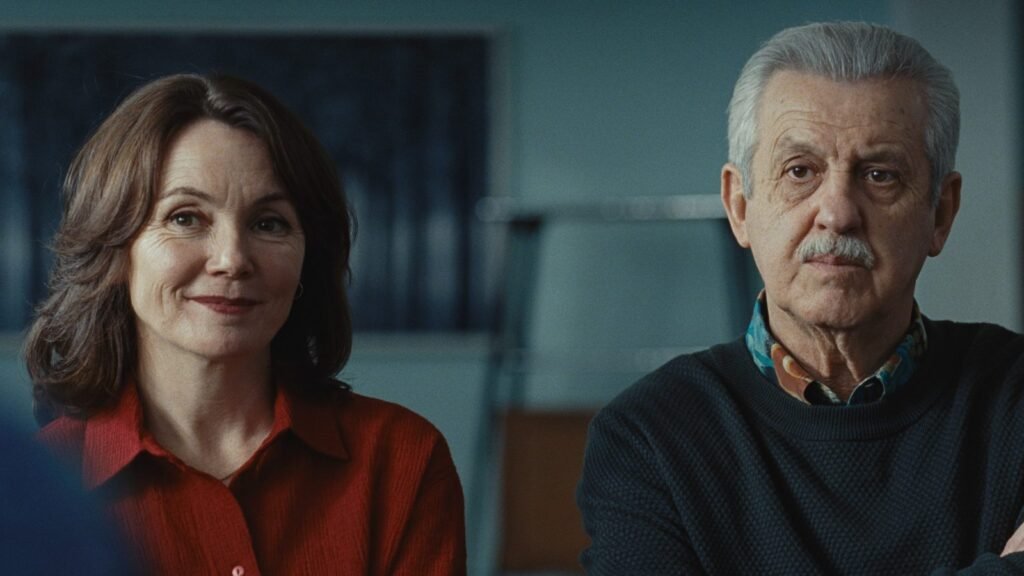
AA: The most important thing in the evolution of their relationship was that it had some sort of emotional knots that must be untied. Both of them are in a closet of some kind: as a gay man who steps back into the closet and Nerea as a woman who hasn’t revealed publicly that her father is gay and hasn’t told her son about him. They are very distant but, at the same time, are in quite a similar situation. At least for me, it was important that they could get closer as the story goes on. I would say half of the story is with her, and the other half is with Xanti.
JMG: The main challenge in showing this relationship was to make the audience feel the weight of the past while telling a story that happens in the present. There are little things about the past, like the scene with the photographs, but making a story that talks about the past all the time is not very cinematic. We had to balance these elements so the audience feels linked to the past but also to the evolution of the relationship in the present. In the beginning, Nerea’s relationship with her father isn’t good, but she’s looking forward. He’s the one who is not ready to face this relationship because he’s frustrated and doesn’t want to accept his situation. Once he does, he’s able to share more with his daughter.
***** Spoilers ahead for Maspalomas *****
Xanti’s character is very interesting because Vicente’s response to him grows more empathetic, despite being two very different people. His death due to COVID and how Vicente reacts reminded me of the loss faced by queer elders during the AIDS crisis.
JMG: For us, Xanti represents masculinity and traditional virility, and we wanted to make Vicente face this in a room. He represents something Vicente both fears and desires. Sometimes when you start relating to different people, it doesn’t matter how far you are from them politically. You find a connection. We haven’t talked too much about this, but you’re right—you can relate the COVID situation in the film to the AIDS crisis. COVID was a way for us to establish a kind of clock that is telling you things are going to change. This is going to end.
Finally, how did you work together as co-directors on this film? I understand that you work with different members of Moriarti, your production company, in various configurations on different projects.
AA: We have been working like this for 25 years. I don’t know if it comes from the cultural working style in the Basque Country, like the cooperatives, but a lot of people collaborate with each other. We knew each other from a small film school called [Centro de Artes Escénicas] SAROBE. We started working on short films and made a production company with five members. We are three directors and a producer, and the last one is, as we say, a “capitalist member”, and we have been working like this since the beginning. One person brings a story and leads, at least at the beginning, and another joins afterward and co-directs. For Maspalomas, Jose Mari wrote it. Other times, we have been co-directing, co-writing, co-editing, co-everything.
JMG: However, we split the job of directing on set because you can’t start sharing this while shooting. But in production and post-production, we are always together, and we decide everything together. That is one of the most difficult parts to manage.
AA: At the beginning, we quarreled a lot during filming. We decided that wasn’t possible because you lose a lot of time, and time is money while shooting. We have also been adapting to our strong points. For instance, one person might not be the best in the technical parts, so maybe I prefer to stay with the actors. At the same time, with every project, you learn. Maybe you are not the same 10 years ago as you are now. At the end of the day, you are one of the directors, and you try to give your voice in every aspect.
*****
Watch the trailer for the film here:


