

Trans Memoria, which screened in Tromsø International Film Festival’s Horizons sidebar, is Swedish filmmaker and artist Victoria Verseau’s highly personal debut feature—a creative documentary effort that looks forwards and backwards in time. Memory, archive, and change swirl around this oneiric snapshot of three trans women, one of them the filmmaker herself, contemplating the dream of gender-affirming surgery and remembrance of Verseau’s late friend, Meril, among other topics. You can read Purple Hour’s review of Trans Memoria here.
At the festival, we sat down with the writer-director to take a deep dive into the film: its many transformations and transitions, Verseau’s ambivalence toward her own vulnerable archival footage, rendering the invisible visible onscreen—and how Trans Memoria has also made room for new projects. Audiences will be able to catch the film next as part of the Global strand of South by Southwest (SXSW), where it makes its US premiere.
*****
Purple Hour: The element that stood out to me most was this element of kinship and sisterhood between yourself and the other two women, Athena and Aamina. How did the idea of this onscreen, and presumably also offscreen, relationship come about?
Victoria Verseau: From the start, it was to be a fiction film. I [originally] cast Athena and Aamina to play me and Meril, and we did a lot of rehearsals before to prepare them for what was coming. Then when we got there, it was all lost—those two years of preparation. The dynamics between us three were also interesting, because they were in the beginning of their transition, and I had gone through it—if you ever get through it. It’s ongoing. But I did the operation many years ago, and they were about to do it, so I think they wondered a lot about a possible future, and they sort of could see it through the film. Another story was about us three and our sisterhood. It’s interesting because it was never easy. We argued a lot, and we have three very different perspectives. There are as many trans stories as there are trans women.
The onscreen disagreements are, to me, what make the film feel so in the moment. There’s no single didactic moment presented cleanly for the viewer.
It’s interesting to see trans women not always agreeing but instead discussing different points of view. It’s been both. We’ve been supportive of each other, but it’s also been challenging. That shaped the story as well because you see Aamina drift away a little bit. That’s something you can see in transition—it’s a transition in the film itself. In the beginning, she was more sure of it, and then as she transitioned, she wanted distance from the film. We had to take away so much material and respect her wishes as well. Athena is very much a part of the film, but she has a very different point of view from me. I think I became a little bit like their mother. I was very worried for both of them. All three of us were not in a good place when we made the film. Athena even expressed that if she didn’t have this project, may be she wouldn’t have been here today. That was heavy. That was a big responsibility at the same time.
At one point, you butt heads with Aamina, and she questions you about putting words into her mouth.
She questioned the approach, like documentary or not.
Yes. I was kind of curious as to how you conceive of the film now. What’s your relationship to fiction and documentary?
That was actually the first thing we filmed when we got to Thailand. I prepared them for two years, but then, when you’re on a set, it’s so stressful. She was asking me about this documentary–fiction thing. I was a bit annoyed. But then it was so good that she asked me, because I think in documentary, there is inherently an element of exploitation. Someone has to be willing to share their story in front of the camera. The camera is a weapon, in a way. There’s a power position in having the camera or being behind the camera. Now, I’m also in front, but she didn’t want anyone to adjust the story—there are so many cases of trans women in films that have been told about us by cis people, mostly men. It feels like there is already this “idea” of a trans woman. She didn’t want a sensational portrait, so that also shaped the story. But it was difficult to hear, and I had to rethink a lot of things also about being a director.
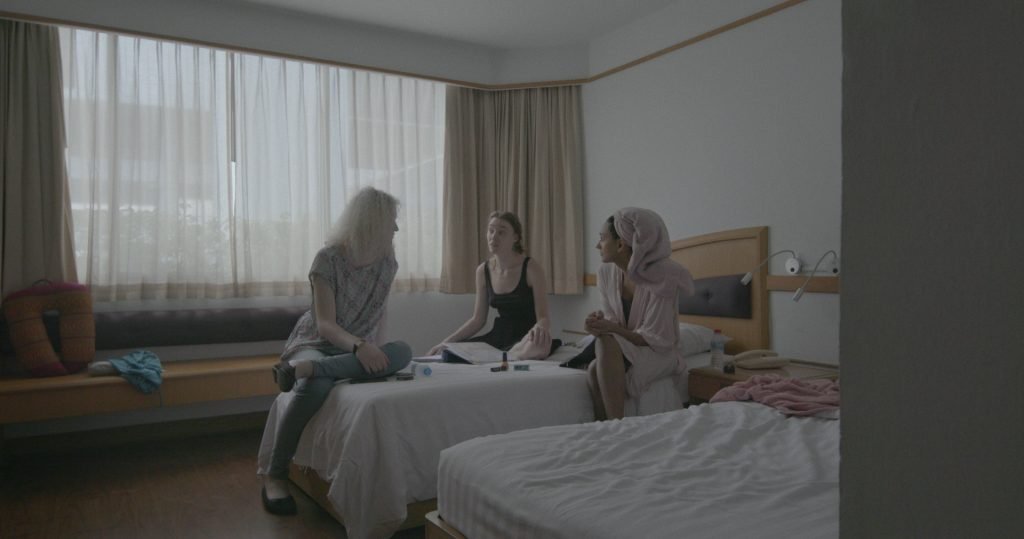
What was going through your mind when this moment occurred?
I was just very stressed because we were going to film so much, and we were on such a tight schedule. We had that climate of being very honest with each other, which was challenging but also very good. I don’t want anyone to get out of a project and feel like they have been used or anything. In a way, I think I’m using myself. It shifts from day to day whether I’m good with this personal, very revealing material. Getting back to your question, I was frustrated because I had an idea of what I wanted this film to be. But I noticed that the fiction film—I couldn’t do it. I had a dream, but that dream was also a little bit crushed. Then we decided to film both documentary and fiction, which I realise is very confusing to people in the project. I was a bit devastated by the fiction film not happening, and then I didn’t know whether it was going to be a documentary. I was aiming for CPH:DOX or Visions du Réel [which are both festivals for documentary film], and I was so sad when it wasn’t what it was going to be. But then the film had its world premiere at Karlovy Vary in the Proxima competition, which doesn’t have as many documentaries. It’s more fiction-focused. The feeling I had was like, oh, that’s even better, because there are maybe some ingredients of fiction there, even though the whole thing feels like a documentary to me, even though there are scenes that are scripted.
You play with all these different styles—the self-archival footage in particular is so intense, especially the makeshift selfie footage with the digital camera after your operation. At what point did that come into the project?
I didn’t even remember I had recorded that. When I was working with the film, I found that material. Editing was so painful. It was so difficult to get this together because there were so many angles and different styles. I wanted to still have this cinematic language, but would that work with the more documentary parts? How would all this work together? I was doubting that for a long time. In the middle of the process, I remember it was winter in Sweden, I was super depressed and just found this material—like God, I had actually filmed when I was there but I didn’t remember. That video diary was only meant for myself. I didn’t post it anywhere. It was like, instead of writing, understanding what I went through and understanding who I was, who I became, who I am in a way. It’s material from right when I woke up from the operation, and I have no idea what I feel, and I’m drugged. It’s so weird to see it, but it’s so important. It’s not obvious for me to be so revealing and personal. I’m very ambivalent about this. Sometimes it feels like, why should I hide this? Everyone cries at some point and says to themselves, I want someone to love me. It’s very human. A lot of people lose their track in life. It’s a film about finding meaning, existential questions of, “Who am I?” It’s not only a trans story.
This touches on one of the film’s throughlines that you explicitly say in the film: the idea of getting what you want or need and the achievement still not creating the sort of eternal happiness your brain erroneously expects.
I’m also an artist and make installations and sculptures and exhibitions, and that’s something that’s always in there. When you go through a transition, you strive so hard for this dream. That struggle becomes part of your identity—it became part of my identity to struggle and fight. There’s a lot of energy in that, even though it almost killed me. I would have died, as I say in the film, if I didn’t achieve this. At the same time, when I got to that dream fulfilled, it sort of dissolved like an illusion. What’s behind that illusion is really difficult to handle. I think many people can relate to this, like Athena saying, “You have to find a new role.” That’s something I’m trying to investigate—crushed dreams. Like Meril never found the love she so much needed, and she gave it up. Her dream coming true and my dream coming true, but then it’s not what you think, and life goes on. You have to be able to handle the normality that comes after a dream.
That’s a universal lesson everyone repeatedly must learn.
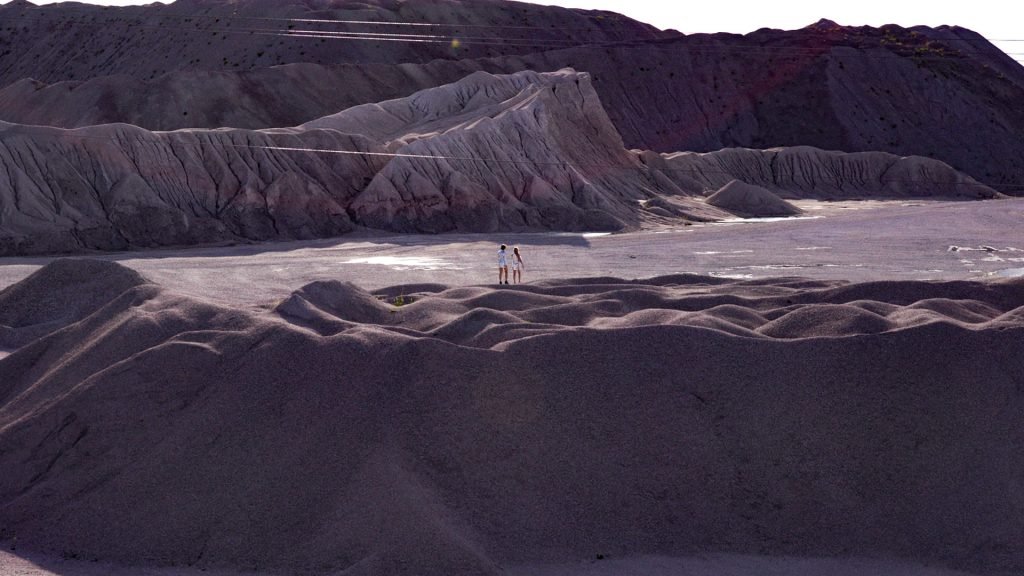
There’s also a spiritual aspect too. It’s also a story about how you relate to the time after someone stops existing and trying to find meaning. I wasn’t ever religious in that sense, but I realised that through art, I think you can approach another dimension in the poetic way. What is so interesting that also connects to being private and personal is that I hope, when someone dies, that there is something. That’s what I’m trying to film—to render the invisible visible, revisiting the hotel and hospital and almost entering a dream. There’s no people. It’s just a memory. It’s some kind of in-between place between memory and dream and reality. The hotel has aged. It’s almost like it has a personality and character. I can feel some kind of presence, but I know nothing ever manifests itself. It’s something invisible, vibrating, but it’s almost not in our dimension of reality.
You feel something, so it does exist. The empiricists would end me right now.
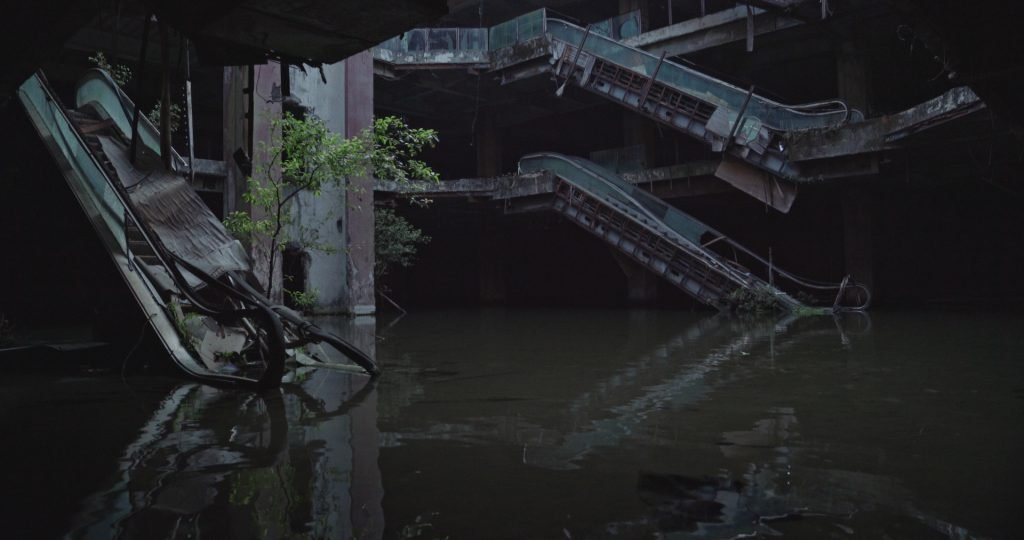
I have this judgmental voice from the ‘80s there, and it’s a very demystified society we live in. There’s a lot of looking down upon that spiritual element, or it becomes too aesthetic. New Age spirituality isn’t appealing to me, but maybe it’s also important to not know. Mysteries are important from meaning, because there’s a depression in that now satellites have photographed everything, for instance. Maybe the oceans are still mysteries, but that’s what I’m trying to approach a little bit: the impossibility of crossing that threshold between life and death. When someone is gone, there’s only the memories. The film is much about trying to film a ghost, but you never see the ghost. I can’t pretend there is one, either. But still, there is something—like this shopping mall we went to. It’s totally decaying and filled with water. That’s almost like looking at a body that’s been decaying and aging. It was like standing on the edge looking down onto the past.
Your relationship to the past and memory-building is also a vital aspect of the film.
Maybe this is a charged topic, but I started writing this when I learned that Meril had ended her life. I was so shocked, because we were so similar, and I sort of mirrored myself in her. We went through this at the same time, and she was my only other trans friend. The starting point of the film was her disappearing and trying to commemorate her, because her family wanted to erase her—we never found a grave or anything. Her Facebook page is gone. But it’s like saying she existed, because, in reality, this film is there. Yet, I never show her face because I could never ask her. In the beginning, I was a bit shocked at receiving a lot of criticism from the community, which was like, “You should make a more positive narrative, because there’s been so many tragedy-driven narratives about trans women.” I completely understand, but those films were not made by trans women—mostly cis men, hetero maybe.
Maybe it’s almost a bit of a shock to viewers, too, who are expecting a sort of happy, unilaterally supportive trio in the film. You very confidently and boldly break that façade, which feels very important to do.
This is me telling my own story and the story of Meril. This is where we are now in the community. We need to discuss this. Should you dictate what kind of stories should be told and what becomes of art? I also, of course, listen to the criticism, and there is a lot of humour in the film as well. I think there are some happy moments in the sisterhood and us supporting each other. The last scene I edited in almost like another layer of time. It was filmed in 2023 just to show that we are still here. We didn’t disappear. Me and Athena are much better in our mental health now, and we wanted to celebrate it. Maybe I shouldn’t go pitch dark, but I find it a bit problematic to get such resistance and so much criticism while making this kind of sensitive film that’s been with me a lot. I felt I had to be totally honest and authentic and not censor myself.
Would you want to come back to the fiction part of this story in some form in the future? Maybe that’s a loaded question.
I think I have to leave this now to be able to go on in life. I realised yesterday that I started writing this in 2015 and it premiered in 2024. It’s been nine years. I haven’t just been working on it—I’ve also worked with exhibitions and all that, but it’s always been there in the back of my mind, and I needed to give birth to this. I do not have any children as a trans woman, but this is my little child now. It’s a teenager running around Europe. I think I have to let go of that to be able to move on. But I have material. We went to Thailand in 2023 because we got the money and we were like, we have to do something. Then we ended up not using any of that material because that was another film. But I realised that could be a very interesting film.
In that case, what are you focused on right now or looking forward to in the future?
I’m working on another project that’s set in the US, and that’s where I have my focus now. I’m planning on making a trilogy based on the trans experience. This was very focused on the operation, the moment before and after, and relating to that dream. But this other one is an earlier period when I was just starting on hormones, and I was very brave and a little bit stupid. I wanted to hitchhike the US by myself, so I went hitchhiking as a trans person. I didn’t know how I was perceived by people, but then I realised people saw me as a biological woman. I think people didn’t really know so much about trans women then, and I was hitchhiking through the south and meeting all these right-wing radical Christians. It was like sexual liberation, because I had never had that love and confirmation. I just met a lot of men, and that was an interesting sort of contrast. Nothing went terribly, but it could have. I was on the edge—it could have been catastrophe, but then it was the best trip I’ve ever known. I want to highlight the euphoria and liberation of a young trans woman just being free, getting out of her small town.


