

Note: This commentary contains spoilers for Trial of Hein.
*****
Hein was always good at lying. For this young queer boy in an island village of not more than 30 strong, it became a tool of endurance despite hardship. Hein (Paul Boche) and his friend Friedemann (Philip Froissant), at a young age, fantasise together a house in the mountains. While Hein wishes to leave for a life they could live together, Friedemann prefers to preserve the past as it stands still, frozen in time. And so, the former leaves, returning now 14 years later to come back for that long-lost dream. His very aptitude for deception is now what troubles the community, which does not recognise him and wishes to test whether he is really who he says he is. However, this goes both ways: Hein himself does not recognise the place where he grew up.
Deceit, survival, and home create a rich triadic backing to Kai Stänicke’s feature debut Trial of Hein (2026, Der Heimatlose), which made its world premiere in the Berlinale Perspectives competition. The village retains an immense skepticism of the returnee, initially making him out to be an outsider looking to deceive his way into the community. Yet, what the ydon’t understand is that hiding himself and his love for Friedemann from his community was what led him to leave. Meanwhile, Friedemann has relied on compartmentalising his emotions and deceiving himself, rather than the community around him, in order to survive in the village. After Hein returns, Friedemann asks him to split into two parts of himself, one face for the community and his true self for Friedemann. But Hein cannot accept the self-deception any longer: “If you cannot be who you are, you must leave,” reads a note he has written.
Instead of holding himself to his memories, which we soon discover are ultimately fallible and shaped heavily by emotions, he grounds himself to his dreams of being with Friedemann. These Hein keeps in a locket, which, in turn, holds a fantasy from their past selves: a home “as far from the sea as possible”. Stänicke’s protagonist thus divorces himself from a conventional idea of home, instead relying on home as the emotions rooted in a person and feeling. The filmmaker further plays with time by making their past ideal of a home in the mountains as a future dream that Hein holds with him in the present. He glides through time onscreen by superimposing flashbacks from the past into the present, as if Hein is witnessing his childhood self right before his eyes. In doing so, we see how the young man is reinventing the past that he wishes to remember.
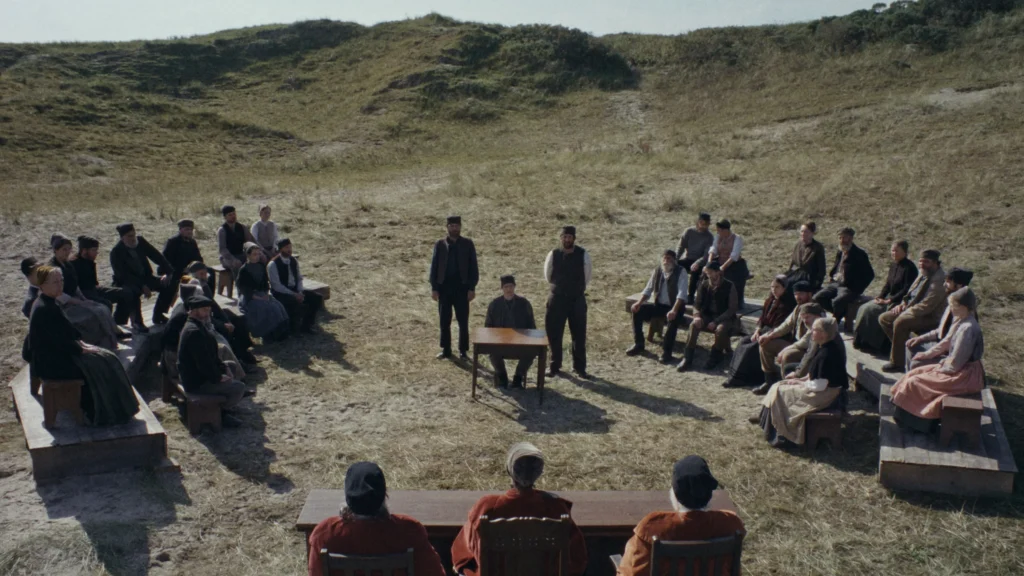
Intentionally unfolding in the most bare-bones of contexts—a closed community, whose houses are built only from the wooden skeletons of a theatrical set or soundstage—Hein’s return becomes less about what he finds and more about the discrepancy in memory that occurs when one’s worldview is changed. In that way, his view of his surroundings and his recollection are shifted away from that of the community’s, in effect altering reality itself. Stänicke turns Trial of Hein into a study of belonging, where Hein no longer feels a connection to the place itself, whereas the community, too, rejects his attempts to belong. The director begins to explore the question of how queer people make something of home upon return, especially as it often becomes something very different than one remembers. What was looked upon fondly may no longer resonate, or a precious item becomes cold and unforgiving with distance.
Trial of Hein stirs up these concepts into a thought-provoking stew, with one’s choices to leave, in Hein’s case, or stay, in Friedemann’s case, never critiqued through a normative gaze. Although Friedemann’s decision to live out his life in the community rather than his truth with Hein, the latter accepts it, in the end. A parallel could be made to the character choices in Portrait of a Lady on Fire, in which Marianne (Noémie Merlant) questions Héloïse’s (Adèle Haenel) desire to simply remember their relationship and move on, as they would have to hide in secrecy forever. Like Hein, Marianne would rather leave in search of something that would allow them to live out their lives as they wish, even if it would be difficult. But Héloïse, like Friedemann, sees this as the highest form of respecting what they have, instead of trying to masquerade through potentially years of a reductive life in the context of their social environment. Neither is necessarily right or wrong, yet both choices are incompatible with the other. Hein thus must move on, back to his new home, in search of something that is more than deceit as a form of survival.
*****
Watch the trailer for the film here:


