

Somewhere along the border between Nepal and India, on the outskirts of a small village called Thori, there is a forest where wild elephants hide in the fog. The village itself is inhabited by locals and members of the Kinnar community who, much like those elephants, arrived there in search of a safe haven. Abinash Bikram Shah’s feature debut Elephants in the Fog, which premiered in the Un Certain Regard section at Cannes 2026 (and just picked up a Special Jury Prize), immerses the viewers directly in that world, where the titular low-hanging clouds limit one’s sight and isolation creates a false sense of security.
Pirati (Puspa Thing Lama) lives in a large house with her three “adopted” daughters. As a respected member of the community that gives her a sense of belonging, she is seen as a worthy successor to their Kinnar leader and well-liked among the villagers. At the same time, she is involved in a secret relationship with a Drum Master (Aashant Sharma) from the big city. This romance goes against the celibacy she once agreed to, making her dream of leaving everything behind and starting anew elsewhere. Yet, when one of her daughters, Apsara (Aliz Ghimire), suddenly disappears during the nightly patrol, Pirati is forced to confront what matters most to her: family, community, or her own freedom.
While Apsara’s disappearance serves as a narrative catalyst, Bikram Shah is far less interested in solving a mystery than in observing the fractures it exposes. As the investigation slowly unfolds, tension circulates between neighbours. Rather than building suspense through conventional thriller mechanics, Elephants in the Fog uses uncertainty itself as its primary dramatic tool, allowing grief, fear, and resentment to gradually reshape the relationship between its characters.
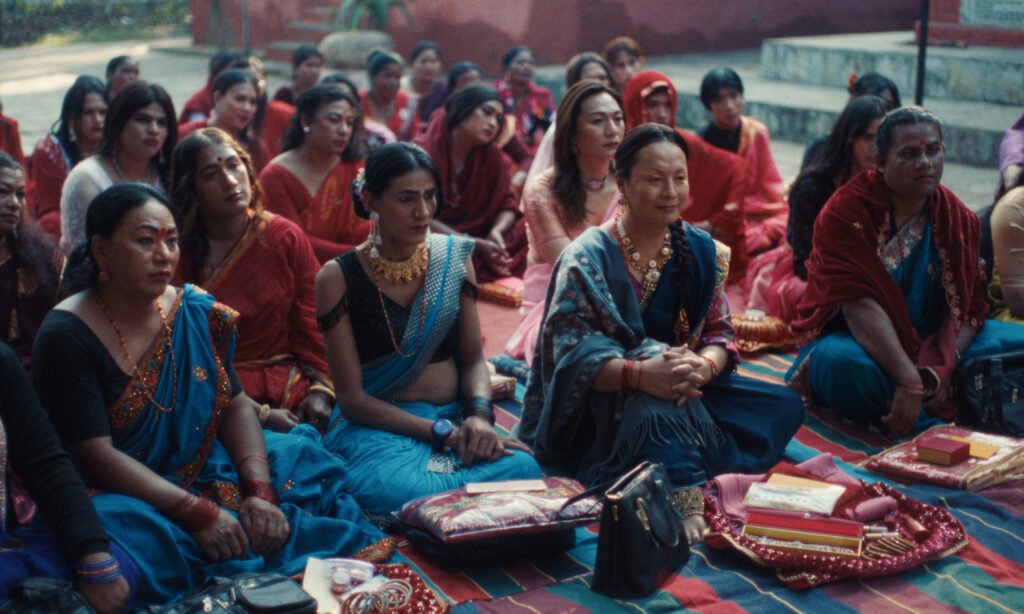
This is where the film’s greatest strength lies: in the depiction of those relations, especially among the Kinnar members. Their community doesn’t stand as a utopia or a site of inevitable suffering but as a complex social structure inhabited by transgender and intersex individuals who found refuge there after being rejected elsewhere. Built around the idea of a chosen family, it offers its members protection, belonging, and the possibility of rebuilding their lives on their own terms.
However, Elephants in the Fog never romanticises this arrangement. The same space that shelters its residents imposes its own expectations, responsibilities, and hierarchies, revealing that even a sanctuary can become constraining. What emerges is a nuanced portrait of a community held together not by idealised harmony, but rather, by a fragile balance between care, obligation, and the universal desire to belong somewhere. In doing so, Bikram Shah frames queerness not as some issue to be explained, but as an inseparable part of everyday life. It informs the characters’ relationships, ambitions, and vulnerabilities without ever reducing them to their identities alone.
The film sheds equal light on the precarious position this community occupies within the wider social fabric of the village. As the havoc of Apsara’s disappearance spreads, previously invisible divisions become impossible to ignore, revealing the fragile foundations upon which this coexistence has been built. Acceptance appears conditional, sustained only as long as everyday life remains undisturbed. When the women from the Kinnar community sing at weddings and perform their rituals, everything is fine. Once they threaten that equilibrium, long-buried prejudices begin to surface, and previous tolerance quickly gives way to suspicion and re-exclusion.

The film’s visual language mirrors this uncertainty. Shot by Noé Bach amidst the Nepal–India borderlands, Elephants in the Fog constantly obscures the line between safety and danger, intimacy and isolation. The fog-covered forest becomes more than a recurring image, functioning rather as a state in which certainty remains perpetually out of reach. The muted, moisture-soaked palette further reinforces this ambiguity. Despite its darkness, the film rarely feels hostile. Instead, its earthy tones and soft lighting create a surprising sense of warmth, transforming the landscape into something similar to the Kinnar community itself: simultaneously comforting and restrictive—but also, inviting and opaque.
Much of the film’s emotional weight rests on Thing Lama, who portrays Pirati. A trans woman herself, she has worked for decades as a key community leader, spreading awareness and supporting those pushed to the margins. In a performance that feels deeply personal, she carefully balances both that commanding authority and hidden vulnerability. She could have easily become a symbolic figure torn between duty and personal desire; instead, she remains profoundly human—full of contradictions, unspoken emotions, and a quiet strength to push forward.
By blending elements of community portrait, quiet thriller, and deeply human character study, Elephants in the Fog emerges as a remarkably assured debut. Bikram Shah may occasionally favour atmosphere over momentum, yet his ability to navigate questions of belonging, freedom, and exclusion with such empathy and complexity marks him as a filmmaker worth following. What there is to hide from and what there is to escape from remain the real questions. The answers, just like everything else, remain beautifully ambiguous.


