

We realised that at various points in the 20th century, people have gone back to Rimbaud and his radical, decadent spirit. David Wojnarowicz staged the whole Rimbaud in New York thing where he wore the [Rimbaud] mask and went around the city in areas that were, at the time, very underground, while now they are super gentrified. That’s when we came across this concept of uchronia, which is a neologism that takes the word utopia, throws it into a nonlinear sense, and spreads it through history. It’s not about thinking of utopia as this place that happens in the future, but as a place that happens through the solidarity of history. It’s a philosophical concept, so you can read it in many ways, but somehow we felt that maybe the way to think about the future is through an imagined solidarity of the past.
That’s when we started thinking, maybe it should be a speculative drama scenario where we’re imagining historical links that didn’t necessarily exist. Occasionally, we ended up finding links that we didn’t know existed. So occasionally, it felt a bit like it wasn’t really that far from reality. Ultimately, we have a real problem of history repeating itself in potentially very dangerous ways. In order for these things not to go further out of control, we thought, let’s look into history, let’s look into the queer subject, as an outsider, as a radical, as a revolutionary. Let’s reimagine the importance of this position, because we have seen that the concept of assimilation has no end. It can really go all the way to assimilating with the people that would normally exterminate queer populations.
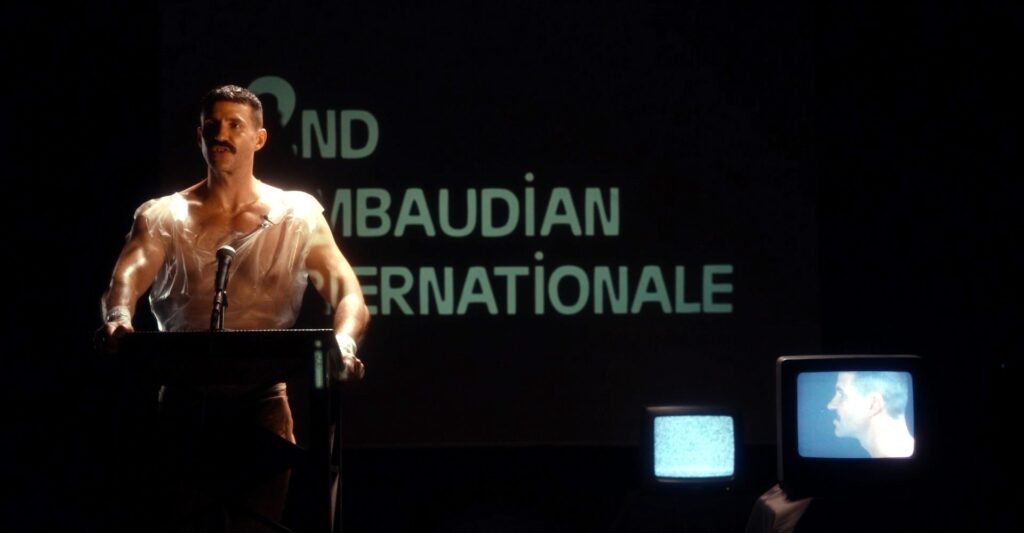
I’d like to dig into this idea of assimilation. When audiences that are very used to a more passive style of queer media see a film like yours, what do you hope this encounter brings?
First of all, I throw together so many stimuli and so much analysis and so many different aesthetics. I think that film festival goers are a little bit shocked at the beginning. However, I think that because the film, in a meta way, claim a language that has already been theoretically won over by the history of experimental queer cinema. We’re not reinventing the wheel here. We have queer cinema that was like that, and we have forgotten about it. I believe that a lot of the things that might seem difficult today were tried by people over 50 years ago. I can imagine that some people might find it impenetrable or too polemical, aggressive in its avant-gardeness. It doesn’t take the audience by the hand and lead them to a specific place, whether that is called a story or a moral. I’ve seen that in some people, some kind of guilt emerges throughout the film when they’re thinking, “I’m kind of switching off, but maybe I shouldn’t be switching off, because there’s something serious that is going on here.” There are some interesting things happening in the mind of the viewer.
The second thing that I wanted to say is that I think there is a slight disparity between film festival audiences and contemporary visual cultures. Contemporary visual cultures are bombarded by something like the aesthetic experience of TikTok, where fragmentation reigns. Theoretically, people today are more ready than ever to see this kind of super fragmented anthology films, that have not 10 parts, but 50 parts. If anything, the straightforward, linear narrative films are a little bit behind contemporary visual cultures. My favourite cinema comes from Iran, and I am a Béla Tarr fan—you wouldn’t necessarily see those things here, and I do not suggest that all films should be like that. But if we’re looking at contemporary visual cultures, something like Uchronia shouldn’t necessarily be considered that difficult of an experience. It’s just that the expectation of a 90-minute film experience is one that has to be a much simpler experience than 90 minutes of being online. And I think that’s a little bit unfair. I think the audiences are actually ready for an experience like this.
Film festivals, in my opinion, are a little bit risk-averse. Even to go a little bit into a very mainstream space: if you look at a film Everything Everywhere All at Once, that was like Uchronia in that it just went all over the place, multiple parts and so on. It’s probably going to be considered a glitch in the history of the Academy. The point is that I think audiences have the visual literacy to work with a film like this. The idea that a film should be a challenging experience—I think we need to bring some of that back. I think that in queer cinema, we’ve had far too many comfortable experiences. I understand if someone was making a film like that in the ‘90s, but today, where so many places have gone totalitarian, and what is happening with our with our history, with exclusion of the trans communities—we can’t really afford to just make these comfortable coming-of-age stories. We have to go back to making films that awaken the audience and even challenge or upset the audience.
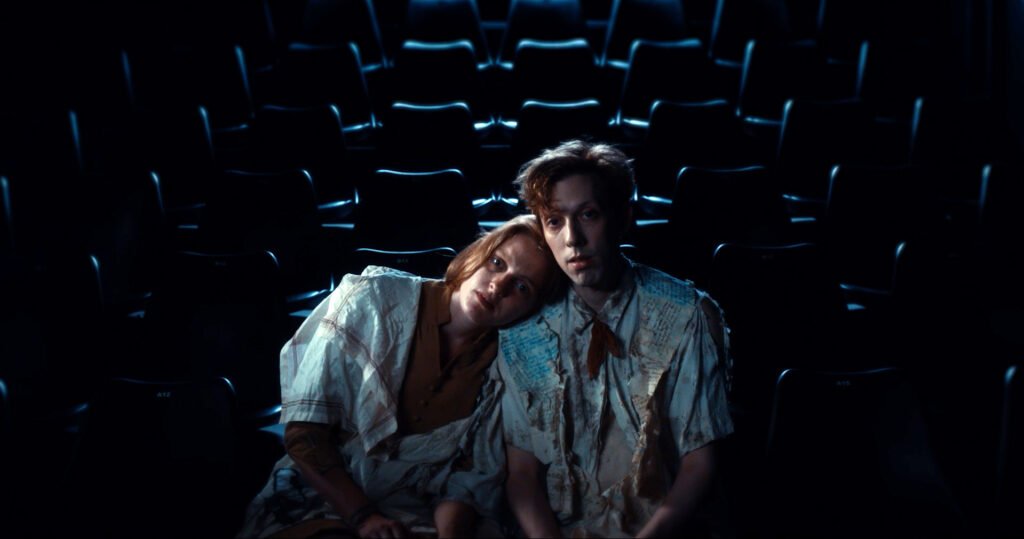
My Purple Hour colleague Federica has called what you’re describing as the queer community spoon-feeding itself representation. In my opinion, it can feel apt in some contexts, even at the expense of feeling harsh. At a lot of queer film festivals, the emphasis is, in many cases, creating this sheltered, comfortable space. With Uchronia at a festival like Flare, how do you see this juxtaposition?
This idea that there needs to be a separation—now you go to this film to feel good, and you go to this film to think—I’m not sure what to make of something like this. I think all films should do all of those things. I think it was a bit surprising for us that Flare selected Uchronia. Among the film festivals, it is one of the ones that generally has pioneered the “nicey-nice” films. The idea is that we’ve suffered for too long, and now we want to imagine two teenage boys running around in the fields and finding love. It was never my experience anyway, because I come from a homophobic country. For this kind of film, sometimes I watch them, and I’m like, do they really reflect anybody’s history?
At the same time, I understand that we’ve also had these doom-queer stories for far too long where everybody had to die at the end. I understand why some of this cinema is a response to that. But also, I think this spoon-feeding that you describe has gone on too long. I like this concept of spoon-feeding because it means that the person cannot feed themselves. It’s fantastic. It means that curators concede that their audiences require spoon-feeding—that they are children who cannot decide [what to consume]. I think it’s better to treat your audience as adults by presenting them with a difficult problem and letting them make up their mind.
For me, the idea of making challenging films comes from my deep belief in democracy and respecting the audience, instead of spoon-feeding them so they tell their friends, and then you sell more tickets as the film travels. I don’t think queer cinema should be like that. My prediction is that queer cinema of this kind of comfortable style will be created by all-straight crews in about 10 years maximum, alongside AI. This will be the nicey-nice stuff that completely leaves the queer communities. Nobody will relate to them any longer. Then the question remains, will we continue to curate them and consume them? I’m hoping that queer film festivals wake up a little bit and see that this kind of thing is just part of a trendy spectacle. It doesn’t have a reason to exist as a cultural artifact. It’s just a machine producing sentimental stories for people whose kids are gay, and they watch this queer movie to wrap their head around it and accept their child.
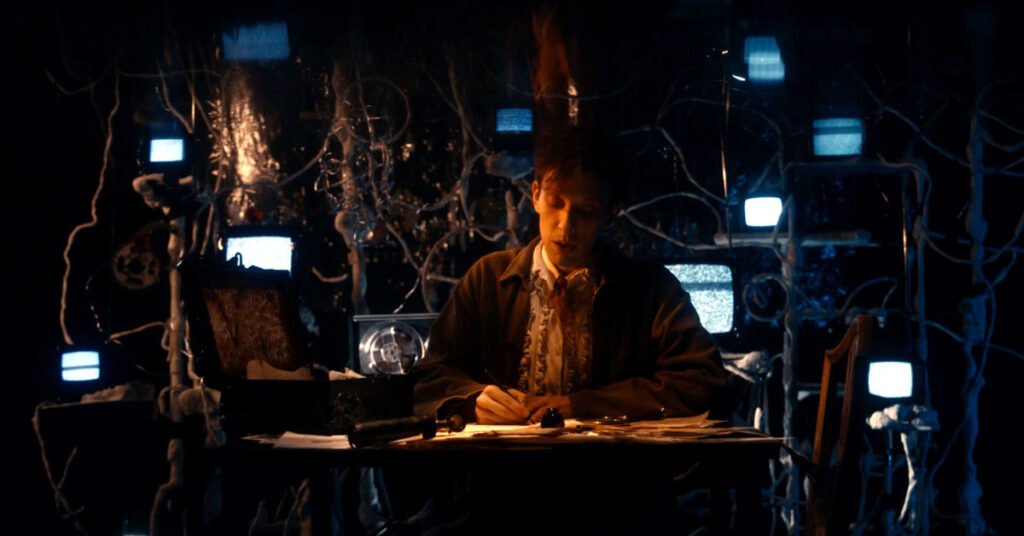
I had a family member who saw a speech by [openly gay US politician] Pete Buttigieg, and to my shock, that was the first piece of media that really moved them to tears for queer rights and trans lives. This was their point of entry. How do you contend with the fact that for some, these stories feel like something accessible and ceiling-shattering, in certain cases?
25 years ago or something, my mom saw All About My Mother. Obviously Pedro Almodóvar is not experimental queer cinema, but I understand that for her, it was a really eye-opening experience. It’s all within context—in the same way that RuPaul’s Drag Race is not for me and not for my community. But there are a lot of people who say, “from my small town, that was the first time that I saw this”. I understand that the pop mainstream has a relevance for contexts. I don’t think we should reject all kinds of mainstream visibility. However, because the whole of queer discourse has been pushed to the right, my job is not to deal with making the mainstream a little bit better. My job is to pull the avant-garde back to the left where it once belonged, pull queer radicalism back to where it once belonged. By doing that, I’m hoping that I’m helping the whole of the discourse to move further to the left. [Someone at a Q&A in Berlin asked], why don’t you do more mainstream things? Don’t you think that you would help society better if you work in a more mainstream context? I would say no, actually. I would say that queer cinema needs its edges resharpened.
In Uchronia, You have multiple iterations of different figures, play across language and film format, and a lot of interesting structural concepts. At one point did you decide the film was “Rimbaud” enough, so to speak? What was this process of translating A Season in Hell from book to screen?
A Season in Hell is a book that many people know of but don’t remember what it’s like. When you look at the book, it starts with a poetic introduction, and then he has a second chapter, which is like 40 pages of a sort of psychedelic essay. The whole book doesn’t rhyme up until three chapters before the end. Then he starts saying things like, “I became an opera” and doing meta things. The book is a real modernist gem in terms of its understanding of itself. It’s playful and gives the middle finger to any notion of straightforward continuities or the style of what should be contemporary poetry for his time. It went without saying that it had to be somewhat translated into audiovisual languages in an equally brave way. In my opinion, this is the reason why the French haven’t touched this book to turn it into a film. We’re talking about one of the most important books in the 19th century for French literature. Anybody who wanted to do justice to this book knew that they would have to make an extremely strange film that just keeps changing styles and material and so on.
The multiple language thing happened because we felt that in the original work there is a sense of an internationalist manifesto, to an extent. We took the book and analysed it a lot for an expansion of poetry into audiovisual mediums. Translation is not a scientific process: it’s a creative process. We had so many graphs of intensity, meta, emotional response, intellectual complexity. We started thinking of the different methodological tools that we like to use. In sound, we were thinking, we need a number of things that have a sense of technological debris, like using material that would normally be discarded or trimmed for the film to be “full quality”. A lot of that stuff was used in both the sound and the image and how they came together to tell a story of these ghosts who are from different eras.


