

Envy is fascinating, beautiful, and frightening—and New York City-based writer-director Jamie Kiernan O’Brien explores it all in her newest short film, Gender Studies, which just made its world premiere at the 2026 Sundance Film Festival. Illuminated by a vivid score by Makenna Lyric, the film follows a trans woman (Jake Junkins) in the eponymous university class who notices a glamorous fellow student (Fannie Massarsky) hooking up with the teaching assistant (Austin Cassel)—and goes out of her way to be just like her.
Gender Studies is the filmmaker’s third short and her first at Sundance, playing as one of the 54 works within the festival’s short film programme. On the occasion of her newest short film’s world premiere at 2026 Sundance, Purple Hour spoke with O’Brien—who also edited the 11-minute film—about Gender Studies. Additionally, we discuss her search for tone as a filmmaker and her love for cinema that is not explicitly queer but instead stylistically in a canon beloved by the community more broadly.
*****
I’d love if you could start by talking a bit about the background to your newest short, Gender Studies, including the inception to it and how you think about it from a thematic perspective.
I’m in grad school, and I had to make a ten-minute film in the programme. In summer of 2024, I was trying to put together what this project was going to be. I was nervous about what people expected of me. I grew up a trans kid, and so I felt like maybe I had to make a film about that. Also, the previous short I did was a comedy, and I felt like maybe I was supposed to do that again, like a big, broad, silly comedy. I just had this idea of a love triangle—a trans love triangle, period.
Originally, it was a very different short, because there was a trans girl in the middle and then two guys. Once I introduced the character of Rachel, which was a note that my producer, Kirsten [Pasewaldt], gave me, it completely morphed into something about envy and feeling on the outskirts of femininity and wanting to join this club of girls, and wanting to experience all of it, even the horrible parts of girlhood. It was funny, because at the same time, despite the fact that I’m older than the character, I felt like I sort of was coming back to that feeling: watching my friends deal with situationships and random hookups but feeling on the outskirts of all of that and like I’m not alive fully as a woman, in a way. I was interested in exploring that feeling of wanting to jump into something that you know is not that good for you, and also wanting to explore sex, not through actual desire but from its perspective as a status symbol. Also, exploring what it means to be having sex with a certain guy, how you’re comparing your sex life to others, and how you can get so caught up in it all when you’re younger.
Could you speak a bit more about how the script changed over time? How did this intervention from your producer shape the film?
At the time, I was a little bit more interested in this idea of passing and making an erotic thriller about that. It’s a similar thought that’s in the film now, which is being sort of treated like shit or objectified in a way that a cis girl is and not in a uniquely trans way—and that being sort of affirming, in a dark way. My producer said, if it’s about being objectified like a cis girl, maybe I don’t need to see the cis girl. I had this other guy character in the love triangle who wasn’t really clicking, so I just replaced him with a girl. Instantly, it was like, well, then [the main character] is extremely jealous of this girl. It became really exciting because it wasn’t about a man at all. I really don’t view it as two girls fighting over this guy. I think it really is about someone who has everything you want, because she doesn’t exist as a real human to you. You think that everything she has is the key to unlock some kind of femininity and expression of girlhood you don’t have access to.
After I wrote it, I realised that I was coming back to references that I love, like Persona and May December. All About Eve is my favourite movie of all time. There’s a lot in Showgirls, too, with the two characters. It had to do with my ethos as a filmmaker, which is women behind closed doors and women interacting with each other in these charged ways that are not necessarily sapphic—but who knows? It depends on who’s watching it. I’m open to it. It’s like all of these micro things that go on between women, and how those things can sort of be exacerbated for trans women, but it’s not exclusive to that experience. It felt like a really exciting unlocking of a lot of things that are important to me as a filmmaker beyond an erotic thriller.
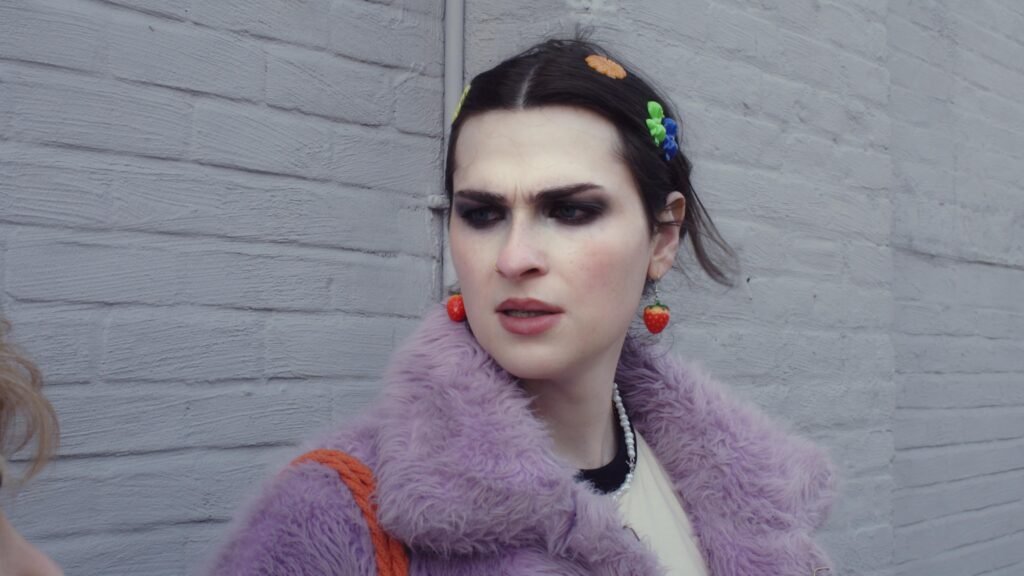 T Mitsock in ‘Egg’
I read the film with a hint of dark comedy. As you said, your previous film, Egg, was much more conventionally comedic—and it is very funny—but also more direct with the dark humour. What is your relationship to comedy in general when it comes to crafting tone?
Tone overall has been a big question for me, because I didn’t know what my voice really was for a while. I was drawn to the dark and to other things like that. When I entered film school, I was sort of looking around and thinking, “Do we make family dramas? Are we all supposed to be doing that kind of very sociorealistic kind of thing?” I wasn’t sure where my place really was, and then I made Egg as sort of an experiment to be like, let me just have fun and not overthink how other people are going to view this.
With Gender Studies, I wanted to bring back a little bit of the darkness and still try to say something poignant. I feel like I learned that a big part of my voice is that a film can still be poignant without taking itself too seriously. I always love adding a little bit of cheekiness, maybe a little camp, because those are the movies I love. I love movies that are really interested in weird, complicated characters but never sentimentalise them. I think that maybe the easiest way I know how to do that is just by giving it a kick of comedy, as opposed to other ways that people avoid being sentimental. That was actually a problem with some other shorts I’ve written before but never made. The second I tried to be serious, it got really saccharine, and I wanted to avoid that. Instead, I sort of found it instead through a bit of a bite.
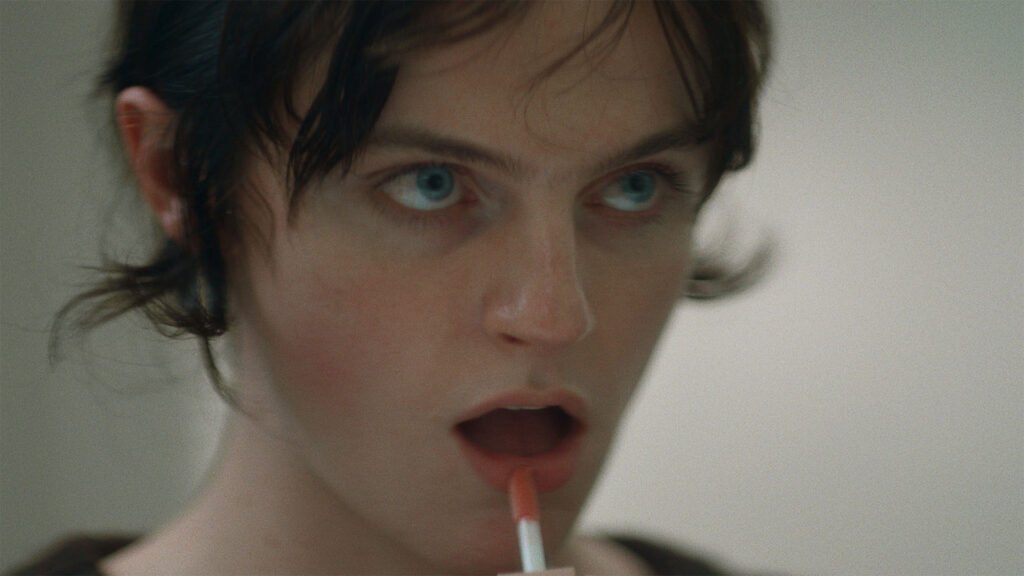 Jake Junkins in ‘Gender Studies’
An early moment in Gender Studies features the main character asking for lip gloss and applying it. In your first film The Yellow Wallpaper, we have this repeated moment where the protagonist’s lip colour is pointed out. I’m curious if you thought consciously about this motif, if you could call it that.
I have thought a lot about mirrors and looking at yourself in a mirror—how painful, but also special, that can be depending on what you’re seeing in that moment, and how much that can change even in an hour. What is funny is I didn’t fully clock that connection until I was, I think, editing Gender Studies. I didn’t even realise I had done it twice. That was the one thing that was more mystical about the filmmaking, I guess. But for me, it is an easy indicator of femininity and reaching this certain perfect ideal. I constantly experienced this thing of going after whatever ideal you think it is, and even a specific product that you think will get you there. Then you look at yourself in the mirror, and you’re like, “Well, I don’t look like that person.” For this one, there actually was stuff that was cut. We filmed her trying on different lipsticks, but it was that one specifically that gave her a sort of power. I ended up cutting that because it didn’t really read, but I was really interested in this way that she’s literally masking and that lip gloss acting like a quick indicator of the mask she puts on.
At Purple Hour, we’re trying to interrogate this idea of queer cinema, trans cinema, and so on—what do these labels really mean for filmmakers? I’ve seen that your films have played at many queer film festivals. Now, Gender Studies is premiering at Sundance and will go to SXSW. The audiences are also very different.
It’s such a deep question, because on one hand, there is this feeling of wanting to be allowed to venture outside of it. Having a trans film that is being played not at a gay festival, specifically, does mean a lot to me, because I want those stories to enter spaces that aren’t designated for them. But also, of course, I feel extremely close and protective of a community and so enjoy those spaces at the same time. Balancing those emotions has been an interesting thing. I often feel like I’ve struggled to articulate how so many movies I love are not explicitly queer in content, but more in tone. They’re not queer, but they just feel really gay, like I mentioned All About Eve. You could do a sapphic reading of that, but in content, it’s not even remotely a queer movie. Yet, there’s something about the tone and the acting. There’s something camp and everything being a little artificial in a lot of queer movies that I really relate to and respond to. That’s exactly what I want to also imbue if I end up hopefully making a film that’s not at all to do with being trans.
I would love to continue to make films for this specific canon, because it’s something that has always meant so much to me. It was the sign to me of a community outside of just the people I knew in my real life—that there are so many people out there who love stuff like this. Those are my people, because I love it too from such a young age. So I feel like I always view it as more of a tonal thing than even a content thing, and that’s really what I love about it. So many films loved and admired by the queer community were completely shit on by the masses at large. My dream is to combine some of that campiness or low culture that so much of the queer community loves with something a bit more high-brow but where people understand what I’m going for. A lot of those films are always viewed as being unintentionally over-the-top—and maybe they were—but I love that kind of stuff.
Going back to the festival thing, I am actually writing a feature about a queer film festival—so that’s funny. I remember I said to my dad that all I really want for Gender Studies is for it to play a festival that’s not a queer film festival because I’ve never played one before. Again, I love those spaces, but I kind of wanted to break into something new. Exactly a week later to the day, I got the call from Sundance. It was like, “I didn’t even mean that!” But it is something that really does matter to me. I want films that exist in both spaces. There’s gonna be a different connection to and love of these movies in a queer space—but people can still love a movie for what it is and for the journey it took them on, even if they can’t relate to it. I don’t know anything about the ’50s in New York with the Jewish community, but I saw Marty Supreme! I want [film viewership] to constantly be growing in that way, and I want to always exist in both spaces as much as possible.
*****
Gender Studies is screening in the 2026 Sundance Film Festival’s Short Film Programme 2 through the end of the festival (22 January–1 February).


