

14 years after departing home from a remote island in the North Sea, Hein (Paul Boche) returns. In his pocket is a locket tying him to someone from his childhood: Friedemann (Philip Froissant), the man for whom Hein says he has come back. The small village, however, does not recognise Hein—he looks, speaks, and acts differently. How could this be the young man who left so long ago?
World-premiering in the 2026 Berlinale’s Perspectives strand, Kai Stänicke’s feature film debut, Trial of Hein, grows like an age-old tree in its gentle love story between Hein and Friedemann, who have now become two very different people. Their connection turns the screw: Friedemann may be the only one who can see both the perspective of the community and that of Hein, becoming a link between their increasingly distant recollections of the past.
During the Berlinale, we spoke with Stänicke about Trial of Hein, which poetically queers the still, objective frame we place on memories.
*****
Purple Hour: I’d love to start by exploring your relationship as a filmmaker to queer storytelling and queer film. How do you relate to this conceptual umbrella?
Kai Stänicke: I made a lot of short films before this first feature film, and queer issues are very close to my heart. It’s my experience. When I do films, it’s always connected to me and my own experience and my view on the world, obviously. So queer cinema was always part of my filmography.
The queer love story at the centre of Trial of Hein is just one part of its larger thematic landscape that touches on belonging and estrangement, hiding and revealing, and so on. Was it always central to the story?
This story is very, very personal to me. It was always the queer experience at its core from the very beginning. Especially with a first feature, I wanted to do something that’s kind of my experience and kind of very close to my heart. In the script work, from very early on, I wanted to take my own personal experience and make it a universal one. I wanted to add different layers. I wanted to touch on different issues. I wanted to take my own personal experience and make it so that everyone can find a connection to it, and everyone can see something of themselves in it.
You transpose this story that’s very close to you onto something more estranging: it’s remote and with older German names, implying a historical context. How did you decide on this setting to tell this story?
I wanted it to be a parable. Every decision I made with the script and with making the film was always in favour of giving it this universal quality. The island, for example, was in the script very early on. I wanted this place to be otherworldly, like at the end of the world. With the historic setting, it’s kind of timeless in a way, and that’s what I really like about the story. You cannot pinpoint the location. You cannot pinpoint the time. This was what I set out to do. The open houses and the stage-like setting are also in favour of that.
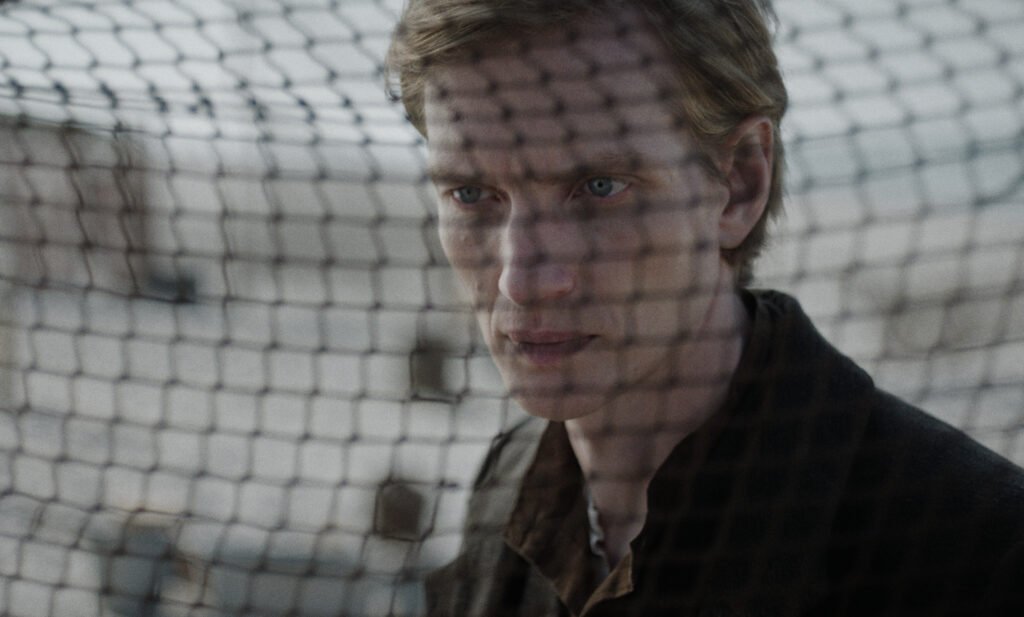
You use multiple different devices to explore the past, two being more conventional flashbacks in the form of recounted memories, and also Hein and Friedemann literally transposed into the present, and Hein sees them as if he’s watching his past self. How did you decide to examine the past in these ways?
There was a long process, actually, because the question was, how do we deal with these memories when he comes back? I was really interested in the feeling that you have when you go home and the conflict between the past and the present. Who are you now, and who were you back then? I was trying to find my way with Hein’s memories when he comes back. His are more intuitive, and the transitions between reality here and now and the flashbacks are more connected with each other. The memories from the trial are more strict and more objective, maybe. This is how I felt my way with the memories. What was important for me is that the audience connects with Hein and that they feel with Hein.
There’s a Letterboxd review that says something like, “This is the average queer person coming home for the holidays.” Despite its joking nature, it does speak to the universality of this story. We often return to the idea that for queer people, the past is either extremely traumatic or memories are not allowed to exist because of erasure, death, or repression. How do you relate to the intersection of queerness and memory?
The memories and the trial and how the trial unfolds—it all came from an experience that I had when I talked with people from my childhood. Very often, they were surprised what I went through in childhood and what I struggled with, because I kept it all inside and I didn’t show it on the outside. This tension fascinated me, because my memories would sometimes be very different from the memories that others had of me. This tension led to the trial [in the film].
Because of its style and thematic emphasis, I began to reflect on it as a reverse Portrait of a Lady on Fire, in a way—a return to a remote place, a rediscovery of an impossible love. This is a bit of a clunky comparison, but it’s what I began to see and how I emotionally connected. However, were there any specific works or references that you drew from?
I think in general, you’re inspired by everything that you see and consume. For direct inspirations, I can really name two. It was Dogville (2003, Lars von Trier), of course, and The White Ribbon (2009, Michael Haneke). These were the two that I deeply admire and that I always looked up to, and I think they influence the story and the setting with the village and the historic aspect of it.
*****
Trial of Hein is playing in the Perspectives competition of the 2026 Berlinale (12–22 February).


