

After his screenplay scored highly in several well-known US screenwriting competitions, Syracuse-born filmmaker Carmen Emmi was able to turn the script into what world-premiered as Plainclothes (2025) in this year’s US Dramatic Competition in the 2025 Sundance Film Festival. The writer-director makes his feature debut with the work, which seems to have remained just as undercover as its protagonist, despite displaying remarkable maturity in terms of its written form and artistic choices. The film also took home the US Dramatic Special Jury Award for Ensemble Cast at the festival.
1990s Syracuse, New York: rising baby-faced police officer Lucas (Tom Blyth) works in a very successful two-man team baiting men cruising for sex at a local suburban mall. With a sly smile, he catches the attention of an unsuspecting man, walking into the bathroom and never speaking, until the man enters a stall and begins to strip down—only for his partner to be lurking outside, waiting to arrest the “offending” cruiser. One day, he’s caught off-guard by the alluringly handsome Andrew (a bespectacled, grey-haired Russell Tovey), who gives Lucas his number; the police officer quickly aborts his mission. We learn that he recently separated from his wife Emily (Amy Forsyth), to whom he has disclosed his interest in men. Suddenly, his guiltless roleplay of “cleaning the streets” for the sake of his career has now gone way too far.
From the start, we are not just immersed in ‘90s upstate New York but instead also plunged into an environment of constant vigilance and anxiety pervasive for queer people cruising in this time and space. This is where Emmi differentiates his film from other films depicting the practice of seeking hookups, typically between men. Lucas’ first encounters with men at the mall are intercut frantically by footage of the same moment, but they appear like analogue surveillance footage, old video tapes, and grainy interrogational close-ups from DoP Ethan Palmer (whose biggest credit to date is, maybe surprisingly, Taylor Swift’s Folklore: The Long Pond Studio Sessions concert film) that turn the film from drama to anxiety-inducing thriller. As editor Erik Vogt-Nilsen cuts back and forth without abandon, he and the director make the audience feel like they, too, are constantly being watched. There is no escape.
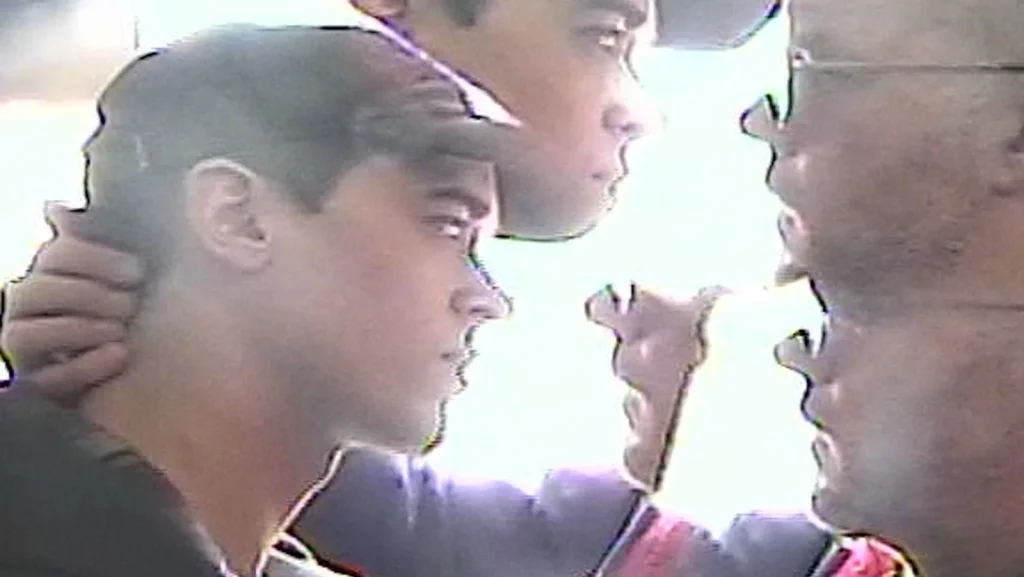
This is similar to a technique in Hernán Rosselli’s Something Old, Something New, Something Borrowed (Algo viejo, algo nuevo, algo prestado) from the 2024 Cannes selection, where we are fed multiple perspectives of a moment from the perspective of watchful eyes and cameras. In Plainclothes, we understand that these lenses don’t physically exist as depicted, but that doesn’t matter. It is the panopticon at play such that the men must constantly live as if they are constantly being watched, from society to the authorities to family and friends.
This is the case for Lucas, too, as he must deal with his overtly conservative family to whom he cannot comfortably disclose his sexuality. The relationship between Lucas and his married newfound lover graduates from hookup territory to something more dangerous for the two of them as each of their careers and lives grow more endangered by their continuing connection. Emmi’s script lets Lucas grow endearingly soft for Andrew, refusing to let his protagonist remain a one-dimensional being; props to Blyth for us being able to quite literally see the emotion of first gay love in Lucas’ eyes. It is ultimately also important to see Lucas struggle onscreen with his decision between his burgeoning career and his personal life as it frames the act of coming out and standing up as defiant, particularly for this time. Of course, not everyone has the luxury of being able to do so safely, making his plight still very relevant when transposed into a 2025 setting.
Plainclothes emerges as an impressive feature debut precisely because of how it incorporates style and content; one without the other would render the film a much more average drama. Heightened and hyper-sensitive sound design by Kimberly Patrick further adds to the sensory experience that Emmi seeks to evoke: that fight or flight situation undoubtedly felt by queer people unsure if they would be arrested for an act, word, or step in what is perceived as the wrong direction. The filmmaker’s bold stylistic choices significantly elevate the film into a work that also grapples with the emotional experience of living as a queer person in the world by putting it on the viewer, too, to try and directly feel.


