Colombian filmmaker Gala del Sol rip-roared her way through the 2025 Sundance Film Festival, which shoots next to Rotterdam’s Bright Future sidebar with her boisterous and colourful debut feature, Rains Over Babel. This colourful two-hour marathon features an ensemble cast of characters whose lives intersect at the titular Babel, a popular dive bar where people can come to bet years of their lives away against La Flaca, the personification of Death.
Upon the occasion of the film’s world and European premieres, we spoke with the writer-director to explore its origins, its eye-popping production style, and the community-driven basis of the work.
*****
Purple Hour: The film is composed of so many different, vibrant characters. How do you relate to your characters? What is your personal connection to this ensemble?
Gala del Sol: I feel that every character has a little bit of me. It’s like a mix of myself with the actors, because the way that the characters were created was with the actors. During the pandemic, I returned to Colombia after living in Los Angeles for six years. I was actually going to shoot my first feature in 2020, and it got cancelled because of the pandemic. I was in a bit of an existential crisis.
I have done theatre since I was four years old, and I called up a friend who moves in the theatre circles of my city, Cali. He gathered a group of very talented young actors that I started working with during that time—but we didn’t know that this was going to become a film or anything. We were just hanging out, having fun, video-calling. They were all theatre actors who wanted to act for film. Obviously, my specialty is directing actors for film, so it was like a perfect match. It was actually through an exercise of character creation that some of the characters were born—about five characters. I asked to create a character that they always wanted to play and to create a character that will help heal something within them. It started from that and, through that, I began seeing themes. I was like, “Okay, this has the potential to become a film.”
I love that you’re subverting the idea of what death looks like in discourse. It’s not all grim.
I think [Dante, who is the servant of death] is my favourite character, to be honest. I’m so lucky I got to cast Felipe Aguilar Rodríguez for it. That was not one of the original characters we created with the actors. It was incredible to find this guy because he had so much of Dante in his life. For example, his grandma had just died and his best friend had just been killed. He came to the casting and told me that, and I was like, “There’s no way because the character picks up two souls, that of a young man and a grandma.” We actually renamed the grandma after his own grandma.
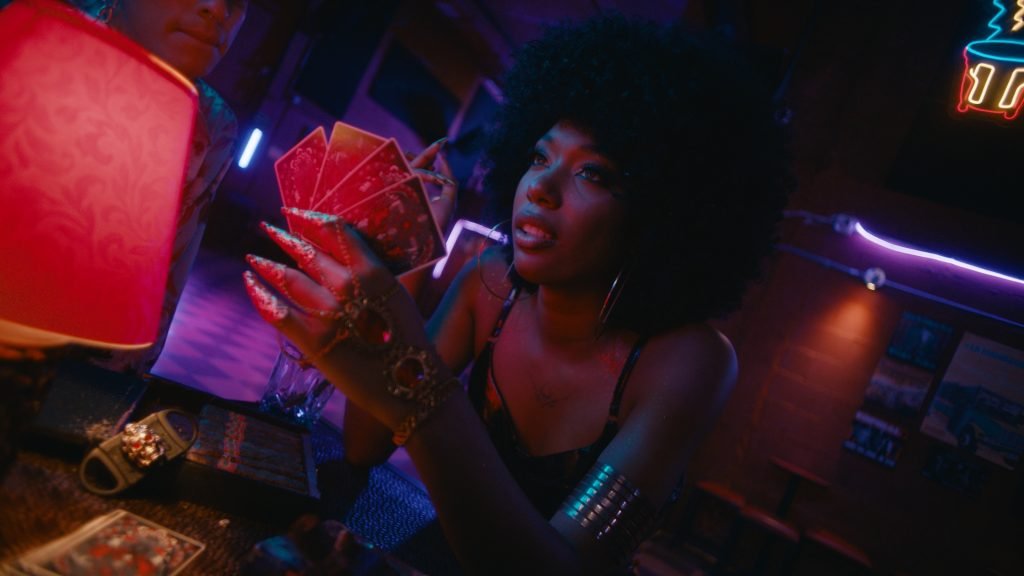
Obviously, I also love La Flaca [played by Saray Nohemi Rebolledo Ospino]. The way she was born was during the pandemic—it was the first time I had to really deal with death and illness. What would happen if I could bet years of my life against that to save my loved ones? Where would she hang out? My city, which is Cali, Colombia—it’s known for its salsa dancing scene with the ‘80s-looking bars. Of course, Death wouldn’t be terrifying or dark like in The Seventh Seal. She would be filled with joy. She would love to salsa dance. She’d love to drink at city bars and bet years of life with drunkards. So I feel like what I’m doing right now is creating a universe where I can play with different stories, with death personified in different cities and how they would look like. I think it’s really fun—that concept that you could meet “Death” in your city.
The production design of the film is so lively and bright. Could you talk a bit more about the site-specific connections?
I’d say the style is retro-futuristic tropical punk. But actually, Ana Souza, the Sundance programmer described it as tropical steampunk—and I love that. When I read that, I was like, “Wow, I didn’t know I was going for that, but that’s definitely what it is.” The film has a lot of things I naturally like in my life. It has a lot of elements of mythology—I’m a huge mythology nerd. I love ancient history. All of the religious aspects, too—I was going to be a nun, and then my mother convinced me not to when I was in high school. I grab a lot of stuff from Latin American magical realism—[Jose Luis] Borges, [Julio] Cortázar, [Gabriel] García Márquez. There’s so much richness in telling stories right on the verge of reality and fantasy.
The film is described largely as a take on Dante’s Inferno, or The Divine Comedy, in full. Was this the starting point for the film, or was this connection something that came later?
It was a happy accident. They say that we are just retelling the same stories that we used to tell 2000 years ago. The stories just repeat themselves in the collective unconscious, and then we just change the form by which we tell them. It was not a premeditated thing. We already had the script, and one of the characters was named Dante. We were just playing around. It was Ana the Sundance programmer who pointed it out one day. She’s like, “This is literally Dante’s Inferno, but tropical.” But we touch on so many things that The Divine Comedy also touches on and that very human desire to know the afterlife. Some of the characters realise that they’re in purgatory, and Babel [the bar] itself is purgatory. The world has hell in it as well, which is My Petite Pony [another bar]. We just messed with the structure—it’s an upside-down pyramid where we start with all of these characters that begin meeting today. We have the climax of the story, but each of them has their own little hero’s journey.
Many of the characters were created in conjunction with the actors. Many of them are very queer, not very heteronormative. Is this something that came organically, or something that came with the script?
We were all between 20 and 25 when we started. When I created the story, I had just turned 24, and it was April 2020. It’s a natural reflection of what this group of 20-something-year-olds were interested in and the themes that were relevant. This is what we thought was necessary in Latin American cinema because we hadn’t seen that before. That was a little bit of the goal: what kind of film do we want? What kind of themes do we want to explore through the characters? Initially, it started as an exercise to heal stuff from our lives. Some of the themes are still very much taboo, but I feel like they’re necessary. We’re also at a juncture where more and more young people have a desire to see these kinds of stories because they’re relevant in our lives. What the actors brought from their lives to heal is very deep and raw and real. I think that helps drive an artist forward. We just mix it with this fantastic world where mythical characters exist with real people, or they can mix with a devil or a guardian angel.
Did this community aspect also come into play during the production process? Is there anything you could highlight about this?
It was definitely the hardest thing I’ve done because I ended up producing it with my siblings and parents. Three days before we started shooting, the producer that we had backed out via email. They left us a big chunk under-budget. We realised that hadn’t figured out transportation, catering contracts, and so on, but everything was ready to go. My siblings, my parents, and my two assistant directors came together during a weekend—the weekend before we began shooting. My cousin, who’s a lawyer, came from another city to do our contracts. My dad was calling all these providers to see if we could get catering, walkie-talkies, a generator. It was insane. They ended up producing in that sense. It turned out to be a really beautiful experience, because not only did we get to do it as a family, but we got to do something meaningful as well.