

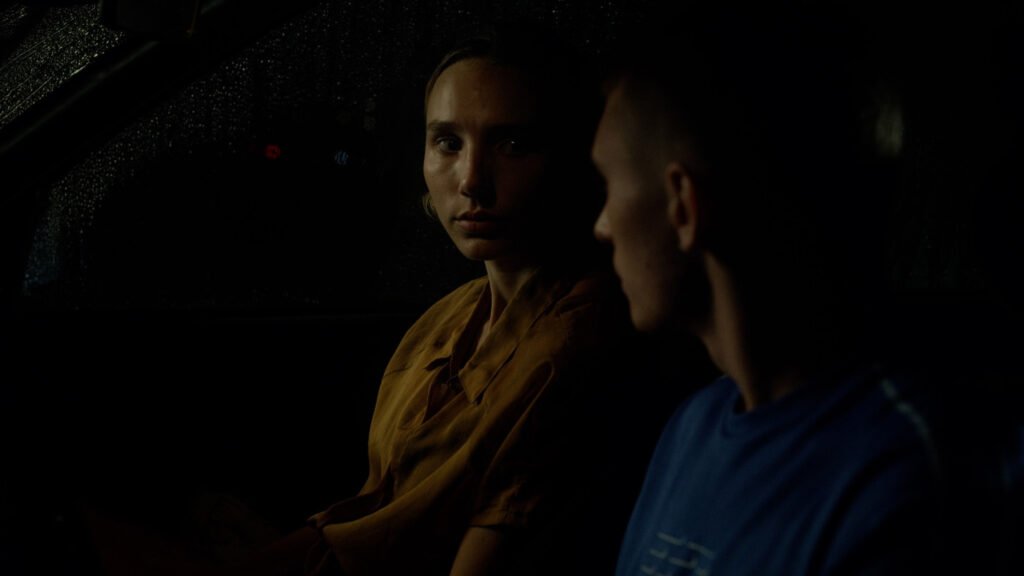
Petty Thieves follows Rio (Gavrilo Jović), a young man who works a service job in a seaside town, finding additional ways to “earn” money by stealing from tourists while living with his grandmother and caring for his grandfather. In a chance encounter, he hits it off with Andrea (Tea Ljubešić), who works at a luxury spa, and the emotional foundation of their relationship becomes intertwined with their separation from the town’s core industry as they find something unique within each other. It soon grows into a mutual curiosity toward the act of theft from wealthy customers; Andrea expresses a light interest in Rio through physical intimacy, yet the latter prefers to wander into the forest to explore his own desires.
Framed in part as a thriller, this debut feature by Berlin-based Croatian writer-director Mate Ugrin unfolds more as a study of social environment, the complexity of interpersonal connection, and learning to communicate in different ways. At the 60th edition of Karlovy Vary International Film Festival, where the film world-premiered in the Proxima Competition, we sat down with the filmmaker to discuss the work.
*****
Purple Hour: The main relationship is between Rio and Andrea, which I would describe as a sort of platonic love. However, the film also features various types of love and care between different characters. What was most interesting for you to explore through these constellations?
Mate Ugrin: The figure of Andrea was important to me because I needed a character who, through tenderness and connection, creates potential for an inner transformation of Rio. In the first draft, it was imagined as platonic love, but while we were exploring the characters doing rehearsals, we also found a space for a bit of ambiguity from Andrea’s side. It brings another dimension to the story, and I think it gives some kind of small inner conflict to the way she perceives him. Maybe she’s trying to get something from him that he’s not able to give.
In the family dynamics, I was interested in gestures of affection and care, but I was also interested in a dynamic that puts Rio in a place to question his position. On one side, he’s there for them in a genuine way, like in the scenes where he is really caring toward his grandfather. Since his grandfather suffers from dementia, this bond becomes non-verbal because they cannot communicate with words—it happens on a physical level with touch and care. On the other hand, on an unconscious level, Rio feels like he maybe needs to start prioritising his needs with his family and create a space for himself. I think the connection with Andrea also helps to trigger this process in him.
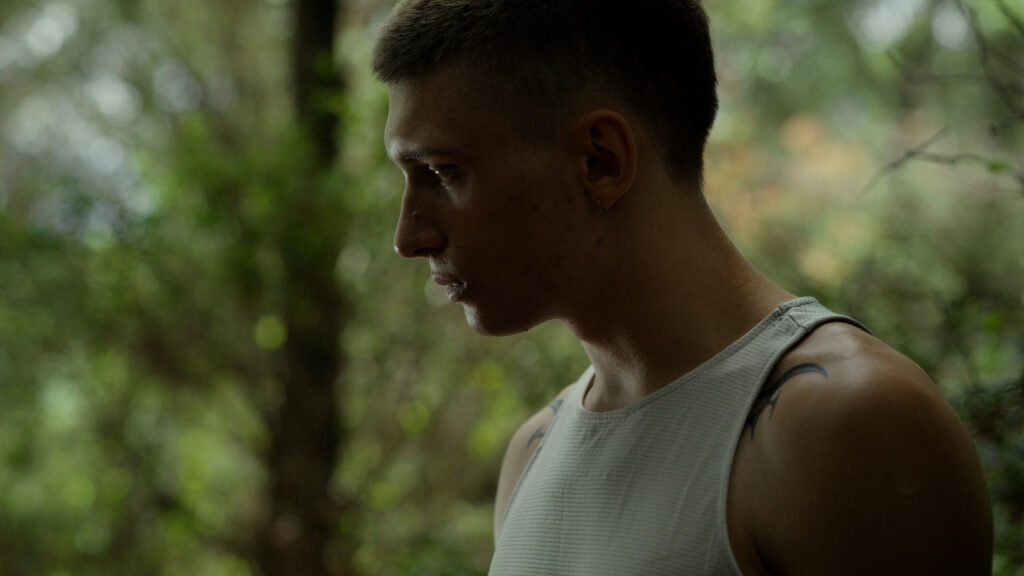
You also feature several short scenes in which Rio goes into the forest—which effectively acts as a cruising spot—and there he meets men with whom he is implied to have intimate moments. Could you speak to this part of Rio’s journey?
The queer storyline is connected to his sexual explorations. Maybe at the beginning, he’s kind of reluctant to let himself go. But over the course of the film, he lets himself go in these encounters. When it comes to the queer element, I wanted to show it as just one more layer of the character and not just as some kind of force that pushes the narrative—which is really common in queer films. It can become a cliché. I just wanted to show it as part of his life: the exploration, the transformation process.
Can you talk about your approach to the film’s context of mass tourism on the Adriatic coast? What was most important for you to highlight?
I was really interested in the interplay between these images of luxury and wealth that tourism creates—and the position of the people in the background who are there to sustain this image. That’s why it was also important for me to have different storylines of the main protagonists, to show some private aspects of their lives. We can see how the socioeconomic positions they’re in and how [the tourism industry] affects their lives in different ways.
You create a visual distancing in some cases from the characters, so I’m curious what you were thinking about in terms of cinematography and this push-and-pull between intimacy and othering.
When I was thinking about Rio, I had a raw, impulsive character in mind who is not able to articulate his needs and emotions. Through the process of getting close to a new person, he learns to find space for that. Of course, we’re talking about baby steps, because the character arc is maybe not so large. However, there is some kind of transformation in him, which enables him to say no, set some boundaries, and let himself go.
The relationship I have with the DoP [Ivan Marković] is special because we’ve been working together for almost 12 years. This is our fifth film together—we did four shorts. The first step for us was really talking about the script openly and finding the most adequate visual language for it. What was crucial was the location scouting where we had the chance to test some solutions we had in mind and see what would work in certain spaces. Also, it was important to us to get inspired by space and reconsider some solutions we had thought about. It was also important to find places that could add some new subtle layers of interpretation to the characters with as little intervention as possible. We also wanted to feel excited about the locations—like places that made us curious and inspired us to work.
Do you have any particular examples of this?
Since I come from the region where we shot, I knew most of the places where we placed our camera. As such, my biggest fear was being too attached to these places and having them be too emotionally charged for me. The DoP acted as kind of an objective eye. I rediscovered some places and found new ways to look at them. Sometimes the intuition I had for some locations was correct, but sometimes it didn’t work as well. In my previous film, it was mostly about going to a new place and discovering it together after doing some research. Here, it was more about the process of rediscovering places that are familiar to me.
*****
Watch the trailer for the film here:


