With a title like Lesbian Space Princess (2024), you’re bound to pick up a lot of attention. The Australian animated feature exploded out of Adelaide Film Festival to rave reviews, picking up the Audience Award for Feature Fiction and shooting across the galaxy (well, world) next to the 75th Berlinale’s Panorama strand—an audience favourite sidebar. For the film, first-time feature directors Leela Varghese and Emma Hough Hobbs picked up the second place Panorama Audience Award and also the Teddy Award for Best Feature Film at Berlinale, where the film was lauded by the jury for “a deliciously subversive vision of a future that is so unabashedly queer in both form and content”. Whether the film lives up to the pedestal it’s put on requires a more nuanced answer.
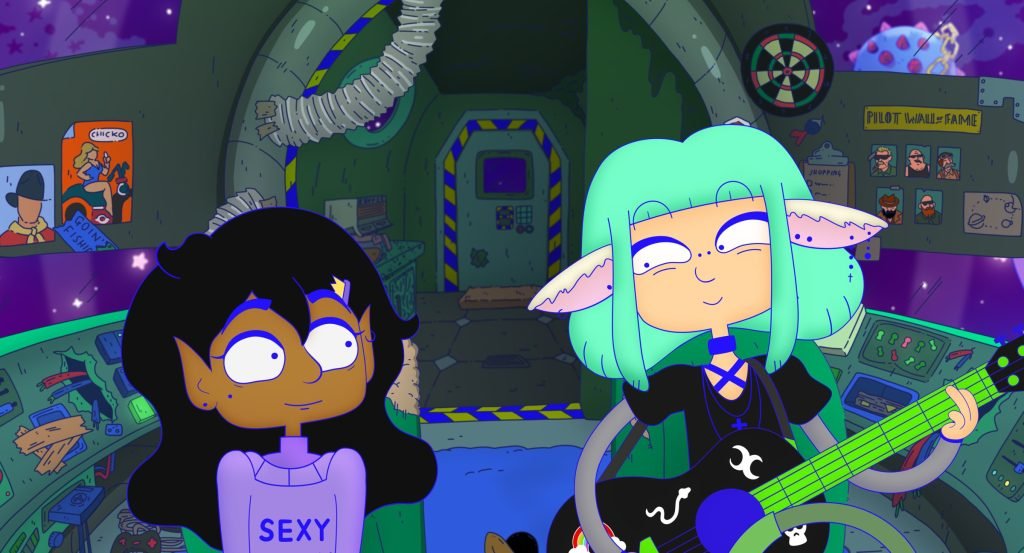
Lesbian Space Princess follows the titular royal, the incredibly shy and insecure Princess Saira of Clitopolis (Shabana Azeez), after she is dumped by her girlfriend-slash-situationship Kiki (Bernie Van Tiel), a badass adventurer with cropped hair and a crop-top. However, after Kiki is captured by the Straight White Maliens (depicted as white rectangles with crudely drawn-on facial features), Saira is called upon to rescue her, despite never having left Clitopolis and having little to no self-esteem or situational awareness. Along the way, she finds connections in the form of her rundown talking spaceship (Richard Roxburgh) and a manic-pixie, cutesy-goth bisexual songwriter named Willow (Gemma Chua-Tran). The film’s most pleasant surprise is the fun and bold voice acting choices, ironically as epitomised by the Straight White Maliens (the leader voiced by Mark Bonanno).
One could easily level a slew of measured criticisms at the silly, satirical premise. Perhaps it’s not trans-inclusive—although some trans flag colour-schemed items adorn the walls of Saira’s bedroom, and the references to clitorises and vaginas aren’t actually particularly all-encompassing in the film, despite what it seems. Or maybe it’s too sanitised to be revolutionary: the two instances of sapphic sex between characters are never actually shown onscreen, a casual omission of a potentially radical image. However, it’s safe to say that audiences were absolutely uproarious for this film, drawing in masses of young queer people in Berlin ready for the work’s most laugh-out-loud moments. To see an animated film receiving this much attention at a festival like Berlinale—where feature animation films are hard to come by, unless it’s in the Generation section—is also a bit of wonder.
Varghese and Hough Hobbs deserve credit for bringing such a work to life, even if it is brought down by its trite jokes and a somewhat bland animation style that doesn’t take advantage of the medium itself. Its onslaught of comedic moments matches, like many on Letterboxd have rightfully noted, a sort of millennial adult sense of humour that would have gone viral in the 2010s—but otherwise seem a part of first-wave LGBTQIA+ activism. The dialogue regurgitates worn-out queer jokes about, to name a few: bisexual erasure, the sex scenes in Blue is the Warmest Colour, the “physics” of how two cis women have sex, the use of the pronoun “they” as singular, and keeps nails short. The Maliens crack bro-y, macho jokes that parody incel behaviour and habits like talking over women or stealing their ideas. The funniest moments are thus those that ultimately push the boundaries, such as an early film metatextual reference to Wikipedia (pronounced “wih-kuh-puh-DEE-uh”) as an “ancient scripture”. These, however, are much rare than one might hope.
The film’s bright and colourful animation is not unlike what one might find on Cartoon Network, for instance, or Adult Swim’s Rick and Morty. Neither of these are necessarily bad references or styles, and they even fit the off-the-cuff, playful tone of the work if one examines stills from the film. However, it’s the lack of nuance that makes the animation feel disappointing, with simple movements and superficial character expressiveness (tears are depicted as quivering masses below the eyes), while few liberties are taken in using the animation style to accentuate the content (no creative transitions, for instance). Here is evidence that a very detailed, accomplished animated feature takes a really long and arduous time to make. If queerness means bending the rules of the world, the animation style is certainly quite straight-laced.
While Lesbian Space Princess isn’t the visual or creative marvel that one might have hoped for, it’s clear that Varghese and Hough Hobbs have put their heart and soul into it, bringing crowds to a film driven by a sense of hopeful, excited energy. As such, one will likely leave the cinema with a caveated smile, hopefully at least chuckling along to a few jokes that stick.