

Writer-director Shan Jiang whisks us off to Shanghai—sometime after the pandemic—in Ephemera (2026, 浮浮游游), a soft but charismatic sapphic take on Richard Linklater’s Before Sunrise and Jiang’s feature debut. A spontaneous coffee date between the 20-something-year-old Asher (Yvonne Shuyu Zhang) and her hip-hop dance teacher Tori (Shu-Yi) turns into a day- and night-long rollercoaster of an encounter filled with shared imaginaries. Ephemera just made its bow in Tribeca’s U.S. Narrative Competition (read our review here) and plays next at Frameline50, the half-century anniversary edition of the San Francisco International LGBTQ+ Film Festival.
The filmmaker’s work focuses on queer Asian subjectivities, intimacy, and shifting identities, drawing from her own experiences between China and the US. Purple Hour had the opportunity to chat with the filmmaker about intentionality when queering a familiar story, the importance of a trusted network of collaborators, and being playful with farewells.
*****
Purple Hour: You were able to make this film soon after finishing film school at Columbia. Can you tell us a bit about how you started independently creating and financing your first feature?
Shan Jiang: At the time I started developing this, I was sort of fresh out of Columbia. I taught for a semester after graduation, but then the question sort of dawned on me: what’s next? Obviously, what’s on everybody’s mind is being able to make a first feature. The thinking really goes to how to make something that’s contained, feasible, and also representative of who I am and what my passion is—what kind of filmmaking I want to be able to do in the future. It just felt like the “walking and talking romance” is a tried-and-true concept that I’m sure every single filmmaker has thought about. I was just really blessed with my high school best friends’ and cousins’ support. That’s essentially how we pulled together the private equity, to be completely honest. We had support from other investors later on, but, at the very beginning, the reason I was able to say, “Okay, let’s actually start prepping for this project,” was because of two of the closest people in my life their generous support and trust in me.
You both play with and subvert elements of the rom-com structure and its tropes, with the most direct reference being Before Sunrise. How were you thinking about being in dialogue with these types of narratives?
From day one, I described it to everyone as a Chinese lesbian version of Before Sunrise. I think a lot of it is true. It is definitely inspired by that format, and I studied the screenplay of Before Sunrise religiously while writing this. I mapped out all the beats, just to do that cross-analysis and see how they would land. But it was also through the process that I realised that there’s so much more specificity from this particular relationship that I could bring. That’s when the story started to feel refreshing to me as well.
In the film, I joke about ripping off Before Sunrise, but I didn’t just want to do the exact same thing with different actors, or just make it queer but keep everything else. The cross-cultural element became really important to me, and how the city of Shanghai has a layer of nostalgia—but also, at the time, sort of this shadow after COVID. This kind of uncertainty I feel becomes a part of the story that I hold very dear to my heart. In the end, I am happy how it turned out. It made me more confident in this way of storytelling: taking a trope that I have been studying in the US for the past decade, and bringing a new perspective to it. It feels like it’s something I could keep doing, perhaps for the future.
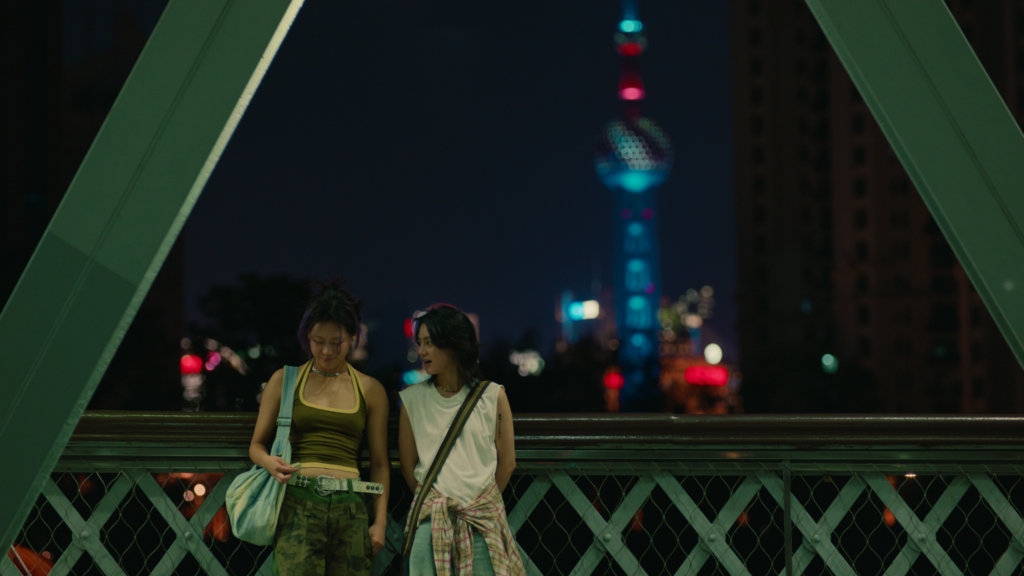
I always find that describing a city as its own character a bit cliché. However, you can really feel how Shanghai adds such a texture to this film as the story is so focused on only two characters, Asher and Tori. Can you talk about finding these locations and what the urbanity means to you?
Finding the locations was really a collective effort, because we didn’t really have anywhere specifically in mind—not because we didn’t have a vision, but it was mainly because of the logistics. We didn’t know if we could actually film in places we wanted, so it was really about going to see all the possible places. We had to start practically because of the constrained resources. When it came to scouting, it went down to the local line producers’ efforts of compiling a list and us as a team all going places together. The coffee shops, the restaurants, the bistros—we had a list, because we had more common locations. When it came to the overpass [near the end of the film] and the elementary school, those spots were tricky. I remember the elementary schools were the ones we couldn’t find until we got very close to the shoot.
My first AD, who’s from Shanghai and had spent time in New York—he’s very much tapped into this kind of indie filmmaking. He was so generous and offered to take me around. He even took me to his own elementary school, just to see what alleyway could actually work. The one we landed on is actually just one of those alleyways we walked through. For the overpass, I was looking to find something that was sort of epic in my mind, but then permits become sort of the issue. I ended up finding this overpass that’s sort of out of the urban center. I remember I was just in a car, I looked up, and it was sort of just there. No one notices that kind of thing. That was luck.
As to how Shanghai plays a role, I felt like the act of making this film and the sheer existence of the two characters queer the cityscape a little bit. At least, that’s what I tell myself. I try to do stuff that feels similar to myself. Hanging up that red banner on the overpass, I played into the idea of having a slogan that’s somewhat like propagandist, but then it sort of just blended into the cityscape so well. No one would know it was us, but then it became a part of the city through the process of filming. I think we accidentally forgot to take it down after that.
I love that you’ve also contributed to the landscape of the city, in and of itself.
That was a fun part, and I love telling people about this.
There’s a huge element of play in the film, from the Pac-Man sequence to the pseudo roleplay at the end, where Asher and Tori imagine their goodbyes through the framework of different films, like Before Sunrise and Lust, Caution.
The ending came rather late in the writing process. It always comes to a point where you, as a writer, sort of start to realise what the story is truly about. Of course, from the get-go, it’s about this queer love, the impulsive night that’s fun. There was a moment where I started to realise—especially for the main character, Asher—that it’s about saying goodbye. The whole film is her act of saying goodbye, or attempting to say goodbye to a lot of things: to Shanghai, to her memories. At the end, I thought it would be fitting for her to kind of propose this imaginary land where they get to say goodbye to each other multiple times, in the wildest setting that they could think of at the moment. It’s tapped into both characters and just bringing them into different “spatiotemporal realms” [in reference to a joke from the film]. I feel like that those were those were the most fun things to do, and I’m glad we did that.
How much of the film was scripted versus improvised?
It’s very much scripted. We had three weeks of rehearsal, two weeks of shooting, and it was during the rehearsal process that the two actors were able to feed so much back into the script. The script was in this ever-shifting status because I was rehearsing with them every single day. I was making sure every line and every pause felt grounded in their bodies. I believe it’s only responsible to make sure they already have that foundation that they believe in themselves before I could ask them to improv anything. That was the process. They had every single line memorised of the entire film before going to the shoot, because there were not many takes we would be able to facilitate. With a lot of it being in the city and in the streets, I wanted to make sure they are extremely comfortable with the lines and with the actual words they’re going to say, because I knew there would be other elements that were going to be distracting.
Do you see the film as being in conversation with a queer canon or queer body of work? How do you see yourself or the film in the landscape of queer filmmaking?
I think I will always be under that umbrella, to be honest, because there will always be something queer in my filmmaking. I don’t know about being a part of a canon, because I don’t think I can make that judgment myself. But I’m proud to be under this umbrella and have my filmmaking be a part of it.
*****
Watch a clip from the film here:


