

“What I am trying to say is that cyborgs are trans, the Iron Giant is trans, and he goes by he/him pronouns throughout the movie,” affirmed Joke D’Heer about The Iron Giant by Brad Bird, of later The Incredibles and Ratatouille fame. Yet, the Gent-based media and cultural studies scholar was certainly not speaking out of context, having now conducted queer readings of many popular films, from Shrek to Chicken Run. The queer reading is one of the more inventive formats of cinematic presentation that encourages an audience to think about a film from a queer and trans perspective, ranging from a very serious analysis to the more far-flung and stretch-of-the-imagination.
Recently, D’Heer conducted a queer reading of the 1999 Warner Bros. animated feature The Iron Giant in the framework of Brussels’ 2026 edition of Anima. A few hours before their talk, we sat down with D’Heer to learn more about how they began doing this type of cinematic engagement, their approach to creating it, and its importance as a collective experience.
The concept began partly as a joke with their friends who run Gent’s Kinoautomat. “It really came from this fun idea of wanting to do something silly yet also real, combining these queer theory insights from our academic backgrounds with animation movies that you wouldn’t expect to contain a queer perspective,” D’Heer explained. It also emerged as a form of escapism while doing their PhD—and as a type of play, which they believe is essential to the format itself. They began with one reading, and one led to the next, including an ongoing collaboration with Gent’s PinX LGBTQIA+ Film Festival.
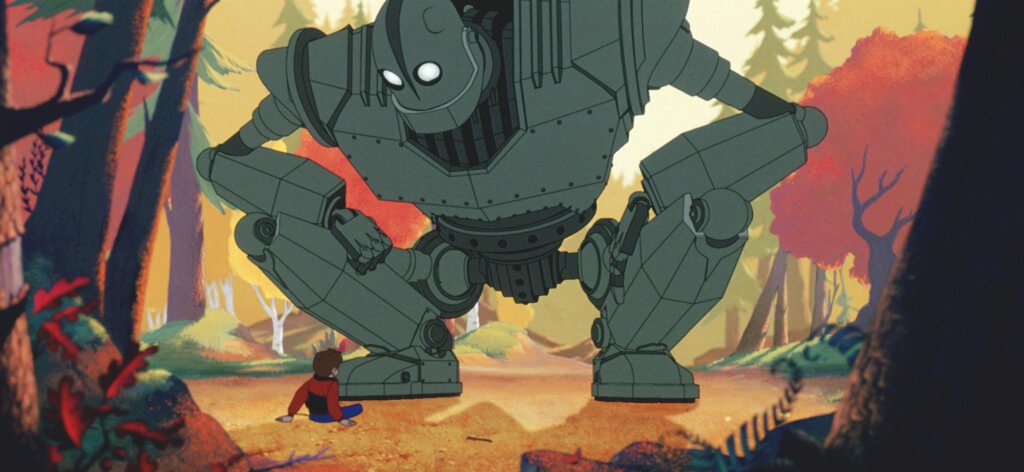
As for The Iron Giant? It’s based on a book by Irish author Ted Hughes, who was married to feminist author Sylvia Plath. “I therefore like to believe that she had a direct influence in the writing of this story,” they explained. The animated work follows a young boy, Hogarth, who finds the titular being in the forest near his home, and they become friends. However, the two are quickly pursued by a US government officer who seeks to capture and kill the gentle Iron Giant, automatically taking him as a threat, speaking also to the film’s post-Cold War context. The film was one of D’Heer’s favourite childhood films and remains one of their favourites today. Introspection led to more: “Why was it so important to me that this kind of resistance narrative existed in the film?”
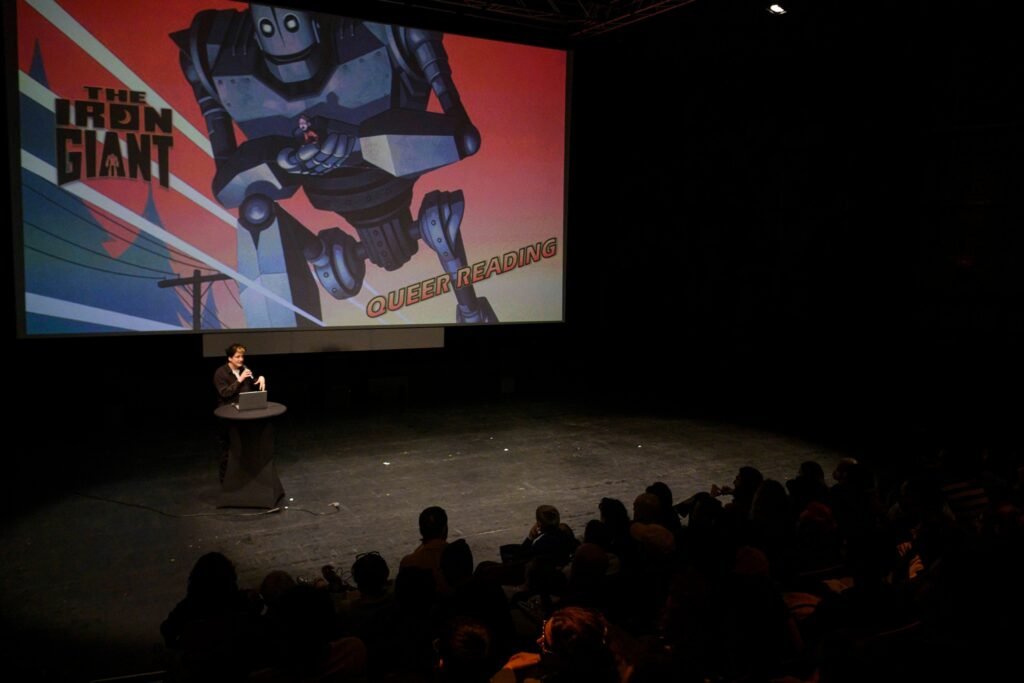 Joke D’Heer conducting their queer reading at Anima 2026 (photo credit: Renaud Fang)
With the Iron Giant, who can fly, jump around, and play with him, Hogarth fulfils his childhood dreams and finds a sense of place. However, “the defiance of norms is viewed as a fantasy: as something that has to be regarded with a healthy sense of scepticism,” said D’Heer in the queer reading. In the film, following an incident in which the Iron Giant fires on Hogarth holding a toy gun, the former “really starts questioning whether he is good or bad, which is a cornerstone of queer existentialism,” explained D’Heer. They also read an even broader message from the film: being able to choose who one is and who one becomes—that fate is not set in stone or predefined, regardless of what one’s social setting seems to dictate.
D’Heer also explored how the film’s thematic core is aligned with that of the trans experience: as “defined by social expectations and norms as well as a wish to challenge them, often resorting to adapting one’s bodies by means of a medical-slash-technological intervention”. In particular, they looked to Donna Haraway’s “A Cyborg Manifesto”, with the cyborg as a hybrid organism-machine—a “creature of social reality as well as fiction, and it defies the notion of identity as inherently fixed”. In this way, the character of the Iron Giant itself rejects socially constructed boundaries between human and machine as well as a fluidity of identity, returning to D’Heer’s half-wisecrack about the Iron Giant being trans.
They also mentioned taking inspiration from the concept of “low theory”, originally from cultural theorist Stuart Hall and later popularised in queer theorist Jack Halberstam’s The Queer Art of Failure. This is a way of thinking outside of a hegemonic framework around success; in Halberstam’s words, “derived from eccentric archives” and “[running] the risk of not being taken seriously”, particularly in connection with a heterosexual standard. Such a connection could be made to paracinema, a term used to refer to work outside of the mainstream, including but not limited to genre cinema, so-called “trash” and B-movie cult cinema, avant-garde work, and pulp. In this way, doing queer readings with films that are looked back on with a less favourable critical eye, like Twilight, makes perfect sense—even if they were once popular or commercial.
“I think I’m inherently guided by the theories I’ve read; I don’t think I can totally separate the two,” they said. “It’s how I view the world: a queer lens of subverting storylines and alternative ways of interpretation.” But beyond the academic, it’s also highly personal: “Everyone gets to see how I view a film, as a queer person and as a trans person—it can be a very intimate process.”
The event always begins with a reading, with D’Heer using a slide deck to present stills from the film in question, combined with a commentary. This primes the audience to watch the film through that perspective. Then, the film is screened in a collective setting. D’Heer sees the queer reading as a “community-building experience”, with the group “actively co-constructing the film”. They consciously introduce a perspective, but the collective audience makes it their own by digesting their explanation and experiencing the work. “I love this type of cinema experience where people are vocal and reacting but not necessarily talking during the film,” they said.
Finishing the reading, D’Heer made one last joke before the screening began: “Let’s us all together devour the queerness of The Iron Giant like robots devouring scrap metal.”


