

The story of two women teachers accused of being lovers at their private boarding school was made famous in William Wyler’s 1961 film The Children’s Hour, which itself was based on the 1934 play of the same name by Lillian Hellman. However, this tale all draws back to a true story in 1810 Edinburgh, chronicled in the 1983 book Scotch Verdict by Lillian Faderman.
In The Education of Jane Cumming, Berlin-based filmmaker Sophie Heldman’s approach scratches at many of the hidden elements of this tale: its intersection with colonial oppression, the question of truth, and the importance of de-invisibilisation through images. Jane Cumming (Mia Tharia), the titular girl of British and Indian ancestry, is brought by her grandmother, the societally powerful Lady Cumming Gordon (Fiona Shaw), to Edinburgh to be enrolled at a boarding school, ostensibly to teach her to be a “proper” woman.
Facing severe ostracisation by her peers because of her background, she begins to find solidarity and comfort at this school taught by Jane Pirie (Flora Nicholson, who also serves as co-writer) and Marianne Woods (Clare Dunne), later wanting to become a teacher herself. Yet, after she is refused, she accuses the two schoolmistresses of having an openly romantic and sexual relationship in the dormitories, unleashing upon them a legal enquiry that tears apart their lives forever.
The film enjoyed its world premiere in the Berlinale Panorama strand in February, Heldman just collected the top prize of Best Feature Film at the fourth edition of Kyiv’s SUNNY BUNNY LGBTQIA+ Film Festival (see image below). As a follow-on to this win and ahead of the film’s next screening at IndieLisboa, we sat down with the director to discuss these themes.
*****
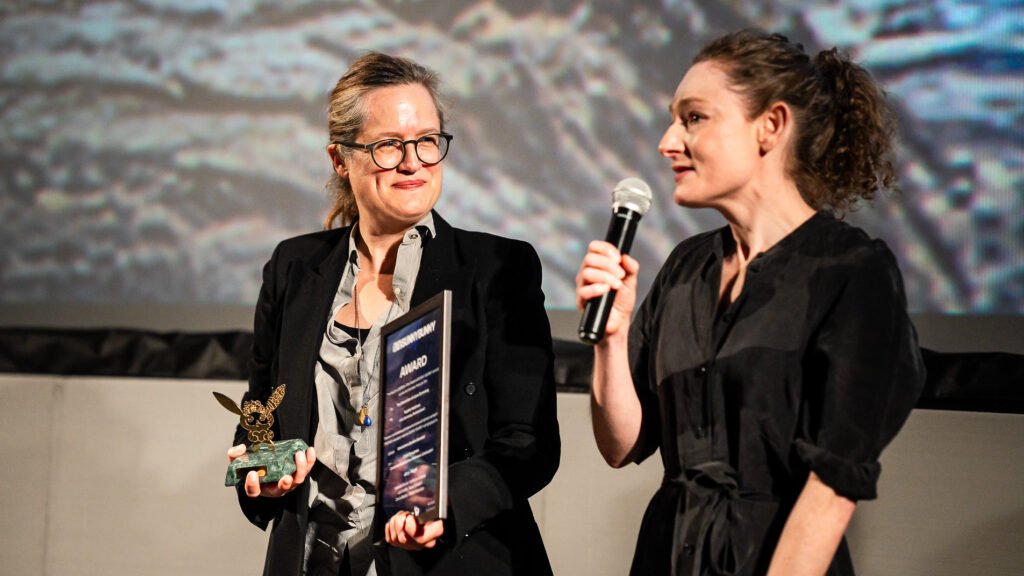 Sophie Heldman (left) and Flora Nicholson accept the award for Best Feature Film at Kyiv’s SUNNY BUNNY.
(Credit: Artem Galkin / SUNNY BUNNY)
Purple Hour: One thing that really stood out to me was the different formations of relationships between women and girls in this story: friendships, pseudo-maternal connections, love in all forms. How were you thinking about the distinctions between the types of relationships, or lack thereof?
Sophie Heldman: One of the things that attracted me to this story was that we could enter this period of time and look at relationships that are not usually the centre of the story. Stories set in 1810 involving women are usually about their relationships with men and marriage. But here, we have a very female world in the microcosm of this girls’ school. Relationships are at the heart of our story. We thought a lot about distance and closeness—physical and emotional distance and intimacy. From the opening images inside the carriage, when you see four people cramped together, you don’t know how they are connected, but you can feel the tension between them. The way the teachers and the schoolgirls have to navigate the shared space of the school makes them a kind of family very quickly. We thought a lot about belonging and home and family, and how this changes through the film. At the centre of our story is the triangle between Jane Cumming and her teachers, and how this develops over time, especially over the summer. The “love” story between the three of them is as important as the romantic love between Jane and Marianne. They are all three outsiders, and they form an alternative “queer” family together. At the time, there was no language to describe what they were to one another, and that lack of definition is part of what makes them invisible.
This idea of “truth” in the story is very interesting to me, as many of the characters, including Jane and the teachers, use imagination and invention as a way to survive in this world. How do you approach an adaptation knowing that archives don’t necessarily hold one objective truth?
We were always interested in a wider concept of truth. It was important for us that the film include multiple perspectives and that the story would rest on different characters’ heartbeats at different times. There are no heroes or villains in our film—only real, flawed people who on occasion make huge mistakes. Jane Cumming tells a lie, but she hits on a kind of truth. She can feel the attraction between her teachers even before it has become something. Fighting for the truth is, of course, incredibly important for the teachers who spend ten years in court trying to clear their name. Jane Pirie sealed her letters with a stamped marked “truth”. She must have had incredible faith in the truth and the judicial system, as it was a very unusual thing to do—for a female teacher to open a court case—especially against a very wealthy, well-connected aristocrat. In bringing this story to life, we tried to be as true as we could to the original archive. Of course, there are huge gaps in our knowledge where we had to invent. When Flora Nicholson and I researched the archive, we had this image of Jane, Marianne, Jane Cumming, and Lady Cumming Gordon’s lives being tangled in a knot. We could see the result of the tangled knot with the court case, and our job was to try to unravel the threads to and piece together how they got there. Often, we needed imagination and invention to get there, but we always tried to stay true to who we felt these people were.
From one perspective, the story can be seen as the experiences of two marginalised groups, represented through Jane as a young women of partial South Asian descent as well as the teachers, who we could see as a representation of a sapphic couple. At first, they find some alignment and solidarity, but then social circumstances pit them against each other. How do you see the role of colonial thinking infiltrating the story?
Colonialism is present throughout—it is lurking in the background. However, it is only at the end when we enter the legal world and hear the lawyers discussing India that we can feel the full extent of the racism that has been bubbling underneath: the stark ugliness that was there all along. The men surmise that Indian women must be formed differently, literally have different sized sexual organs and that Jane Cumming must have witnessed women having sex with each other in India because it doesn’t exist in Scotland. In their mind, there is simply no such thing as a Scottish woman having sex with another woman. These comments were all taken directly from the archive papers.
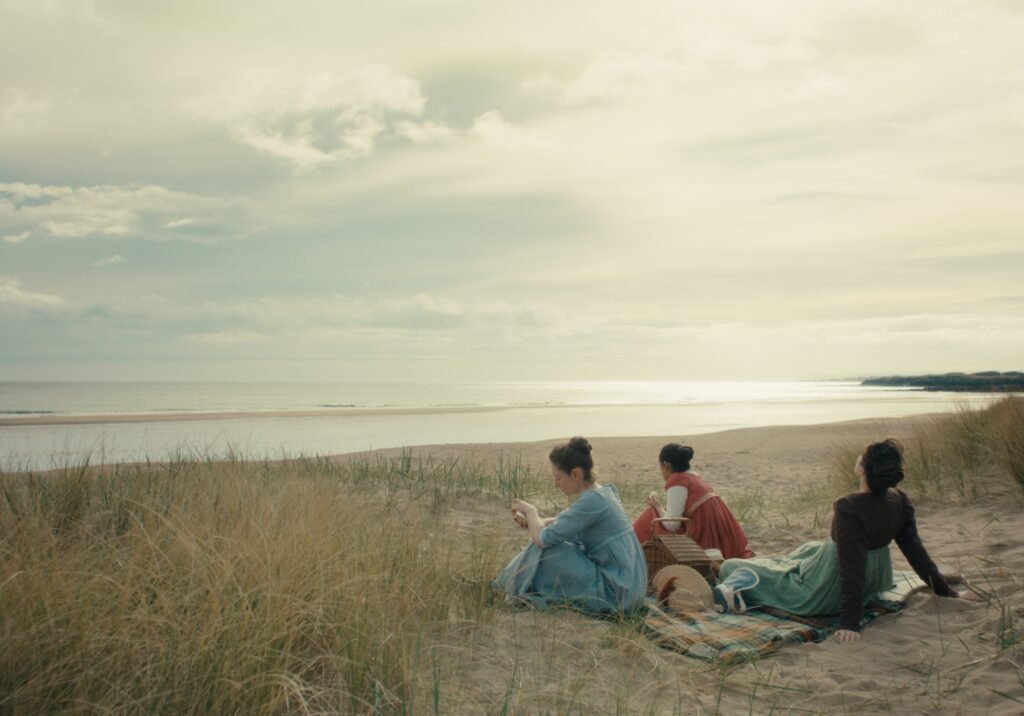
When we spend time in the school, at times, it is almost like a utopia that exists separately from the wider patriarchal world. Girls are valued for their intellect and creativity, liberated from thinking of their worth on the marriage market. We almost forget about the wider society they are living in and the restrictions it holds. Jane and Marianne are choosing a life of independence outside of a heterosexual family context. They are outsiders, like Jane Cumming. They are all trying to find their place in the world, a place they can belong. All three of these women were completely insignificant to the society they lived in and the establishment, as two unmarried teachers and an “illegitimate” biracial girl. They were practically invisible until they became an inconvenience, which they could not ignore with the accusation and the court case. The judges presiding over this case did everything in their power to stop the details of this case being known to society. Jane Cumming and her teachers are united by the same feeling of powerlessness over their future and a need for autonomy over one’s own life. They must fight simply to exist.
The film has a short sequence where we are witness to the physical and romantic encounter between Miss Pirie and Miss Wood that occurs after a moment of great crisis. I’m curious about your intention behind ensuring that this moment actually has its time onscreen, rather than simply implying that it happens.
For me it was important to show them coming together, in part to show the contrast to what they were described as doing. When we see them kiss, it is clear they have never done this before. It is new to them. They are discovering new frontiers together. It was important that the audience did not miss any of the steps of them coming together. I didn’t want the audience to wonder if they had missed something and think Jane Cumming is telling the truth. The accusation is so scandalous and graphic, and I wanted to bring Jane and Marianne together physically in a way that felt simple and vulnerable and real. This was to restore dignity to their sexuality, which was corrupted by a lie for 200 years. It was also important to show their sexuality, as the lawyers argue that lesbians don’t exist. I hope that by bringing the audience close to Jane and Marianne’s intimacy that we feel more invested in their fight to clear their names.
Queer cinema is a label that some filmmakers opt to use, and others opt to disengage from. How do you relate to this concept, or how do you see The Education of Jane Cumming in the framework of queer cinema?
It is a very queer film in a sense that it is not conforming to norms. If you look at the characters and the way they behave, queerness here is about being different, individual, or non-conformist to the mainstream of a society. That includes even Lady Cumming Gordon, who is part of the establishment. She also is a non-conformist by taking in her grandchild born outside of marriage which, at the time, was a stigma. The story itself has many different levels and the film is an invitation for the audience to discover a period of change where simple answers to complex questions are nothing but an illusion.


