

Cannes 2025 Queer Palm winner The Little Sister is based on Fatima Daas’ 2020 autofiction novel of the same French name—in an interview for Bidoun magazine, the pseudonymised Daas stated: “I was never ashamed of being a lesbian, but I was ashamed of the loneliness of being unable to talk about it.” This sentiment is core to Hafsia Herzi’s screen adaptation (which she both wrote and directed) of the story of Fatima—a 17-year-old French girl from an Algerian Muslim family the cusp of adulthood —which she carries over to the film with grace. French filmmaker Herzi herself began as an actress (two-time César winner and the Marcello Mastroianni Award at Venice) before moving into directing and is of Algerian and Tunisian descent.
The Little Sister (2025, La Petite Dernière) most recently played at the Tromsø International Film Festival in the main competition, where it secured a special mention for the Faith in Film Award, dedicated to films that engage critically with the role of religion and spirituality in everyday life. Nadia Melliti, who plays Fatima, was scouted in Paris, making it her first-ever role and, she also picked up the coveted Best Actress Award at Cannes for her seemingly effortless performance—one in which she demonstrates her mastery of microexpressions. Beyond the Queer Palm at Cannes, the film also picked up the Louis Delluc Prize for Best Film (a prize that, notably, went to Céline Sciamma’s Water Lilies in 2007).
Living with her mother (Amina Ben Mohamed), father, and older sisters Nour (Melissa Guers) and Dounia (Rita Benmannana) in a Paris banlieue, Fatima bears the weight of her sexuality alone without any examples in her everyday life, surrounded by a friend group of teen boys. With an archetypically quiet and tomboyish personality, she hides her face under baseball caps, tied-back hair, and smoke from cigarettes. Yet she also has a boyfriend, the hilariously peach-fuzzed Ahmed (Razzak Ridha), who completely misreads the relationship and wants to ask for her hand in marriage. “You know girls and boys can’t be friends,” he says, criticising her clothing and for not being feminine enough. Although her expression doesn’t move an inch, he still calls her a princess—it’s heartbreaking how she’s rendered voiceless to express just why she isn’t interested in him, just as much as he feels lost over her response. It’s a lose-lose situation.
The first half of the film is devoted to Fatima’s queer romantic discovery and coming to live openly with herself, while the second half of the film is devoted more to queer platonic discovery and coming to live openly with those around her. Although Fatima doesn’t have personal, physical experience with a woman, she’s not afraid to go out and get it—first, by paying an older lady to simply talk with her about the mechanics of having sex with a woman and then on the apps, including one-night stands. Eventually, she says her truth out loud: “No boys. Only girls.” However, she continues to constantly mask herself on dates by lying about her name, age, background, and family.
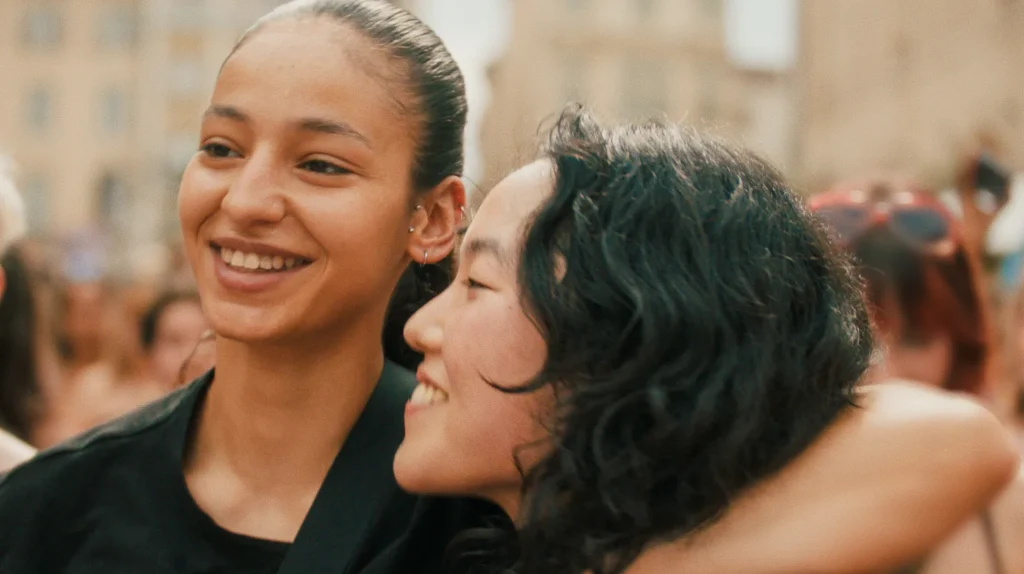
Although Fatima’s relationship to faith is clearly a very internal experience, we ultimately only see her religious devotion through scenes of prayer and the fact that she doesn’t drink alcohol, less so how it impacts her life as a whole. There are further some moments that feel out of touch with the tone of the film—leaning into stereotypes that could simply be removed but give the impression that they’re anecdotes pulled directly from the book. The Little Sister does struggle at times in the complexity of its story, but what it lacks in narrative development, it far makes up for in style, owing largely to the intimate camerawork of cinematographer Jérémie Attard. However, this is a Queer Palm winner rooted in the depiction of an experience that will resonate with so many, first and foremost. The feeling surrounding the depiction of Fatima’s experience is something that cannot be ignored about the film: gradually warm, but never overbearingly cheesy.
It’s only when Fatima meets French-Korean nurse Ji-Na (Park Ji-Min, who appeared in Anna Cazenave Cambet’s Love Me Tender, also at Cannes in 2025) at a workshop for asthma patients does she feel like she can let her guard down. After locking eyes with the 30-year-old (eyebrows might initially be raised at the age gap, until we again think about the book), Fatima later sees her on a dating app. The first time Fatima and Ji-Na sleep together, the sequence is almost completely wordless—not merely because Fatima is a young woman of few words, but Herzi uses the wordless gaze of her protagonist and the lens as a tool and is not afraid to linger with the camera. In Fatima’s silence, music speaks for her instead: the yearning phrases of arpeggiated cello rise as she discovers more, her hunger grows, and she becomes increasingly eager to explore.
In terms of filmic runtime, the relationship between the two seems to end as quickly as it starts—owing to Ji-Na’s severe depression—even though it is meant to take place over a few months, at the very least. At this point, Herzi turns to the aforementioned phase of Fatima’s queer platonic discovery, coinciding with her move from studying for the French baccalaureate into her first months at university in Paris. Here, she’s plunged into a completely novel environment where even the most stereotypically straight guys embrace their queer friend, cheering for him as he hooks up with another boy at a party.
Through her newfound group of friends, she meets the older Cassandra (Mouna Soualem), who is also French-Algerian, and her partner Jade (Jade Fehlmann): staring silently in awe, Fatima has never witnessed open sapphic love. Cassandra becomes the one to goad her into really opening up, after which we see Fatima descend into a more beautifully hedonistic period in her sapphic awakenings: exploring herself by partying, as well as hooking up, with the couple and their friends. Now, she’s encouraged to desire freely: in one scene among many in the montage-heavy second half, she gazes up in full lust at Jade as she gives her a lap dance. However, these encounters ultimately fulfill her sexual and platonic, but not romantic, desires. Her heart still lies with Ji-Na.
As the film proceeds and becomes more surprising, there’s a certain undeniable warmth embedded in the film, cultivated by the film’s two loose parts. Herzi reveals the complexity of queer awakening in a fashion that feels more like unfolding a very intricate piece of origami than turning on a light switch. The Queer Palm jury statement said: “We chose a film that seems to us to be more about Coming IN than Coming OUT.” Where the film leaves Fatima is where her life perhaps really begins, yet again. Coming out in conventional terms is only one part, if at all, of the bigger picture.
*****
Watch the trailer for the film here:


