After taking their daughter to a violin class, while sitting next to each other in the car, Marija opens up a hurtful conversation: she wants to divorce Vytas. She doesn’t love him anymore, but there could not be a worse moment to end a marriage—the day after her open confession, the war breaks out in Ukraine. Written and directed by Lithuanian writer-director Andrius Blaževičius, How to Divorce During the War (2026, Skyrybos karo metu) premiered at the 2026 Sundance Film Festival in the World Cinema Dramatic Competition, bringing a parallel and destructive experience of relationships and society. What unexpectedly emerges from this clash is a brutally honest mirror on both socially enforced gender roles and political activism, carried by the backdrop of war.
As the ongoing Russian invasion of Ukraine scares the country, Marija (Žygimantė Elena Jakštaitė) and Vytas (Marius Repšys) navigate their divorce. In Vilnius, where the story is set, everybody is panicking at the possible outcomes: “Will we be next?” echoes through the streets. A need for solidarity rightfully engulfs the whole nation in hopes of bringing shelter and assistance to the people of one of their fellow former Soviet countries. It is time to take a stance: either support the Ukrainian people or indulge in pro-Russian state propaganda.
As the title suggests, the story becomes a vehicle through which conflict creates dark comedy in everyday domestic situations, carried by the frustration and absurdity of heartbreak. The two represent an archetypically unbalanced straight relationship, where male incompetence and female resilience are at their worst. Marija, the former breadwinner of the couple, will stay in their custom-built house with their daughter Dovilė (Amelija Adomaitytė), while Vytas is destined to return, shamefully, to his disappointed parents’ home. As her ex-husband faces solitude, Marija is already enchanted by Jūratė (Indrė Patkauskaitė), her female colleague. With her, Marija tries to find the excitement she feels is missing with Vytas, whom she so desperately wishes would stand up and act like the “man of the house”.
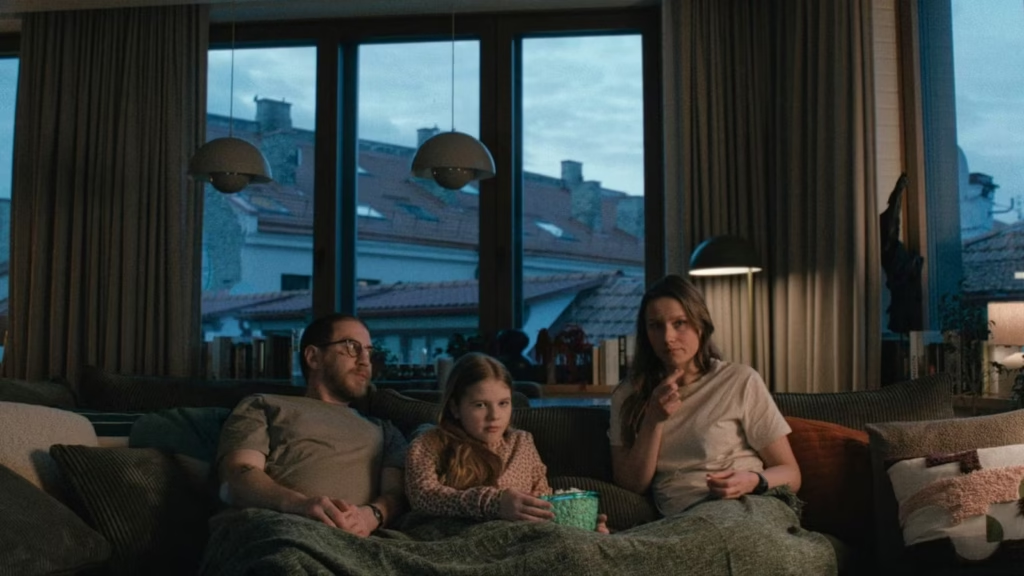
Vytas, meanwhile, lives out a midlife crisis where, feeling useless in his marriage, he finds solace in playing the saviour by showing up to pro-Ukraine demonstrations and playing the part of the politically active artist. Marija, unfulfilled and overworked, tries to regain her sparkle with a woman and abandons her high-paid job, failing to coming to terms with her own selfishness. Both scenarios are predictable and at the centre of many failed heterosexual relationships looking toward gender roles to guide the way. As he seeks to regain his status, she looks to subvert these sociocultural norms completely as an act that looks like rebellion. While both are fundamentally desirous of roles aligned with a gender binary, they never look inwards to interrogate where this impulse is really coming from.
The film’s characters fall between a fine line between poignancy and rawness, where the brain fog caused by their everyday mundanity begins to unravel the dynamics of the gender binary. This is also due to Blaževičius’ directing style, in which the camera carefully captures stillness naturally. This technique can interpreted as falling even within the spectrum of documentary, lending a dose of believability to the compelling portrayals by Repšys and Jakštaitė while creating a perfect blend of boredom and subtle aggression for the viewer.
The lives of both start to parallel each other in their loneliness and dissatisfaction with themselves, turning instead to performativity as they look for a specific role to play, whether it be an activist or just a truthful and loyal lover. Marija attempts to solve her issues by indulging in a sapphic relationship with an ambitious, caring colleague and taking in a Ukrainian family that she ultimately cannot stand. At the same time, Vytas finds himself devoted to a pretend form of altruism to make up for his lack of constant loneliness and inability to provide financial stability for his family.
Living in the comforting bubble of binarism at the core of society’s gendered relationships, their hearts bend to mirror their own environment: one struck by a war that has shaken up their lives and the world as they know it. None of the people involved in this story are capable of balance, but they represent a great display of the fall of stereotypical gendered parts. As a result, they face each other instead in a reflected situation of disillusion and disenchantment, staged and acted out because it feels like the right thing to do. With his characters balancing themselves on imbalance, Blaževičius’ third feature gives shape to a sharp dark comedy that thrives on the natural contradictions of society and its so-called rules.
*****
Watch the trailer for the film here: