

Unless one has grown up in a fishing town, it’s questionable what the average viewer knows about lobsters. Crusty and bug-like, this hardy creature has survived the most destructive of extinction events. Its firm exterior gives it protection—but when it’s moulting or its shell is removed, it becomes soft and vulnerable. Visual artist and documentary filmmaker Pete Muller uses this context to craft the humble crustacean into an unlikely symbol for the men of Bucks Harbor, the area of the tiny American fishing town of Machiasport, which is nestled near Canada’s New Brunswick. And with it, he encourages us to leave our preconceptions of this community at the door.
Muller takes us into the heart of Bucks Harbor with an eponymous new documentary—his feature-length debut—that brings out both the heartwarming and the unexpected through a portrait of masculinity, community, and overcoming the mentality of “survival of the fittest”. Bucks Harbor (2026) world-premiered at the 2026 Berlinale (12–22 February) and picked up the Prize of the Ecumenical Jury for the Panorama strand, an award presented to “directors who have succeeded in portraying actions or human experiences that are in keeping with the Gospels, or in sensitising viewers to spiritual, human or social values”. The film also landed in third place for the Panorama Audience Award, likely owing to its revealing but non-judgmental gaze on its male protagonists while still maintaining its humour. Muller uses a gentle hand to deconstruct our stereotypes around homogeneity of conservative, patriarchal, and heavily white and religious towns in the USA today, all while retaining a certain visual clarity through colour contrasts and cool-toned grading.
Wide-eyed, sporting a Superman t-shirt, and with plenty of missing teeth, the empathetically honest David Cale has all the air of a post-rehab man (spoiler: he is). But his deep East Coast drawl and infectious laugh has viewers trusting in him from his very first moments onscreen, where he shares his story and the challenges he’s overcome without self-aggrandisement or fanfare. “I’m probably more intelligent than people realize or whatnot”, he says to the camera with confidence, only to offset it with a comedically long pause afterward. This is clearly a man who has reflected long and hard about his many decades of life. Now, he just wants to live healthily, work a decent job, and mind his own damn business.
Mark Alley would’ve loved to have participated in the drama club when he was younger, but it simply wasn’t possible. Without ever really uttering the words out loud, he tells the camera that he would’ve been seen as effeminate and effectively crucified by both his family and those around him. But today, as a middle-aged man, Mark dresses in drag and streams on TikTok to an adoring audience, performing songs and also creating everyday video diaries of his life along the water. His wife doesn’t love what he does, he says, but that doesn’t matter. It’s important to him, and even more crucially, it’s his version of normal.
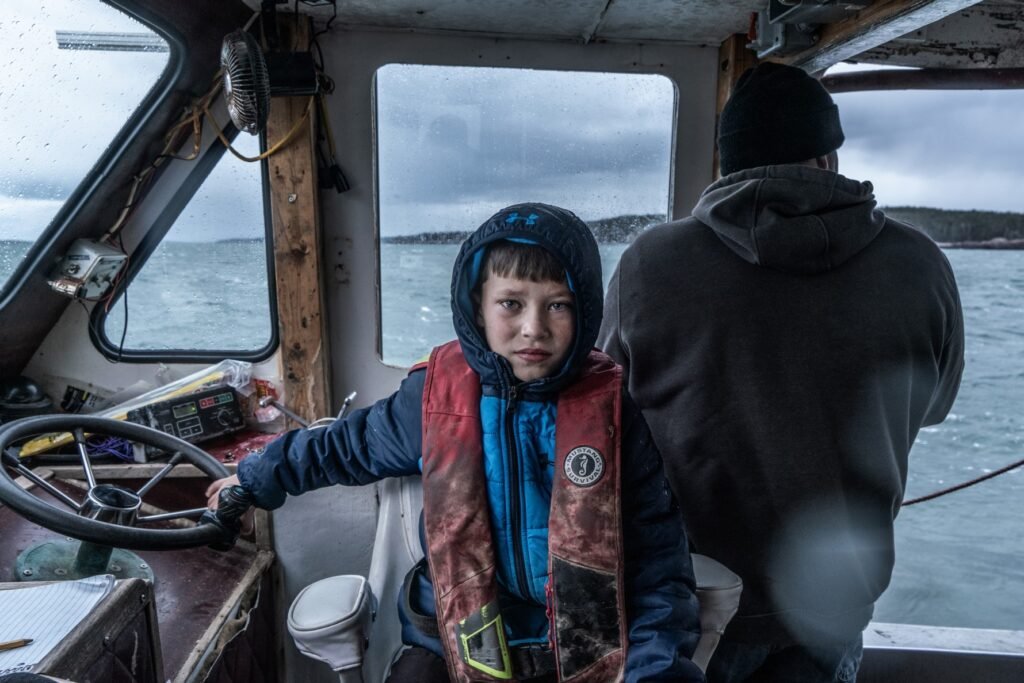
The director, who also serves as writer and one of the film’s cinematographers, weaves together these two primary stories with smaller portraits of Bucks Harbor boys, most of them teens and preteens. As they go out fishing and hunting, they reflect on what it means to be strong: overpowering others, such as ruining the traps of others to show them who’s boss at an activity in which success defines masculinity. During a church group conversation, a man says the hardest thing to do is to admit when he’s wrong and humble himself—it’s not really about physical might but instead vulnerability, hiding under that lobster shell. Several nod in agreement, but it must be said out loud to be acknowledged at all, because it stands in opposition to the implicit reality as shared by the boys.
David and Mark have arrived at where they are today by fighting their way out of the paths laid out for them, a simply truth that reminds viewers just how much communities and their social environments create their constituents. While David’s family quietly reflects him on not being able to send him to school, Mark’s mother recounts putting a baby Mark in a dress, to the absolute fury of his father. Fate is an intergenerational curse—but to be broken, someone must choose to break it and have the resources to do it. The stories of the two men are just two cases and two ways in which they were able to shape the lives—plotted out for them in their habitus—as their own.
Machiasport exists everywhere in the world: maybe it’s instead an industrial town or a farming village, an archetypical space formed by the passage of so-called traditional values through families and networks of people. There are no big revelations in Bucks Harbor; it’s likely viewers have seen everything at some other point, either in their own lives or onscreen. Yet, there’s an honesty to which Muller frames his protagonists onscreen: we witness them as they speak on their own terms, defined not by the space around them but by what they choose to share. There is no overexertion by the filmmaker to show the patriarchal pressures or machismo of their environment through grand cinematic gestures. These effects are felt instead through the words and bodily expressions of the protagonists, with their own syntax and diction and, most importantly, in their own spaces at seemingly mundane moments: eating dinner, taking care of pets, attending community events, driving a boat out on the water. Rather than focus on their journey and fixating on the difficulties they had to overcome, Muller shows their current states, which are naturally ever-evolving. The struggle to get where they are today is implicit: things aren’t always what they seem on the surface.
This is where Muller’s original metaphor enters the picture, where the film’s overall social realism is punctuated by sequences of lobsters in their ocean environment. The filmmaker builds his symbol cleverly in that the community literally captures the crustaceans, yet he also symbolises community members themselves as lobsters through dark, moody shots of the animals that could almost be describe as brooding. There’s a meta-turn here in which the community keeps future generations in check by enforcing preordained values: from one lobster to the next, the shell must remain on, never to have its soft core revealed. The lobster imagery sometimes heavy-handed nearer to the end of the film as the filmmakers seeks an essayistic close, but the device is one that lingers.
There is this idea that one must escape their original environment to undergo a transformation, and, for some, this is certainly salvation. For others, it might be too estranging, and they shouldn’t be villainised for this choice. Muller neither prescribes a roadmap nor gives us all the answers: the performance of struggle or hardship is not at the core of either David’s or Mark’s roles in this film. Instead, Bucks Harbor suggests that there is profundity, too, in staying put and working through change this way. A lobster in the ocean, too, will moult.
*****
Bucks Harbor screens in the Panorama Dokumente strand of the 2026 Berlinale (12–22 February).


