

Spoilers ahead for Rose.
*****
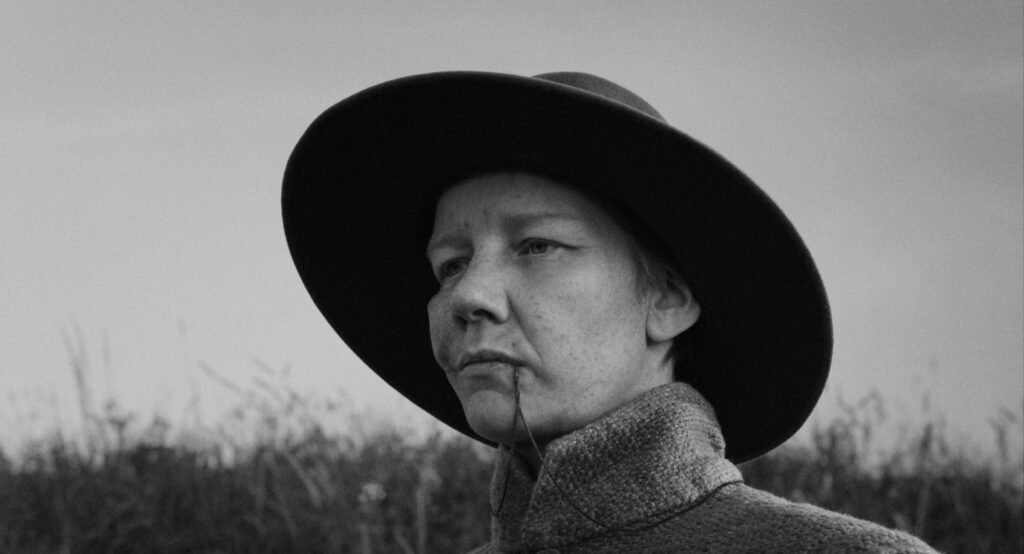
In the wake of the Thirty Years’ War (1618–1648), she committed a “wicked deed”, says the opening intertitle of Markus Schleinzer’s eponymous Rose, which premiered in the 2026 Berlinale competition. With narration befitting a fairytale and a whistling soundscape that seems to ooze from the land itself, the film touches on proof in a way that eagerly responds to the current moment, a world frequently described as post-truth. Rose (Sandra Hüller, in her Silver Bear-winning role), with a twisted smile due to a large scar along her mouth, says she served as a soldier in the Brabant, coming now to claim a ragged piece of farmland as her inheritance. The villagers acknowledge her title deed and take her as a gentleman. She is a man amongst them now.
Before I saw the film, friends struggled to describe the Austrian filmmaker’s protagonist to me. Does Rose identify as a man, or is she dressing as a man to get by? Or maybe we are mischaracterising her entirely? In the end, that hardly matters. Schleinzer refuses to put any singular word on what we witness of Rose, challenging our need as viewers for rationalisation. His narrator shifts between both he/him and she/her pronouns for Rose, and we never learn the name that Rose uses during her time in the village itself, leaving us with a few jigsaw puzzle pieces remaining. In doing so, Schleinzer challenges our contemporary proof-seeking tendencies as they are tied to the body, suggesting that we should look elsewhere to satisfy our desire for the empirical and our self-deception that there is one absolute truth.
Schleinzer’s directorial vision, in addition to his story, offers up a cinematic language that removes the emphasis on the corporeal. He calls into question the very nature of the body as a site for proof and regulation which is, today, frequently weaponised in favour of exclusionary practices. In the film’s arguably most climactic scene, Rose is confronted by a horde of angry villagers who demand that she pull down her pants to prove she is a man, calling her a fraud. Fighting back, she yells for the men to do the same, only for one of them to do so. Caught in place, she first denounces the group for having no respect. Then, she begins a more severe line of questioning in a grand monologue, asking whether the jobs, wealth, and opportunity she has brought to the village are also fraudulent and untrue. The logical problem stands: she wouldn’t have been able to do all of this so successfully if she weren’t a man.
This moment, of course, has eerie parallels to individuals standing up against politicians today, particularly in the US, asking them how they might “prove” the biological sex of someone in a setting such as a bathroom. Rose inverts speaking truth to power by offering a different truth that the community cannot deny, which completely upends the oppressive system’s worldview. Her truth is not biologically defined and instead abides by a social contract that is far more weighty. Knowing they cannot deny this, as Rose’s manhood has enriched their livelihoods, the villagers continue in pursuit of their original endeavour, and she flees with her wife, Suzanna (Caro Braun).
Schleinzer keeps instances of violence offscreen and away from the viewer entirely, as if in defiance of cinematic expectation to witness—and, as such, refusing the viewer to ever be allied with the system. We are never witness to the assaults that occur through the film, nor are we privy to a flashback that recounts how Rose suffered from the bullet that tore through her cheek. She now wears this around her neck and gnaws on it, as if unconsciously fighting back against the object that violated her body. The moment when she is first undressed by Suzanna and their servants—to aid in healing a bee attack—is also shielded from view, a moment with violent reverberations for her identity in the community, even if the intention is not violent. Finally, we never see the fates of either Rose or Suzanna; we are only told, knowing that it took two swings of the sword to kill Rose. Schleinzer, however, plays out the rehearsal of how she would be killed, a way to witness truth without witnessing the violence itself, as requested by Rose herself.
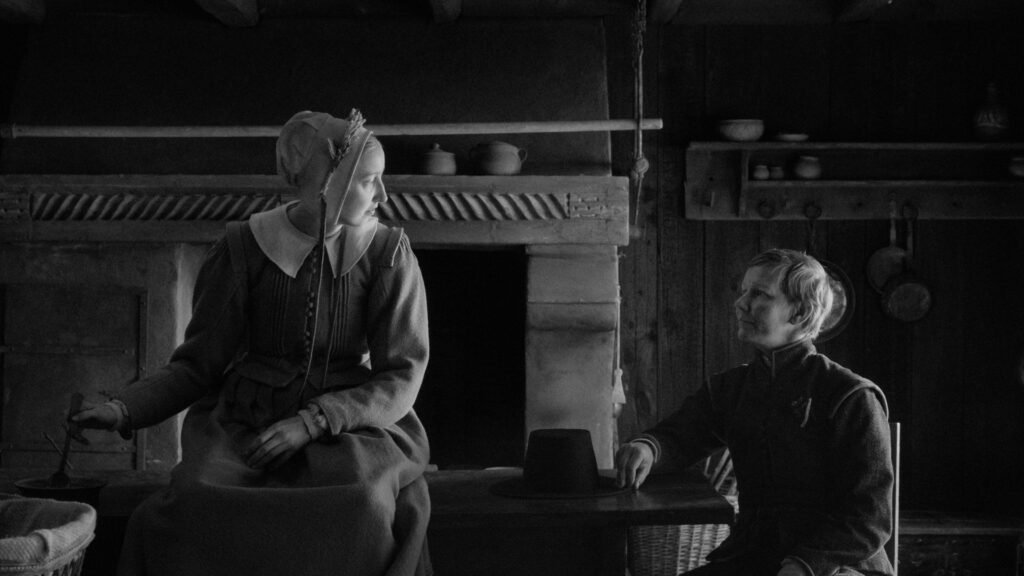
Rose, in the end, says the community made her a man rather than any sort of personal belief. At some point, she had the ability to assume that role and, by doing so, claimed agency and power she would never otherwise be granted. The environment can be seen as the enabling factor of Rose’s transformation, rather than Rose’s desire to be perceived as a man. By dispelling attention away from her body entirely, she once again is able to fight against the patriarchal biopolitical scheme in which the women around her are trapped: be married and procreate, be put to work, or both. Find truth elsewhere than the body, Schleinzer seems to say.
This further ties to how the filmmaker chooses to present Rose: without any over-the-top masculinisation. We witness Rose as a man because she is in this particular societal position, and the community (initially) accepts her as one. We are not privy to any intimate moments that might challenge the prevailing view that Rose is a man, other than the fact that the role is played by Hüller. Schleinzer is not intent on preserving some sort of inalienable truth or fooling the viewer into buying into a façade. It just is, and Rose just is. Likewise, we also do not know who the biological father of Suzanna and Rose’s child is, even if the rest of the work commits to a standard of realism asked for by a contemporary viewer when it comes to depicting the 1600s. This question is never answered, and one could even interpret it as a sort of supernatural occurrence. The filmmaker thus also challenges this idea that cinema must adhere to a certain standard of reality-making, with film as a body in and of itself. Why must the image, too, show itself for all to see because the viewer demands it?
*****
Read our interview with Markus Schleinzer here.


