

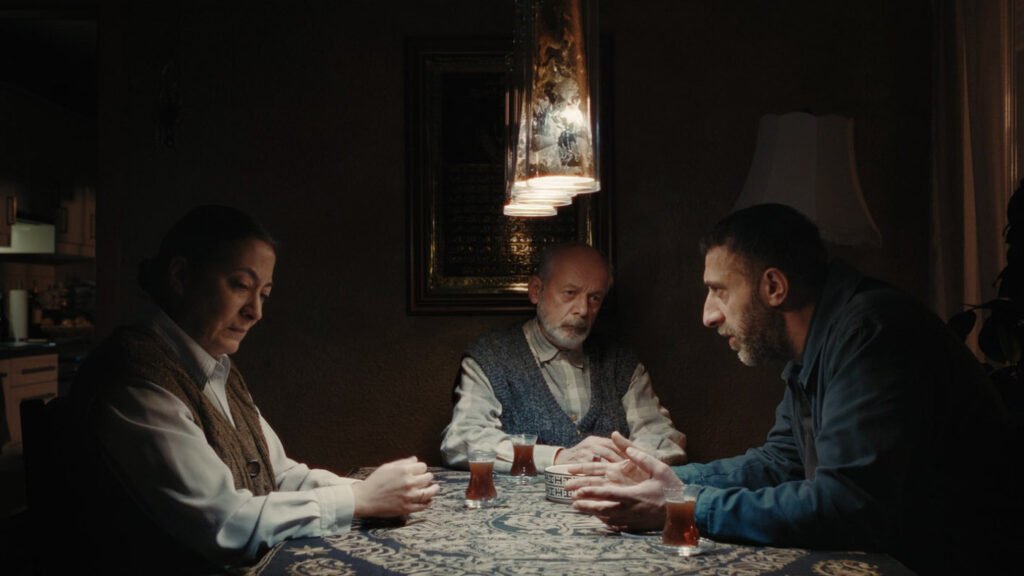
Hijamat features the Turkish-German Murad (Kida Khodr Ramadan), who is driven into a moral dilemma when his beloved younger brother Kerem (Jael Cem Ilhan) is outed as gay and dating a white German man. Their family and religious Muslim community in Berlin immediately crack down on Kerem, prompting him to spiral and attempt to reject his identity—all while Murad himself is prompted to question his own identity, religious perspectives, and perception of self.
The title refers to the practice of cupping—common across a number of traditional medicines worldwide—in an act to draw out and purify the body of toxins. Hijamat had its world premiere in the Crystal Globe competition at the 60th Karlovy Vary International Film Festival this year. Having collaborated with Saeivar on the screenplay of his own film 3 Faces, Palme d’Or winner Jafar Panahi notably serves as editor and producer.
At the festival, we sat down with Saeivar to discuss making his first film in Europe and queerness as an entry point into the worldview of a specific community.
*****
Purple Hour: The film is set in a very multicultural setting, Berlin, but the story features the pairing of a German couple of Turkish and Kosovar backgrounds. Why was this choice important for you?
Nader Saeivar: Berlin is a very cosmopolitan and multicultural city. I can say that Berlin is not even a German city. It’s an international city. It’s so normal to see various [backgrounds] even in one family. When I came to Berlin and met some people, I went to their homes, and they introduced themselves. They said, for example, “I’m from Germany, and my husband is from there, but his aunt and uncle are from other places.” That’s why we wanted to show multiculturalism in the film.
You also have collaborators of different ethnic and cultural backgrounds all working on this film. Do you see the film from a regional or national perspective, for instance?
I can’t tell you exactly what nationality it is. The film doesn’t belong to a certain nationality because today, you don’t work in this way. That is, unless a director themselves insists on showing a story from a certain play. For instance, a Japanese director could make a samurai film. Now, when I’m making films in Europe, I have to think that I’m making a film that belongs to world cinema, not to that city or a certain place. In fact, putting together all these cultures gives you a lot of opportunities to shoot really dramatic scenes. Finally, we have a way to understand each other.
Lately, I’ve been noticing more films that focus on the experiences of a queer character’s family or loved ones. What are your thoughts about this perspective on a queer story?
I used the issue of a queer person as a doorway to enter this community. If you come across a huge concrete shelter, and you want to enter, you have to make a hole—you have to explode a wall somehow. Here, being queer played the role of that bomb or explosive to make a way to enter that community.
Could you see another type of element also acting as this element to create an entryway?
My opinion is that the biggest element that can create a way into that community—playing the role of that explosive—is being queer or having queer characters in the story. Once upon a time, you could say that Galileo’s or Darwin’s theories would give a shock to religion. In today’s time, we can say that maybe discussions about being queer or part of the LGBTQ community gives that main shock to religion, especially to Islam.
Why were you interested in making this film now? What are your inspirations?
I have grown up in a country under 50 years of religious dictatorship. I never had the opportunity to ask my own personal questions about religion. After immigrating, finally, I had this opportunity to ask about everything. As such, I decided to tackle the issue of religion and questions about God. If we look from this point of view, I can say that this might be my first film. The first three films that I made are really about Iran. This film is about Nader.
Were there any memorable moments on set or shooting process that you weren’t expecting to happen, but ended up in the film as a pleasant surprise?
In Germany, there is nothing unexpected. At least for three months, we were just having meetings every day—even to drink water, there must be a meeting. I think I got old through all of these meetings! In Iran, when we decide to make a film, next week, we are already on set. In Germany, even for very small and minor things, we have to have meetings every day. To have an unexpected thing when shooting is like witnessing an atomic bomb go off.
In Iran, we are used to coming face-to-face with the unexpected. We expect the unexpected at every moment. Suddenly, if something doesn’t go right, we go on to the next step, and that’s quite normal. We grow with it. In Germany, the second way is to just shut it all down.
*****
Watch the trailer for the film here:


