

Myanmar-born director Aung Phyoe cut his teeth with two short films that screened at Locarno Film Festival, Seasonal Rain (2018) and Cobalt Blue (2019)—and most recently, Evening Clouds (2022), which acts as a sort of thematic and narrative basis for his debut feature, Fruit Gathering.
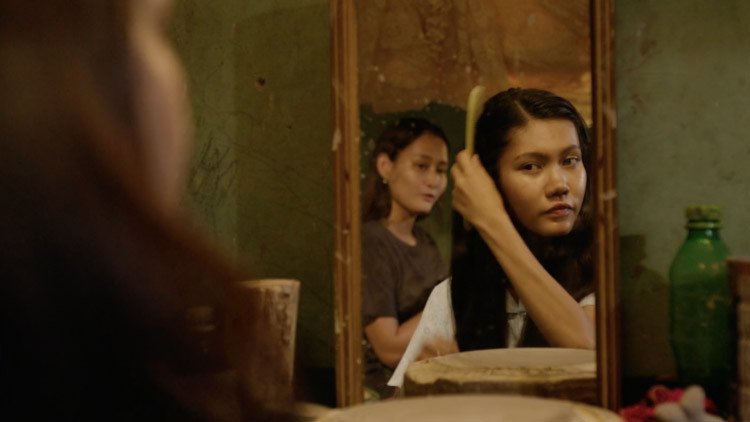
The Yangon-set film follows a young textile factory worker, San Kyi (Nandar Myat Aung), who develops a close and complex relationship with a fellow worker, Theint Theint Oo (Nandar Myint Lwin). In the filmmaker’s gentle exploration of the reality of working-class women in contemporary urban Myanmar, San Kyi navigates worsening economic and labour conditions alongside a deepening emotional pull toward her friend.
At the 60th Karlovy Vary International Film Festival, where the film just premiered in the main Crystal Globe competition, we had the chance to speak with the director about portraying a variety of realities in Myanmar: intimacy between women, social stratification even amongst those of the same background, and the perhaps transcendental nature of a fleeting encounter.
*****
Purple Hour: Your 2022 short film, Evening Clouds, relies on a similar premise between best friends with the same lead actor. What did you want to aspire to bring in from your short film(s), and what did you hope to build upon?
Aung Phyoe: Yes, we did that short film for many practical reasons, but personally, it was challenging. My producers wanted to see whether the lead actress could bring the style of acting we needed, and I also needed to have three short films to apply for funding for this feature project, which I didn’t have at that time. So for me, I had to make a convincingly similar emotional journey for the short film, while not exploring the whole emotional landscape of the feature script. But personally, I don’t feel I succeeded with it as a short film, but somehow our intention was served.
You play with this idea of an ambiguous relationship, also with the understanding that intimacy between women is accepted as a part of friendship, especially in Myanmar and parts of Asia more broadly. However, there is—eventually—a more direct physical encounter between San Kyi and Theint Theint Oo onscreen. Did you always envision their relationship evolving in this way?
When I started working on the script, it was just friendship and confusion hanging over it, and the story was just fine, but there was no substance to make it memorable. Although the longing and unfulfilled desire were always there, that one consensual physical encounter they experienced maybe seems like a blessing, or a gift. As I was developing the script, I felt she deserved that moment.
Can you elaborate on your depiction of intimacy and your approach to shaping the nature of this encounter in the setting of Myanmar?
Intimacy is something that, for our culture, is considered dirty and sexual. We have a kind of culture where sex and intimacy are not even properly understood by most people. To be able to go into this human intimacy, beyond sexualising images that we are very familiar with
For me, intimacy is a blessing—it’s not that arousing feeling. It’s not just sexual desire. To go beyond that when you really portray a particular sexual encounter—I think that’s what we’re trying to do in the film, because there is only one encounter in the film, for the main protagonist. For her, it’s some kind of memory she will cherish forever, maybe. That’s how I tried to portray intimacy in the sense of reality, a real situation—something which is transcendental for her.
Do you see Fruit Gathering as fitting in a landscape of queer cinema or queer desire? If so, in what ways?
I think so. Generally, it’s human desire. I believe there is something special about queer desires; whether tenderness or brutality, there is always something extra in same-sex relationships. While I wish I could fully express social description and individuality, I would also like to be able to express the inner psychological conflict of individuals who have to grow up with the notion that they are different.
The socioeconomic imbalance between the two women becomes a point of contention: knowing how to work within the heteropatriarchal environment, for instance. What was most important to you when it came to creating the film’s underlying context, especially for an international audience?
Yes, for me that point is very important. In Myanmar society, even if we share the same social background, there is always an underlying imbalanced privilege based on gender, religion, and race. Although I didn’t explore those topics in this film, that imbalanced dynamic between the couple is something I personally wanted to express. For an international audience, I would like to convey the complexity and experience of being and living in contemporary Myanmar, rather than just the message that we are suffering.
You’ve spoken in brief about the film’s title, Fruit Gathering. Could you elaborate on how you see it from a non-literal or poetic lens?
The title comes from a collection of poems by Rabindranath Tagore that I have in a Burmese translation. For local context, in the upcountry region of Myanmar, it also evokes a specific tradition. Following the Thingyan water festival in mid-April, and just before the heavy mid-May rains begin, groups of women venture out to the large trees near their villages to gather fruit. Mango trees, in particular—often planted in groves—are prone to damage from storms, so their fruit is harvested early and left to ripen. Therefore, I feel the title resonates with that particular time, reflecting the homesickness of a young woman working in a garment factory who longs to return to her upcountry home and bring her friend along.
San Kyi’s gaze feels particularly strong from the beginning; we watch her watching her friend and others. What did the conversations with your actors look like when it came to certain gestures, movements, or looks?
I think it’s very difficult for all of us—me as the director and the actors who are making their first feature film. As you can imagine, we shot randomly out of sequence, so deciding how much to express and how close to be to each other for a particular moment was very difficult to control. Therefore, we did a lot of rehearsals. I asked my actors to memorise their lines by heart without thinking about any logic, so that we could focus on pauses and movement. Since we couldn’t confirm the locations ahead of the shoot, on the set we worked mainly on blocking and their rhythm. Because I was trained as an editor, that experience somehow helped me to control the movement and rhythm.
What did the development and production of this film look like as an international co-production? With many lush locations, were you able to shoot in all of the places you wished to do so?
It took many years, not just to improve the script, but also to polish it to make sure the international funds could fully understand the subtext and atmosphere. There were also many practical problems with money transfers, a difficult local banking system, and the requirement to follow the strict rules of the funds.
Locations were very important because we couldn’t afford to recreate them in a studio. The situation in Yangon was so uncertain that a location we chose today might not exist a few days later. Once, we secured a location ahead of time for an evening shoot while we were shooting somewhere else in the morning. When the line producer went there in the afternoon, that location was gone. So we had to decide on a new, similar location immediately, and I had to walk onto it for the first time just a few minutes before we shot. It was very challenging for us in terms of blocking and shot breakdowns. I had to make my shot notes without knowing the exact location and adjust them according to whatever space we could secure. But I feel it was worth it. We got locations that had real texture and lived experience.
*****
Watch the trailer for the film here:


