

When Feng Xia (Joan Chen), a Chinese-Canadian middle-aged mother of two, meets Camille (Charlotte Aubin), a 30-year-old sapphic Québécoise, she unlocks feelings that she has suppressed, personally and socially, for decades. This seemingly unlikely pairing forms the basis of Xiaodan He’s romantic drama, a Quebec-set mid-life coming-of-age of sorts that sees Feng Xia begin to liberate herself from the obligations that have confined her as an immigrant woman with a traditional husband.
Featuring the iconic Joan Chen, the film has already had a landmark run on the festival circuit around the world, particularly at queer film festivals. Before Frameline50, where the film screens next, we spoke with the writer-director to discuss combining her experiences as an immigrant with a desire to create a commentary on Chinese conservatism toward queer life, letting nothing stay hidden onscreen, and the body as a site of both emotional and sexual liberation.
*****
Purple Hour: We’re seeing more films that have a coming-of-age element to them for different demographics, such as queer and sapphic stories of middle-aged women. Did you draw from any stories or experiences to create Feng Xia’s backstory and narrative?
Xiaodan He: I had an interest in making a queer love story, especially a Chinese lesbian love story, because I know homosexuality is such a taboo topic in Chinese culture—actually, in the whole of Asian culture. I paid attention to this phenomenon since I was in university in Beijing when I studied cinema there. With my age and immigrant experience in Montreal, seeing the queer community of other nationalities in Canada, how they live and how they express themselves—I think this helped shape my vision toward this topic. It took time to really understand what I wanted to do. After 20 years in Montreal, this helped me find the story, because I had an interest in a Chinese lesbian story, but I didn’t know what age, in the beginning. On the big screen, I noticed that in Asian queer movies—especially in Chinese movies, there are almost none of them that look at this age group. I said, we should tell the story from an original angle.
I’m a filmmaker who always likes to pass on some message in my movies, some social meaning and social engagement. The artistic vision always comes first, but after this, I’d like to have some meaningful inspiration for the audience. For me, a middle-aged repressed Chinese lesbian’s story is much more interesting and complex than that of a younger woman, either in China or Canada. A middle-aged woman has so much more baggage on her shoulders, either as life experience or cultural pressure. When we shot this movie, it was 2024, and I did some research. It seemed to be the first time ever that a middle-aged Chinese lesbian is a protagonist on the big screen.
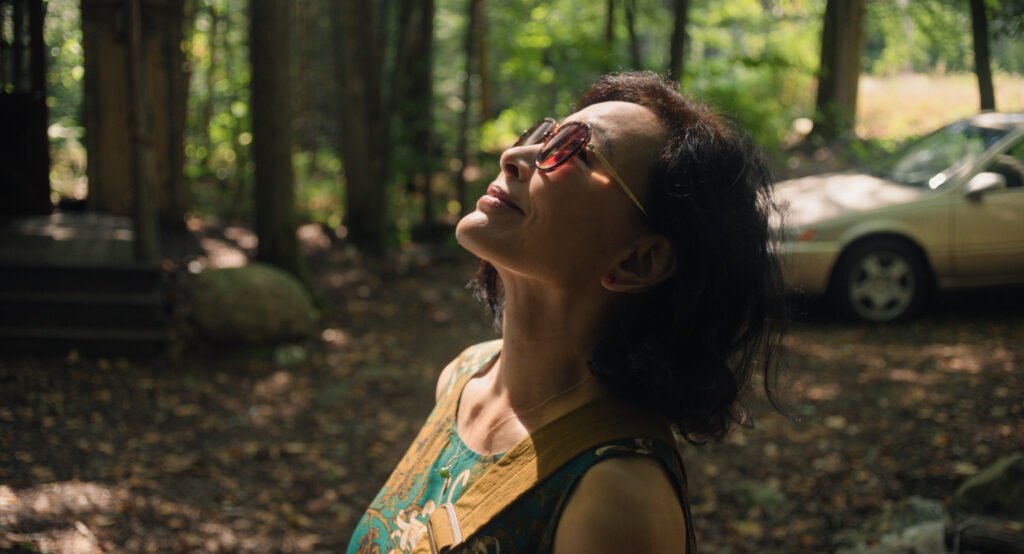
In the park scene, Camille says to Feng Xia that she is the nicest person she’s ever met, which speaks to why Camille is attracted to her—in the purest way. At the same time, it perhaps also speaks to how people have treated Camille and her identity as a young sapphic woman.
Together, the two help each other pass through a very tough moment in their life. These women are of two different ages. They’re so different also in their cultural backgrounds and personalities. You wouldn’t imagine they’d click, but as you said, the kindness of Feng Xia is the first thing to really touch Camille. Camille pretends she is cool: she’s strong, she’s confident, but deep inside, she’s not really. I think Feng Xia’s kindness is such an important key to opening the door to Camille, who lacks love and security because of the lies in her parents’ marriage [as we see in the film]. Feng Xia, who’s this traditional and more conservative Chinese woman—a bit shy, but very honest and authentic—makes Camille relax and take off her mask.
I think it’s important to show their women’s friendship, because usually we want to share our secrets with our girlfriends rather than our partners or families. The scene in the park is actually one of my favourite scenes. There, they open up to each other sincerely. Feng Xia also has something to tell—the dark story about her husband who forced her to have a son, which can happen very often to a Chinese woman, even today. Their friendship to me is very important to this story, and the love story is based on that.
You are very open to portraying both the emotional side to their relationship as well as the sexual one onscreen. You’re not afraid of putting these very sensual moments front and centre.
This was absolutely my purpose—I think this movie is the two sides together. For Feng Xia and liberation at her age after a long period of repression, you can understand the many levels of it: sexual repression, obligations as a mom and traditional wife, and so on. I would like to show her liberation from both sides as deep as possible. I wanted to give her this chance, this liberty to live as one time herself—let her feel her body. The body can speak to so many things: power, identity, courage. Her body’s liberation goes together with her spiritual freedom. They advance each other and influence each other. I didn’t want to hide anything—there’s nothing to hide. In body language, you can see her sexual intimacy with Camille—it’s beautiful and sensual, but there’s also sadness. I read a comment from a user on Letterboxd that said she never imagined she would cry so much during a sex scene. I completely understand why she cried like that.
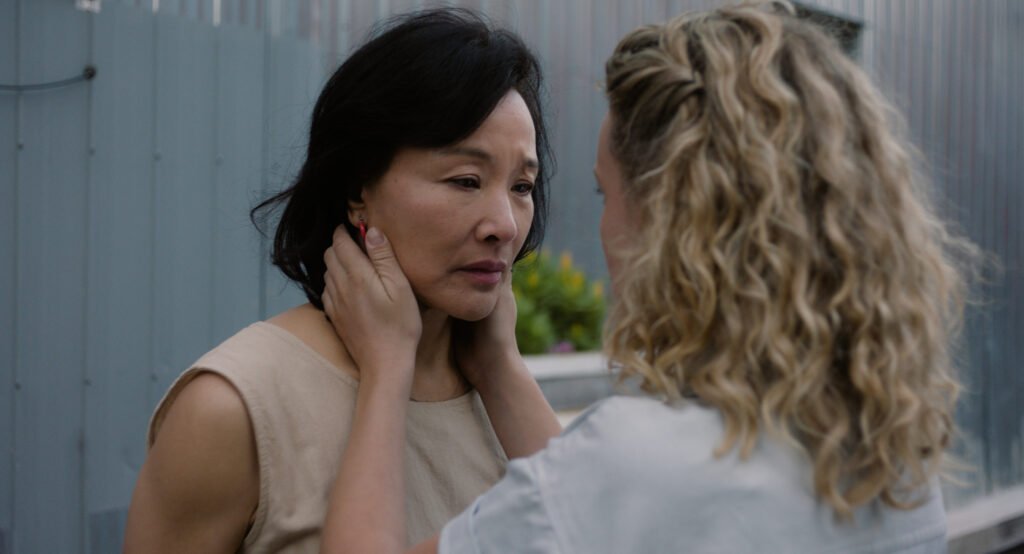
Feng Xia’s personal coming-out story runs parallel with a sort of cultural coming-out story: that is, feeling more confident speaking French, feeling more open in moving around outside the bubble of her family home. Camille also plays a huge role in this. Can you talk about creating these two stories together?
We see the dilemma of her choices, her husband, and her immigrant life. That dilemma is everywhere in her life as a repressed queer woman. I didn’t want to make this ideal image of anyone. Feng Xia seems very shy, but deep inside, I think she’s a brave person, but she enver had a chance to bring this out because of many reasons we discussed. This is important. When Camille arrives, she brings Feng Xia out of her shell. I like this contrast also because Feng Xia cannot be very brave immediately. That wouldn’t be beautiful or authentic to me. When we approach freedom, no matter what kind of freedom, we always hesitate first. In the final moments of the film, when Feng Xia tells her husband to stop the car, we don’t know whether Feng Xia has really taken her destiny in her own hands, because her face is not that sure. The nuance in that moment of uncertainty is interesting to me. But at the same time, we feel some hope.
*****
Montreal, My Beautiful is playing at Frameline: The San Francisco International LGBTQ+ Film Festival (17–27 June 2026). Tickets are available on the festival website.
Watch the trailer for the film here:


