

Premiering out of competition at the 2025 edition of Venice Film Festival, Paolo Strippoli‘s The Holy Boy (2026, La valle dei sorrisi) is one of the most intriguing titles in this year’s Karlovy Vary International Film Festival, where genre cinema continues to find a place alongside auteur-driven filmmaking. In his third feature, the Italian filmmaker—now with an upcoming film in the 2026 Venice Competition—creates a work that comfortably inhabits the space between folk horror, psychological drama, and coming-of-age story.
The film follows Sergio (Michele Riondino), a PE teacher escaping an unnamed personal tragedy, who accepts a temporary position in the secluded mountain village of Remis, known as the “Valley of Smiles” (also the film’s original title). In Remis, nobody is sad, and the people are heartwarming and joyful as if characters from a folkloric fairytale. Behind the town’s idyllic calm lies an extraordinary ritual: every week, the villagers embrace fifteen-year-old Matteo (Giulio Feltri), whose mysterious ability allows him to absorb their emotional pain. The practice appears miraculous, but Sergio is the first to question the moral economy sustaining the ritual, wondering what becomes of the pain that has supposedly vanished.
Rather than treating this premise as the foundation for conventional supernatural horror, Strippoli uses it to examine the consequences of emotional repression. As Matteo’s queerness is silently and slowly introduced, its apparently monstrous nature blatantly comes to the surface. The residents of Remis engage in collective denial by outsourcing grief, guilt, and trauma onto the body of a single adolescent. Matteo is transformed into a sacred object whose value depends entirely on his usefulness to others. The community protects him, reveres him, and exploits him simultaneously, never allowing him to exist simply as a teenager.
The film’s horror emerges less from supernatural forces than from the mechanisms of social control operating from within the village’s carefully maintained harmony. Strippoli favours restraint over spectacle, creating an atmosphere of quiet unease through measured pacing, austere compositions, and desaturated imagery. The picturesque mountain setting gradually becomes claustrophobic, its apparent tranquillity masking an increasingly oppressive emotional landscape.
It is within this affective architecture that the film’s queer dimension quietly unfolds. Although The Holy Boy never foregrounds Matteo’s sexuality, his identity becomes inseparable from the film’s exploration of repression. Matteo is a gay teenager whose desires remain largely unspoken, existing beneath the surface of daily life much like the supernatural force that shapes the village itself. His queerness is never sensationalised or instrumentalised as a source of horror. Instead, it simply exists as another aspect of the self that the community does not acknowledge.
As tragedy and collective fears unfold, the monstrous is not attached to queer identity itself but generated through the structures that deny its expression. Matteo is celebrated as a saint, yet is denied personhood. The village defines Matteo entirely through his function, leaving little space for him to exist as an ordinary adolescent. The expectations imposed upon him—spiritual, familial, and communal—leave no room for desire, intimacy, or self-discovery. His emotional isolation becomes inseparable from the supernatural burden he carries, until both threaten to erupt simultaneously.
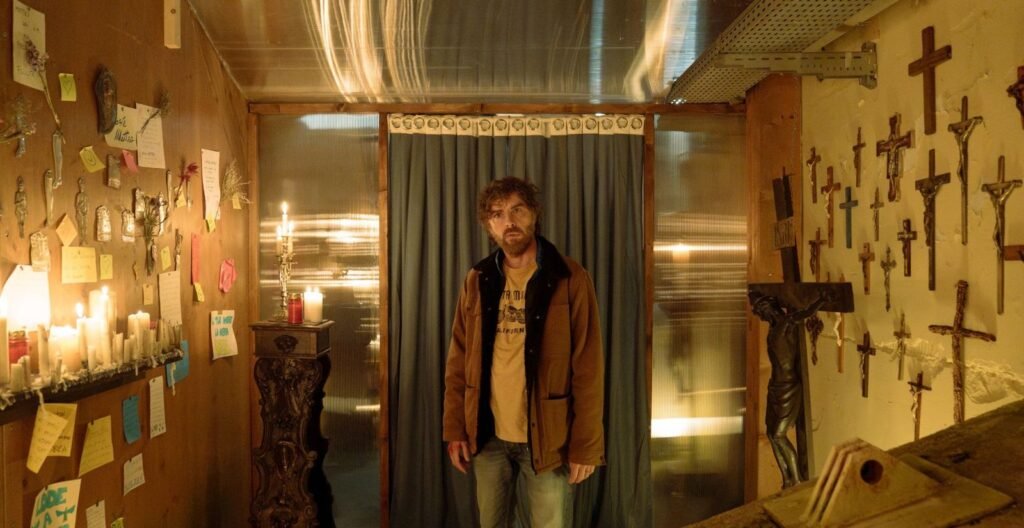
Strippoli thus subtly reworks the oldest of traditions in folk horror: the violence accumulating beneath the narrative stems from the refusal to confront grief and accept difference. Matteo absorbs not only the pain of the villagers but also the weight of their projections, fears, and impossible expectations. What eventually emerges is not the horror of otherness but the horror produced when individuality is systematically erased. Rather than presenting queerness as monstrous, he reveals monstrosity as the product of repression.
The film’s most unsettling gesture is not the supernatural ritual itself but the ways in which it creates a hierarchy of visibility. Matteo is hypervisible as a sacred object and simultaneously invisible as a desiring subject. In this sense, the queer dimension never requires declaration: it structures the film’s economy of looking. Monstrosity remains latent not because queerness is concealed, but because the social order depends upon keeping it unspeakable.
Feltri delivers an extraordinary debut performance, balancing adolescent fragility with an increasingly unsettling interior strength. His Matteo never becomes a passive victim despite the immense pressures surrounding him. Riondino provides an equally compelling counterpart as Sergio, whose own unresolved grief gradually allows him to recognise Matteo not as a miracle or symbol but as a lonely young person. Their relationship quietly becomes the emotional centre of the film, offering the only genuine human connection within a community built upon emotional transaction.
While probably hinting at recent events in Italy, the film carries a genuine and original foundation. If the screenplay occasionally leaves aspects of its mythology deliberately opaque, this ambiguity ultimately strengthens the film’s thematic resonance. Strippoli is less interested in explaining supernatural mechanisms than in examining the human need to displace suffering onto others. The result is a work in which genre elements function less as narrative ends than as expressive tools for exploring loneliness, inherited trauma, and the fragile process of becoming oneself.
The Holy Boy ultimately refuses simple allegory. Its queer dimension remains deliberately understated, yet it profoundly shapes the film’s emotional logic. The monster never speaks its name because it is never truly visible. It bubbles beneath the surface, thriving off of the structures of silence, repression, and emotional exploitation that govern Strippoli’s eerie, emotionally enduring village.
*****
Watch the trailer for the film here:


