

There was not a dry in the house at San Sebastián’s Victoria Eugenia Theatre after the screening of Leah Nelson’s Tangles. What followed was no less than a several-minute-long standing ovation for the film. This was deservedly so, as Nelson has evidently created one of the strongest queer animated features of recent years. Endlessly moving, filled with sharp queer humour, and utilising an animation style tuned to the story, Tangles premiered at Cannes in the Special Screenings section and went on to grab the Sebastiane Award, the prize at the San Sebastián International Film Festival—where it screened in the Perlak section—for the best film with LGBTQIA+ themes.
Nelson, a Canadian artist and filmmaker, makes her feature debut with Tangles after co-founding the Vancouver-based animation studio Giant Ant, which creates animated work across many mediums, including television shows and spots, commercials, brand videos, and more. Tangles is a fascinating example of transforming creative expertise from short- to long-form work while leveraging the narrative and formal knowledge from other artistic spaces like graphic novels and films. (The film was co-produced by Point Grey Pictures, the production outfit founded by Seth Rogen and Evan Goldberg, as well as Lylas Pictures, co-founded by Lauren Miller Rogen.)
Tangles is based on Canadian author, illustrator, and professor Sarah Leavitt’s 2010 graphic memoir, Tangles: A Story About Alzheimer’s, My Mother and Me. The film tells of Sarah’s (voiced by Abbi Jacobson) experience balancing her own life across the country with her mother Midge’s (Julia Louis-Dreyfus) rapidly progressing Alzheimer’s, before she decides to move home to be with and care for her mother in her final months. The screenplay was co-written by Leavitt, Nelson, and Trev Renney.
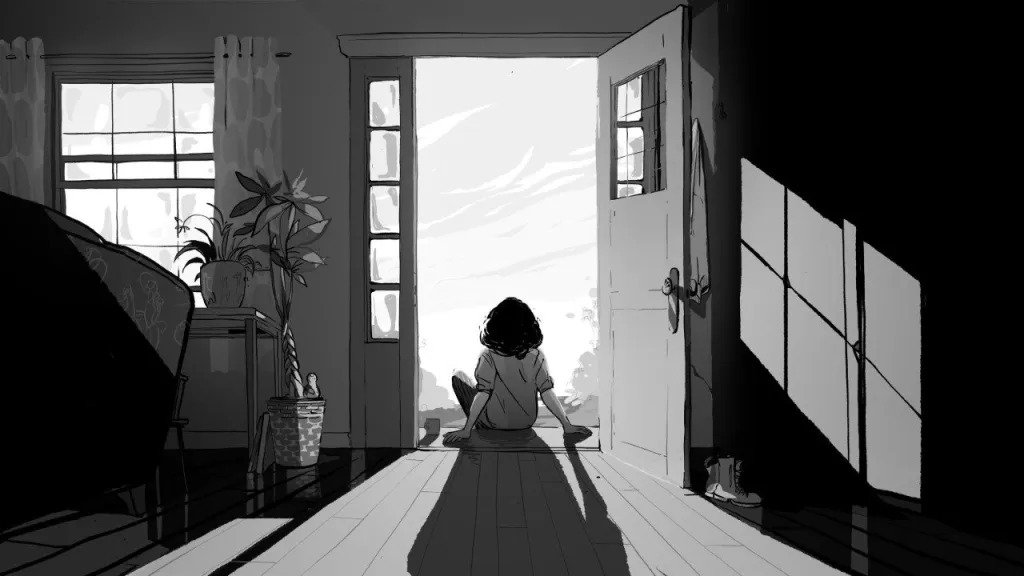
Thematically, Tangles is reminiscent Alison Bechdel’s own 2006 graphic memoir, Fun Home (subtitled A Family Tragicomic, a descriptor also relatively suitable for Tangles, albeit in a different way)—queerness, complex relationship with a parent, strong influence of a romantic partner in one’s life. (Along the way, we meet the Black masc biker Donimo (Samira Wiley), to whom Sarah is immediately attracted and with whom she begins dating very early on in the film; she is also to whom the film is dedicated, having passed after over two decades together.) Yet, it’s naturally very different, and its story seems to have a stronger focus on the distinction between comedic moments and the guilt and sadness that accompany Sarah rather than the dark-humoured tone of Fun Home.
The film’s already-moving opening is a well-wrought scene-setter for the dynamic between mother and daughter. Young Sarah, scared of monsters under her bed, calls on her mother to fight them off. Instead of dismissing her daughter’s irrational fears, she takes the flashlight and uses it as an imaginary weapon, bravely dispatching the monsters all around, to both of their delight. Midge is shown to be a defender of queer rights from Sarah’s young age, influencing her daughter’s views of her as a superhero. While these scenes are few, they quickly deepen our empathy for Sarah’s heartbreak at seeing her sharp and headstrong mother in cognitive decline.
We cut to Sarah’s life as an adult: she has a good job as an illustrator for Outspoken Magazine, a (fictional) queer magazine in 1990s San Francisco—a queer haven of sorts. If the opening sets the tone for reminiscence, the first scene of her job sets the tone for the film’s quick-witted humour. Her boss Paula (Wanda Sykes) sends her to make the dirtiest scene of gay sex as possible, to the amusement of her sarcastic coworker Dale (Bowen Yang). Unlike films like Lesbian Space Princess [read our review here] and Jim Queen, which go for broke without care for sensitivities or campiness, the comedy in Tangles relies neither on hyperbole nor extreme trope-ification of queer stereotypes for a forced laugh. With plenty of sapphic jokes and an extremely effective repetitive gag of a flight attendant’s announcement narrativising Sarah’s inner thoughts, Tangles manages to strike a balance between sentimentality and rough honesty.
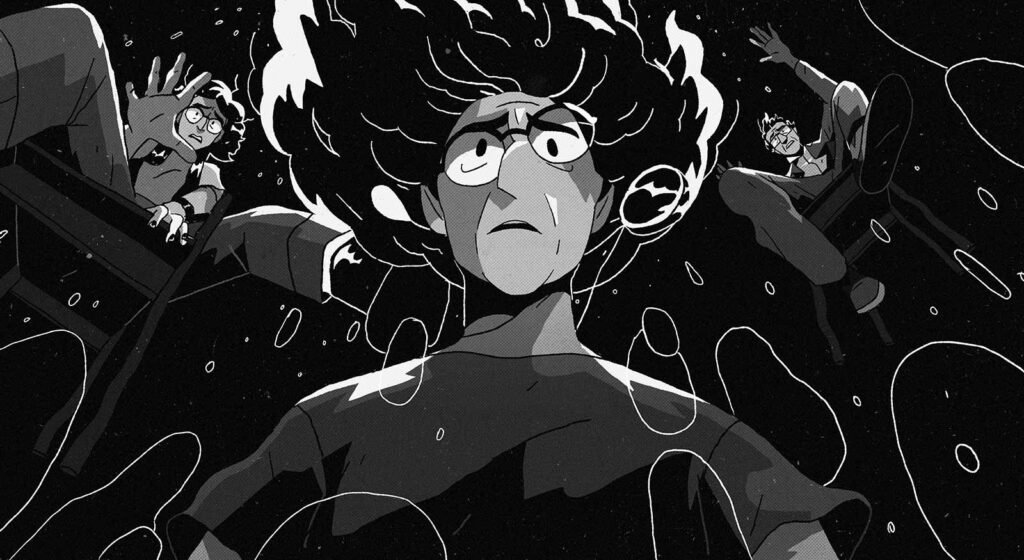
Nelson elaborates upon the relationships between Sarah and those closest to her in impressive detail without ever being too expository— describing her hometown as the “conservative backwater” of the eastern US. Early on in the story, we discover the complex relationship between Midge and Rob, Sarah’s father (Bryan Cranston), who initially refuses to admit or acknowledge that she might have a neurodegenerative disease. Alongside her eccentric aunts (Pamela Adlon and Sarah Silverman), Sarah’s relationship with her younger sister Hannah (Beanie Feldstein)—who puts up a harder protective shell than Sarah and is also present with Midge while Sarah isn’t—reveals itself to be profound in transformation by the end, even if their scenes together are actually limited.
It’s worth noting that the film’s graphic style is very different from that of the graphic novel, which has a very simple, line sketch-like unrefined quality while preserving the majority black-and-white hues. However, the change works completely, becoming a mix of animation style familiar to movie-going audiences and one malleable enough to play with sparse bits of colour, simulate VHS clips in “animated archival” sequences, and accentuate changes in characters’ appearances, especially her mother’s. By keeping the base environment simple, the film’s most playful events come to life in animated form, whereas the simple facial designs, similarly, make facial contortions and expressiveness easy to interpret.
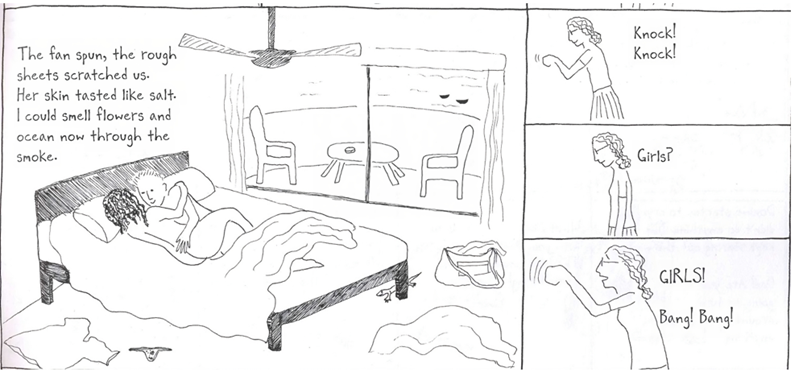 A still from the ‘Tangles’ graphic novel
Moving past several years, Tangles dives into the immense guilt that Sarah feels for constantly being absent while her family takes care of her mother, which also impacts her relationship with Donimo. Once Sarah decides to move back home to spend more time as a family together, the tone shifts again, and the true weight of an Alzheimer’s diagnosis becomes deeply felt: the immensity of watching someone involuntarily lose parts of themselves while helpless to stop it all. Memories are reshaped, every moment becomes precious, and the most important things in life rapidly become crystal clear.
Again, its’ clear that Tangles is one of the best queer animated films of recent years since Jonas Poher Rasmussen’s Flee (2021), which is dramatically different in style and tone but, notably, also inspired by a true story. Nelson interrupted the film’s final moments with a risky yet stunning choice, inserting a bit of levity into the work’s most inevitable seconds. Yet, instead of taking away from its impact, it lets the audience hang still in the air for just a moment—like Wile-E-Coyote running off the cliff, so to speak—before going into full free-fall. Rather than plunging us directly into a pool of tears, Nelson invites us to think again about all that a person is and stands for, far beyond the terrible, unavoidable conditions in which we witness them.
*****
Tangles screened in the Perlak section of the San Sebastián International Film Festival (18–26 September 2026).
Watch the trailer for the film here:


