

There are things the sea keeps, and things the body refuses to bury. In No Rest for the Wicked (2026), director Kasper Kalle turns the Faroe Islands into a landscape of beautiful hostility, where the sea presses against the land as insistently as religious morality presses against the body. No Rest for the Wicked premiered at the 30th edition of Fantasia International Film Festival in Montreal, Canada—where the film picked up Best Director for Kalle, the Cheval Noir Outstanding Performance Award for Asbæk, and the second-place audience award—and just made its European premiere in the Official Fantastic Competition at Sitges International Fantastic Film Festival of Catalonia in Spain.
Set in 1862, this Danish queer gothic follows Baldur (Egor Venned), a young fisherman whose quiet existence with his mother is unsettled by the arrival of Helge (Pilou Asbæk), a Danish whaler whose ruggedness seems to carry the promise of another life. What begins as a tentative encounter between two men gradually acquires the weight of a curse. Desire, once awakened, refuses to remain human.
The film’s most compelling achievement lies in its photography. Cinematographer Jacob Møller approaches the Faroese landscape not as a picturesque backdrop but as an emotional condition. Grey skies, cold water, and dense fog seem to dissolve the distinction between the world outside and the turmoil within. The images possess a strange tactility: the dampness of the air, the roughness of fabric, the warmth of a body beside an open fire. There is little separation between atmosphere and flesh. Even the landscape appears to have a skin: one that is perpetually bruised by the weather.
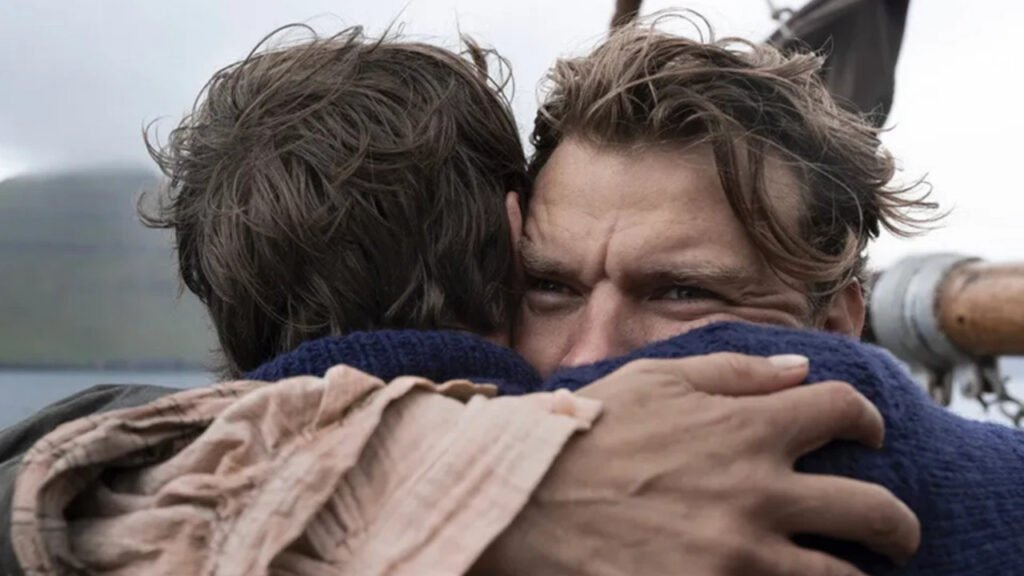
Inside Baldur’s modest home, warmth offers a temporary reprieve from the hostile expanses beyond its walls. Yet, these intimate interiors are hardly free. The cottage is a place of domestic obligation and religious observance, where the possibility of another kind of intimacy must exist in the margins of ordinary life. Kalle understands the erotic potential of confinement. A glance held a fraction too long, a body occupying the same small room, the silent recognition that passes between two men: these become gestures of quiet transgression. The camera does not simply record their attraction. It lingers around its edges, allowing anticipation to become an experience in itself.
This is a cinema of suggestive surfaces. Masculinity is rendered neither as an abstract ideal nor merely as an object of desire, but as something vulnerable to touch, scrutiny, and transformation. Helge’s physical confidence contrasts with Baldur’s inwardness, and their attraction acquires its intensity through this difference. The film’s sensuality emerges less from explicitness than from proximity: the charged distance between two bodies before it disappears.
Vampirism enters the film’s gothic vocabulary on the sidelines of the central story, acting like a natural extension of this intimacy. The vampire has always occupied an unstable position between appetite and affection, seduction and violation, and the promise of eternal union and the terror of losing oneself to another. Here, the supernatural as a whole—including, but not limited to, vampirism—becomes a language for feelings that the community cannot accommodate. Baldur’s desire does not simply challenge the social order; it begins to disturb the boundary between life and death itself.
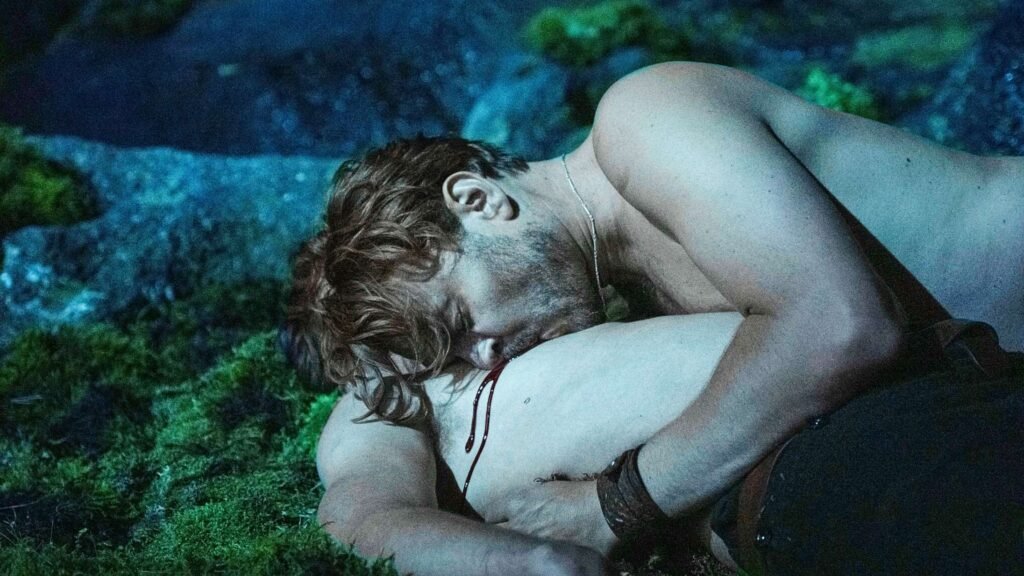
There is, however, a familiar tension in representing queer desire through the language of the monstrous [see our review for Paolo Strippoli‘s The Holy Boy]. Queer cinema has repeatedly returned to figures who exist beyond respectable society, finding freedom in their refusal of conventional identities while remaining haunted by the prospect of punishment. No Rest for the Wicked navigates this tradition without entirely escaping its fatalism. Its strongest moments propose that the real transgression lies not in desire itself, but rather, in a social order that insists on treating it as something shameful.
The film’s atmospheric precision occasionally comes at the expense of dramatic complexity. Its symbolism can feel more assured than its character development, and its visual restraint sometimes leaves emotional shifts insufficiently explored. However, its images possess a lingering intimacy. The interplay of natural light, close framing, and textured surfaces gives the film a visual language that is expressive without becoming illustrative.
Ultimately, No Rest for the Wicked is most interesting when it treats vampirism not as a spectacle of evil but as a question of what it means to need another person. To desire someone is to risk being changed by them and to surrender a measure of control over one’s own body and identity. In a world that demands repression, such vulnerability can appear dangerous.
Perhaps the film’s most radical implication is that queer desire does not become monstrous because it violates convention. It is, instead, made monstrous by the conventions that refuse to recognise it. What survives is the memory of a touch, the persistence of an image, and the possibility that intimacy might endure beyond the boundaries imposed upon it.
*****
No Rest for the Wicked competed in the Official Fantastic Competition at Sitges International Fantastic Film Festival of Catalonia (8–18 October 2026).


