

Tunisian writer-director Leyla Bouzid’s latest feature, In a Whisper (À voix basse), tackles the immense complexities between familial norms and social pressures through the eyes of Lilia (Eya Bouteraa), a 30-something Tunisian living in Paris. When she returns to Tunisia for her uncle’s funeral, secretly bringing along her partner Alice (Marion Barbea), she uncovers a family secret while also being forced to confront the nature of living between sociocultural systems. The film premiered earlier this February in the Berlinale Competition (read our review of the film here).
At the Sarajevo Film Festival, where the film screened most recently, we sat down with the filmmaker to discuss the work in more detail.
*****
Purple Hour: At the Brussels preview of your film, you mentioned that the film had already been playing in Tunisian cinemas for over there weeks. I’m very interested in how you see the tensions that exist between the film and the state of social acceptance of queerness in Tunisia.
Leyla Bouzid: While writing the film, I really started with the character and the story itself. Little by little, the intimate story reached the political and the social side. From my point of view, the intimate and the family are the origins of the system and of the social treatment of this kind of subject. I always think that a topic starts from the family, which is the heart of all systems, and then it filters into wider society.
It’s an approach I already worked on with my first film, As I Open My Eyes (À peine j’ouvre les yeux, 2015). It’s something that’s more or less natural for my way of writing. For the release of the film in Tunisia, it was really interesting because with the distributor, what we tried to do was normalise the subject and really not do any polemics, and this worked out. So we thought that it’s a very good historical step. It’s very good that the film exists and a lot of people felt really represented and more legitimized. At the same time, people who are maybe not aware of this subject find a space to think, or to wonder, or to maybe make a step in the direction of queer people.
I found Lilia’s intention not to reveal her sexuality to her grandmother (Selma Baccar) very interesting. It’s something different from the so-called Western idea of coming out as a rite of passage for queer people. Here, it’s a form of respect for her grandmother’s desires and vision of the world. Could you talk about this?
In the film, there are three generations of women, and I wanted to show that it doesn’t make sense to push the oldest generation toward something they just can’t understand. It’s not because they are intolerant or something, but just because they come from another way of being and it’s too far from them. I wanted to show that everyone have his own point of view. Also, there is her mother (Hiam Abbass) and the aunt (Fériel Chammari), and they are really different. It’s just that everyone deals with life in the way they can and with what they have.
When Lilia comes out to her mother in Tunisia, which is already something very big, we can already ask ourselves: Is it worth it? You’re not obliged to do so. However, I thought that for the character of Lilia, she needed to do it with her mother because, at one point, it forbids her to go further in her own life. It’s what prevents her from making a family. So she needs [to do this], but she doesn’t need to for her grandmother. She doesn’t need her grandmother to know in order to build her own life. So I found it more right to act in that way. In the end, it’s all about love. Lilia loves her grandmother, and she knows the space she has with her. Maybe the grandmother knows, or maybe she doesn’t know, but words don’t need to be spoken.
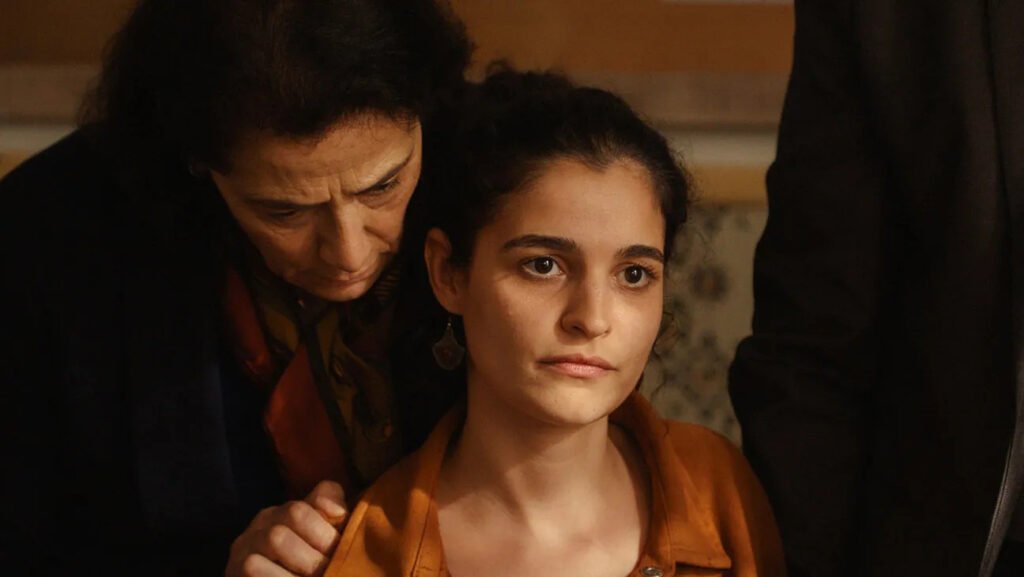
Lilia’s mother does seem to express some resentment toward her daughter because of the freedom she has. Conversely, the grandmother really dislikes that she had a divorce, even if she is a very well-respected doctor. What about these complex intergenerational mechanics were most important to you?
I wanted to work with the character of the mother in a way that’s maybe not what we expect from a clichéd mother in an Arab country. I really wanted a mother who is like a lot of women in Tunisia: a working woman who chose a career, who is divorced, who is a doctor and head of department in a big hospital. She has a modern relationship with her daughter, but she has her own family history. Also, she lives in Tunisia. So when Lilia is telling her who she loves, she will just think, okay, my daughter will not be happy in our country because our country does not welcome queer people—which is correct. You can say she’s wrong, but she’s right in saying Lilia probably will be unhappy. The relationship and the dialogue between the mother and the daughter are very complex. That’s also what I search for in the reactions in my film: complex situations. On one hand, it’s very simple, but on the other hand, it’s never black and white. It’s never yes or no. It’s yes, but this and that, and that’s what makes it human because it’s never easy.
My favourite scene in the film is when Lilia and Alice are pulled over by the police after coming home from a bar. My interpretation of that scene is that the policeman is testing to see whether Lilia has adopted another worldview—whether she is still Tunisian at heart, so to speak. What were the origins of this scene?
The scene came from the idea that you are in a situation in a country or city where there is a lot of pressure. This pressure can come from wherever, like in a check of your driver’s licence and your car. The way the policeman is really asking some private questions and commenting on her life brings up the theme of Lilia living far away. She grew up in Tunisia, but she left Tunisia. Some people can reproach you because you don’t give back to your country what your country gave to you. At the same time, there is this foreign eye through Alice.
The policeman is obviously corrupt, but in the end, he refuses [Lilia’s bribe]. So once again, it’s something very complex. It’s not black and white. There is some way of doing things, but sometimes you don’t know how to act. I think this scene is very important for Lilia to feel all this pressure around her, but indirectly.
At the end of the film, someone tells Lilia that female homosexuality isn’t taken seriously. It suggests that patriarchy also impacts men in harmful ways—gay men are severely punished, and women are simply seen as objects or as less-than. What was your intention behind including this comment?
First of all, you have to know that homosexuality is punished by the law for women just as men are. However, it is very hard for to prove, and the police are not really searching. In reality, it’s almost only men in prison for this. We don’t have really official numbers, generally there are very few women in prison for this in Tunisia—unless they are already in prison for something else, and in prison they are accused of having relations with other woman prisoner. It’s something I found out while writing and preparing the film—that really it is not taken seriously. In some ways, it seems like it’s protecting queer women, but in the same time, it’s so contemptuous. It’s like viewing them as if they are children and not respecting them. It’s also something I think that’s very much connected to the idea of a sexual act as requiring penetration.
I think in the lack of imagination of this patriarchal system, they think that, for two women, there is somehow no danger because there is no penetration. In this way of thinking, men are arrested because the police think they are taking the place of women. I needed to put it in the film because I wanted to give a body and existence to love between two women in Tunisia. I wanted to put it in the framework of what is the most legitimate and important in Tunisian society: having a child. You might think it’s not important, but in the end, they have a child. This is the most important thing in our society. I wanted to show that [one might think] it’s not serious, but of course, it is serious. They have the genealogy of a family.
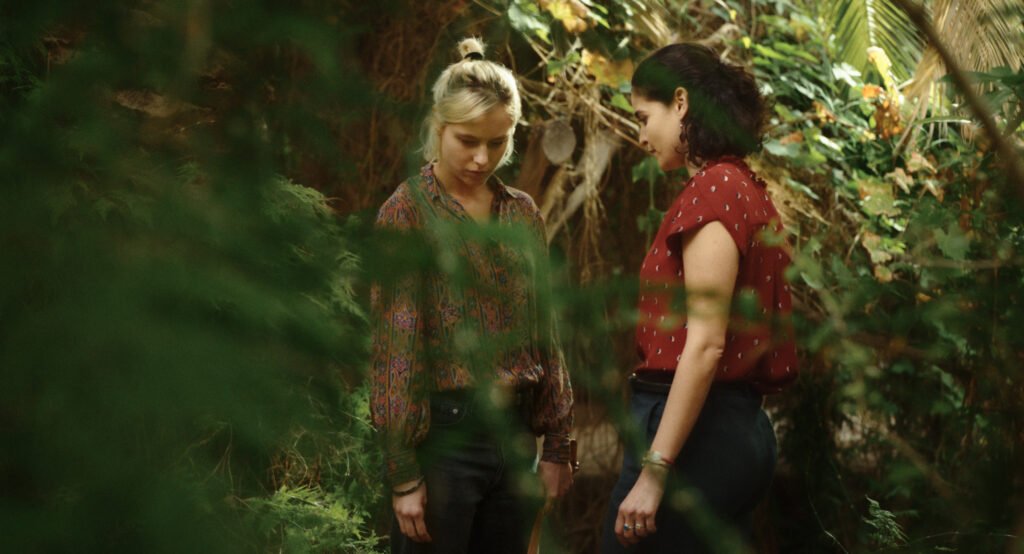
Some Tunisian feminist lesbians are really fighting for women’s rights in Tunisia. They told me that the real revolution in the film is the child, and that’s what I thought also when I wrote it. This is what is making it serious [in Tunisia]. I also wanted to make some kind of happy ending, maybe because there is a big tradition in lesbian films that it ends a tragedy. I didn’t want to do that. I wanted to give hope and to propose an ending that could be simple and easy, even though there is always this nuance with the fact that the grandmother doesn’t know the truth.
Were you looking at other queer Arab films as inspiration? Or how do you see this film as paving the way for other work?
I was trying to see what there is, but when I wrote and directed the film, there were really few films about sapphic love in an Arab country. Since then, there were more films, like Where the Wind Comes From, as you mentioned, although there’s only a short scene, as well as Bouchra. While travelling with my film, I was told by some viewers that there are sapphic scenes in some films. I was really surprised because in some of these films I saw long ago, I didn’t see that there was this theme. Someone told me that Caramel [by Nadine Labaki] is a queer film, but I don’t remember something about love between two women. I have to see it again, of course.
I found out that there are a lot of signs or something speaking to people about this theme, but maybe my film is simply very direct. It’s not a film where I’m talking about queerness while hiding it. There is Lilia and Alice, but there is also the gay uncle and the transmission between two generations of being queer, and this was very, very important for me. This transmission between them is like an invisible link. There are a lot of projects at the moment about this, and they are very different from each other. That’s what’s coolest right now.
There are films in which [queerness is not the main theme], but the main character is a lesbian. However, for a film happening in Tunisia, I think we had to first make a film where it is the subject. This step hasn’t been done yet, and in my view, this step had to be done at least to create some representation. That lesbian Arab girl maybe won’t find herself completely in Lilia, but she’ll find someone who is more or less living like she’s living. I had so many people writing to me privately on social media, telling me how much the film is important to them. This was really beautiful.
How have different audiences responded to the film and the different character dynamics?
The film has been released in many countries now, but the most important release to me is the one in Tunisia. We are very happy with the Tunisian distributor, as they helped us reach the Tunisian audience. All the meetings I had with the Tunisian audience were really rich. There was very useful and important dialogue. What was really beautiful was that there was a lot of tolerance and a lot of curiosity. We tried to normalise the subject and really not create a polemic but instead create a deep, profound, and sincere dialogue about queerness. People who were very far away from this theme [of queerness], or even a little bit homophobic, could—through the film—participate in these talks. We could really make a very important step [by doing this].
Now, we are in Sarajevo, and I haven’t presented the film yet—but I saw that in Berlin, all of the Balkan people [I spoke with] felt very close to the film and the relations of the family in the film. French people—they empathise with Alice, but they don’t like her so much because she’s a little bit representative of the white gaze. I think young French people don’t feel so comfortable with Alice’s gaze. I also had a talk with Tunisians about her, and they all find her very much like they see French people. The reaction to Alice is very, very different from France to other countries. American and European audiences love her. Everyone seems to like her but the French. However, mixed couples completely understand their dynamic. I was surprised—I thought that maybe I didn’t write her well or could have made her more complex, but also Lilia made her many promises to take her to Tunisia, and at some point, she gives up.
*****
In a Whisper screened in the Kinoscope section as part of the 32nd Sarajevo Film Festival.


