

For our August edition of CURATOR TALKS, we shine the spotlight on the 37th edition of the Hong Kong Lesbian and Gay Film Festival (HKLGFF), Asia’s oldest queer film festival. Ahead of the event, we sat down with Daniel Woo—the festival’s International Gay Feature Film Curator and Film Traffic Coordinator—to discuss the origins of the festival, how it has evolved over time, idiosyncrasies and unique points in curating for a Hong Kong audience, and why showing up to the cinemas is of the utmost importance.
*****
Purple Hour: Could you start by talking about the origins of the festival?
Daniel Woo: The festival was founded in 1989 by Edward Lam [acclaimed as a screenwriter, particularly for Stanley Kwan’s Red Rose White Rose]. Back then, the audience wasn’t even considered the LGBTQ+ community—it was just the lesbian and gay community, which is still what we have in our festival name. We have talked about changing it in the past, and we often get questions from talent who fly in. Even though our programme reflects the changes in the community, I think the founders haven’t really decided on how much they want to change the name. It’s probably at the back of their minds because there’s so much going on. There’s also the Macau Queer Film Festival that started about three years ago, so changing it to the “Hong Kong Queer Film Festival” seems a bit of a copycat move.
At one point [before 2000], the film festival stopped because it’s independent—run independently from government organisations—and we rely on ticket sales and the box office. If that doesn’t perform, we are unable to continue for the next year. In 2000, Ray Yeung came back and said, “Hey, let’s restart it. It’s quite important for us to have a film festival that’s showcasing queer life and queer representation.” As you know, Ray is a filmmaker himself, so I feel like our festival is much more focused on the filmmaking side of things rather than the business or industry. The previous director of the festival, Joe Lam, is also a sort of businessman-entrepreneur who believed in the LGBTQ+ cause. For the past two years, after Ray took back the mantle and became the executive director, we’ve been seeing more of a shift to the crafts of filmmaking and curation.
How do you think this creative filmmaking focus has influenced the festival’s engagement with the LGBTQIA+ community?
I’ve only been working with the festival for two years, but I think the festival before Ray didn’t have much of a “face” to it. Because Ray is a prolific filmmaker in Hong Kong, especially in the queer scene—he’s a Teddy Award winner [for All Shall Be Well]—a lot of people know him. He really has a presence in this city, especially for the cinephiles. If you think about social media and how that landscape has changed, you know you really want a face for your organisation. It’s about having that person who’s really ingrained in the industry be front and centre of the festival. For instance, the cover [of the festival brochure] this year is Ray’s dog, Daffy. We’re trying to make it a little bit more personal. We’ve also started trying to do more greetings before the film festival. I don’t necessarily know if that’s something that Hong Kong audiences particularly like, but I think it does help the audience connect to a festival a little bit more when the curators [do that]—rather than it being just another screening, let’s say.
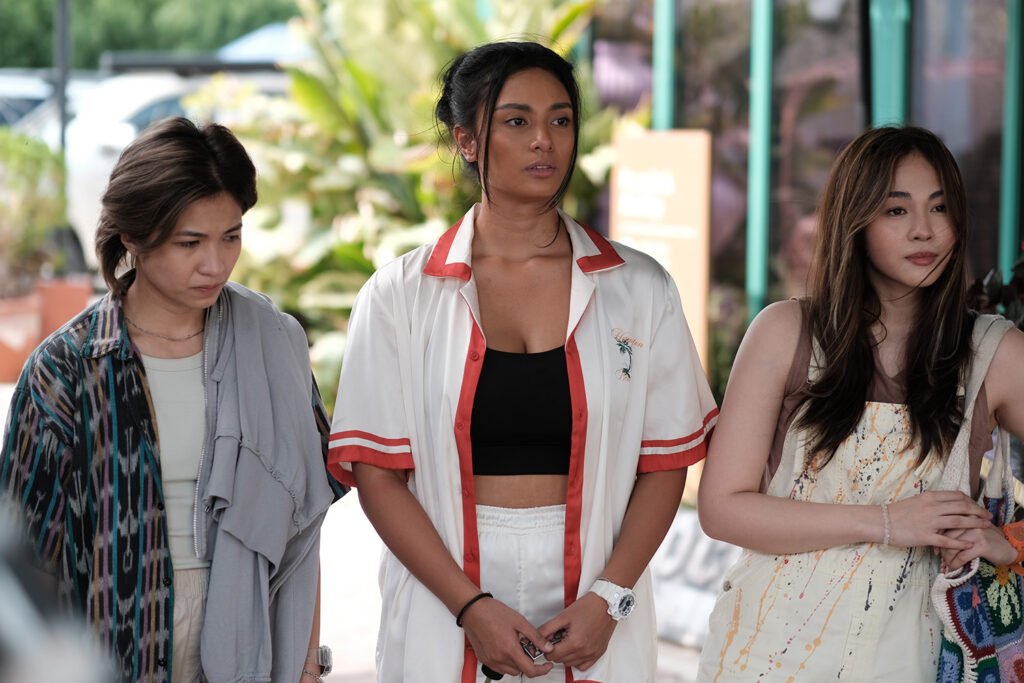 Still from Open Endings by Nigel Santos
How is your programming and curation team structured? Could you break that down?
We have quite a big programming team because everyone is a volunteer at the festival. I would say 90% of my colleagues don’t work in film for their full-time jobs. A lot of them are LGBT activists or really just believe in giving back to the community, and then a bunch of people are on the filmmaking side, or scriptwriters or playwrights. I think some of them are previous writers for the festival’s [short screenplay award competition], and that’s how they recruited some as colleagues.
[Our programming team] is still structured in quite a traditional way. We have five teams [looking at different titles]: international gay, Asian gay, international lesbian and queer, Asian lesbian and queer, and then shorts. I don’t know how I personally feel bout it because I do think sometimes the films kind of overlap. Last year, we had a film called Sauna [by Mathias Broe—read our interview with the filmmaker], and it is technically a trans film, but [it features a relationship between] a trans man and a cis man. I was thinking, is this a trans film or a gay film? This year, we have Montreal, My Beautiful [by Xiaodan He—read our interview with the filmmaker], and it features Joan Chen as the main character, and she’s Asian. Is this an Asian film or a Canadian film? These boundaries are getting more and more merged. When this happens, we usually consult both teams, and both programming teams watch it and give their feedback. Especially for international gay features, I think I watched about 140 this year. If everyone’s in agreement that it’s not a film for us, we skip over it. If there are disagreements, then we discuss them.
Does the programming team structure influence how you curate films for the public?
This year, we’ve tried to do something slightly different, which is following in the footsteps of BFI Flare and have moods: love, laugh, reflect, thrill, pride, and remember. We’re trying to get audiences to engage in different moods rather than just lesbian or gay titles, although I don’t know how this will land. I feel like people can be quite superficial. I don’t go clubbing, but some of the talent that come in ask for recommendations, and when I ask the rest of the team, they’re like, “What kind of men are they into—twinks? Bears?” The bars are segregated like that. I think we have a very label-driven audience, so I’m interested to see what the box office is like this year and how audiences are reacting to the mood board, so to speak.
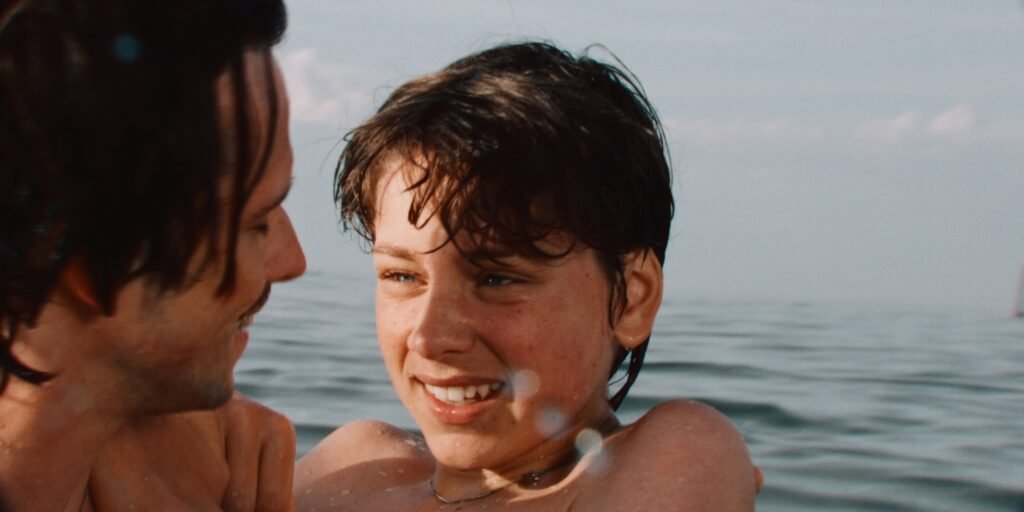 Still from Shutterspeed by Jasper De Maeseneer
Do you also work with and programme films that are perhaps queer-coded or could be read in a queer way? People we speak with also talk about films being stylistically queer.
I would say it really depends on how we view the film and whether we think there’s a strong enough case for us to screen it. Sometimes it’s also about the context around the film—whether the filmmaker is queer, for instance. Maybe the film itself doesn’t really deal with super queer themes, but we can tell that there’s kind of a queer lens on it. This year, we have a short called Shutterspeed [by Jasper De Maeseneer — editor’s note: the film won the festival’s Short Film Jury Award], and it’s interesting because this film is more of an obsessive film. It’s about a teenager who’s obsessed with one of his teachers, and there’s some sexual tension implied in the filmmaking. However, he never explicitly says he’s gay and that he’s enamoured with him. We still chose to programme the film.
We also have films that touch on pedophilia, for example, but nothing happens between the two characters, and one of the characters is a child who is not reciprocative of any of these feelings. He’s just battling demons inside. I think we do take into account the context around the filmmaker and what the gaze might be in the film. However, I would say that sometimes, if we are choosing between two films, we might be leaning toward a film that is more explicitly queer. We also tend to spotlight more films that have a queer heart at the centre of the story.
Have there been any trends or themes that have stuck out to you over the last two years of our work with the festival more broadly, within queer film?
I don’t know if this is a product of a sales tactic, but I would reiterate—films about pedophilia. There’s Blue Film [by Elliot Tuttle—read our interview with the filmmaker] that’s come out this year, and we had No Dogs Allowed [by Steve Bache] last year. I think we had two shorts in the programme that also dealt with pedophilia—maybe not with a child, but the lines are blurred. That’s a theme that’s been popping up quite recently. I don’t know if it’s because filmmakers necessarily want to make a queer film that’s around pedophilia or whether they’re just interested in pedophilia, and then the queer angle just comes out because of what they’re thinking about.
I also work for Peccadillo Pictures [an independent distributor of queer films] in the UK, and we see a lot of films that are oriented around family and friendship films as well. At the festival this year, we have Open Endings [by Nigel Santos], which is a Philippine lesbian film about four lesbian friends who have all dated one another. There’s one called Before I Do [by Gary Jaffe]. I feel like there have been a lot more films about gay friendships that are cropping up rather than purely romantic films, and that’s quite refreshing to see because it’s just a different sort of representation.
We do still have coming-out films, although we’re moving a bit further away from just having that as your gay storyline. As a programmer, I guess we still try to have one or two each year because the theme of coming out is still quite relevant in the gay community. However, I actually think those films don’t necessarily resonate as well here in Hong Kong, just because a lot of people in Hong Kong don’t come out to their families. It’s quite separated, and they’re able to have these double lives and don’t really think too much about it. It’s not as big a deal as it is in the Western Hemisphere.
A lot of films that do really well at our festival are boys’ love [also known as BL] films—Asian titles where you have two good-looking Asian men. They don’t even have to be gay. I think if they were straight and in some sort of K-pop or J-pop group, that’s even better because you get both gay men who are interested in these men and women as well. That’s quite a stark difference from what I’ve seen in the UK with Peccadillo—we don’t deal with any boys’ love films. In fact, we have a lot of pushback when the characters are not played by actors who are actually queer, and that’s quite an interesting audience difference.
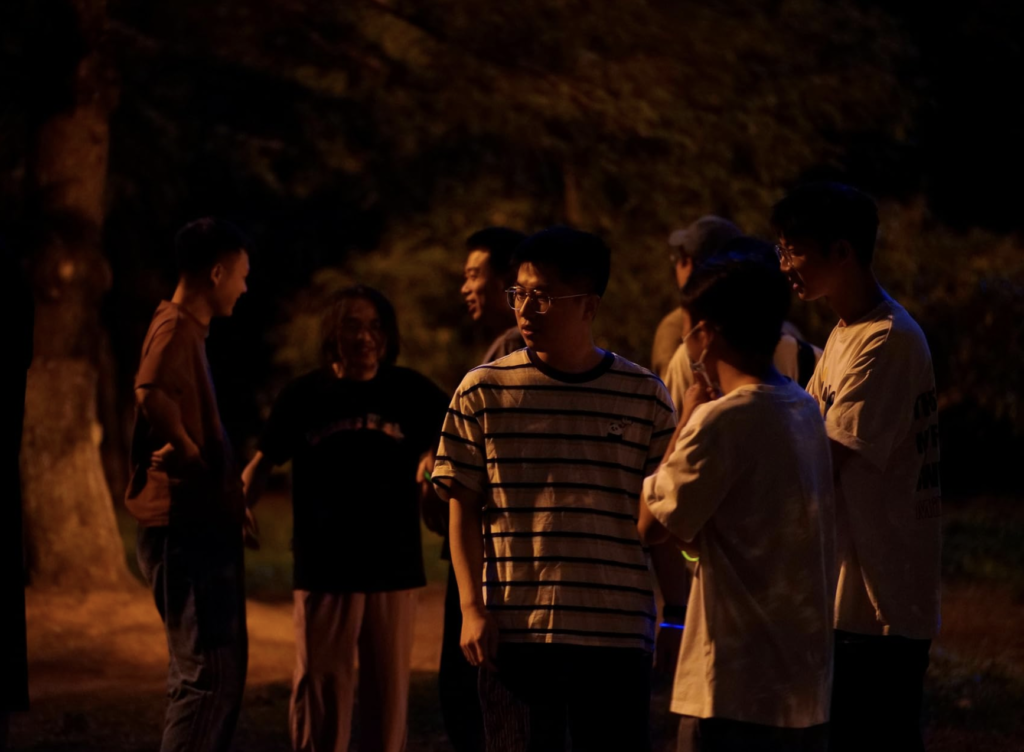 Still from Under the Gaze of Night by Zhan Yakui
Could you illuminate any unique challenges as a festival in Hong Kong or with a Hong Kong audience?
The first thing I would say is that we really struggle with the language barrier. Even though English is still an official language, not everyone speaks English. For the Hong Kong International Festival, because it’s a government-funded festival, they get to make subtitles for the films, which draws in a lot more people because they know, “Okay, this film has Chinese subtitles; I can go watch it, and I’ll understand everything.” With our festival, we don’t really have the means to do that. It’s quite expensive. You also have to look at whether the film is encrypted or not. Otherwise, you have to do an electronic projection, which requires manpower and more costs as well. You can tell that a lot of our audiences are more international or expats because we often only have English subtitles for our films. I would say it’s still better to have English subtitles than not, and we will try to have the English subtitles even on English films because some people feel more comfortable with subtitles.
I also don’t feel like some of the political themes that emerge in Western titles necessarily resonate with the Hong Kong audience. I think that sometimes there’s a bit of a myopic view on racism. Racism in and of itself is a very thorny subject, and it’s regarded in a very different way all over the world—even between the UK and the US, for instance. There was also a film that came out this year, and many people flocked to see it because it had a major celebrity in it. But when I watched it, and when many programmers from the festival watched it, we all thought it was a very problematic film because of the way it portrays gay people. There is room for education for Hong Kong audiences, especially those who might not be gay and might not understand what the film is actually implying [by a comment]. The festival is a chance for this kind of education, but it’s really hard for us to pull in people who are not within the gay community to see the films.
I don’t know if other programmers say this, but for trans and lesbian films, it’s so difficult to get audiences in, and it’s such a shame because there are so many really good titles. Every year, we have to reduce the number of lesbian or queer titles because we rely on the box office. If they’re not coming out to watch the films, we can’t programme for them.
How about the unique opportunities that present themselves through HKLGFF?
Opportunities-wise, our festival is made up of a cohort of staff who are really into helping out with the LGBTQ+ community. They’re doing a lot more panel work, so we invite guests from different walks of life in Hong Kong who are queer to talk about the films and themes. We have a lot of events running through the festival, even though marketing those events is another beast. I would say the team is very much into spreading the word about queer life and queer culture, making sure people are not alone.
Last year, we had a film about bullying, and we invited some students from a school—who were bullied because they were queer or trans—to talk about their experiences. We were a bit nervous because we thought people wouldn’t stay for the talk, but I would say 80% of the audience stayed. I think it was momentous for the students, because they realised that they have a voice. That’s the essence of what our festival wants to do.
We, as a festival, should also be leveraging the fact that we’re the oldest LGBT film festival in Asia. We have been doing quite well with our Asian programming. This year, we have one world premiere, which is quite rare for us to get: it’s called Under the Gaze of Night [by Zhan Yakui], which is a mainland Chinese film about a man who’s cruising in a park during COVID. I would hope that we can eventually get to a point where we have more world premieres and more eyes on the festival internationally. However, I know that takes a lot more time and effort because most of us are volunteers.
*****
The Hong Kong Lesbian and Gay Film Festival runs 4–20 September 2026.


