

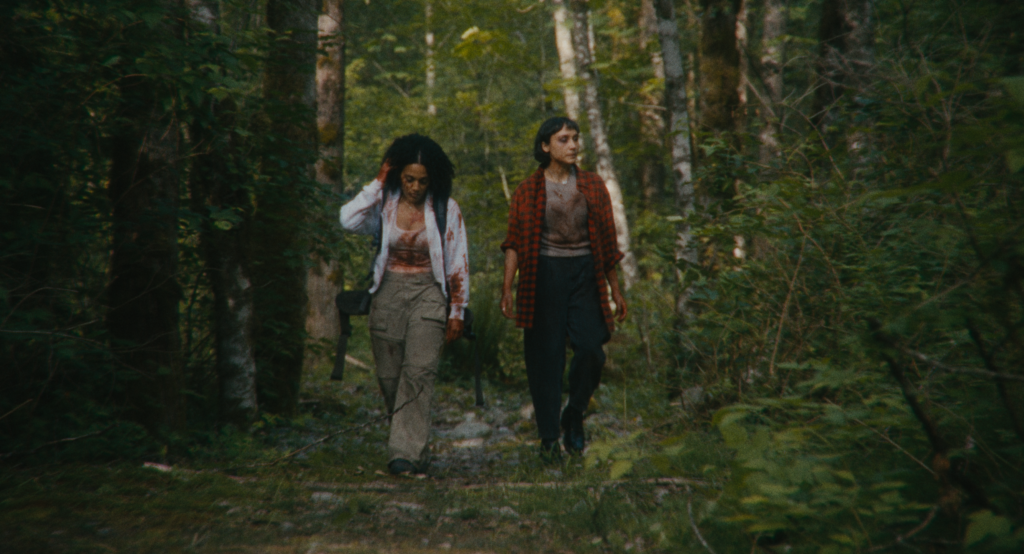
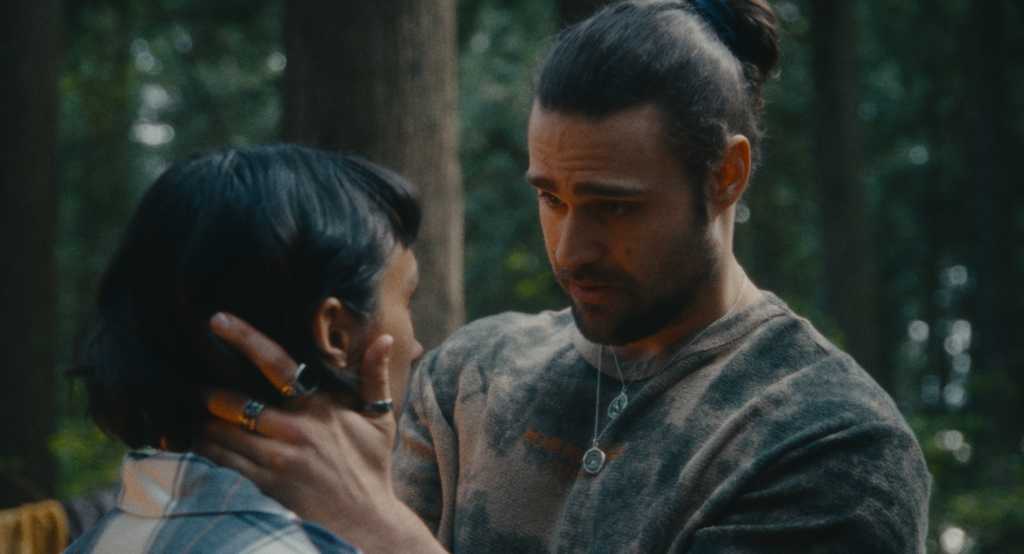
After being abandoned in the forest by her boyfriend, Alex (Bethany Brown) comes across the charismatic Kianna (Tandia Mercedes) and her own boyfriend, Matt (Cody Kearsley), quickly learning that they are bank robbers—à la Bonnie and Clyde, living their best lives, heist-to-heist. Witnessing their carefree dynamic leads Alex to rethink what she understands about herself and her desires, tumbling her into a potentially dangerous love triangle.
With her debut feature, A Safe Distance, Canadian filmmaker Gloria Mercer crafts a nature-set thriller with psychosexual elements while playing with themes of freedom, safety, compulsory heterosexuality, toxic masculinity, and women’s desire. With a screenplay by Aidan West, the film debuted at the 2026 South by Southwest (SXSW) and is based on the short of the same name.
Purple Hour caught up with Mercer and Brown before Frameline50 (the 50th San Francisco International LGBTQ+ Film Festival) to close that distance—so to speak—from both a directorial and performance perspective. Here, we learned more about making the psychosexual elements onscreen feel seamless, rethinking a socially informed concept of safety, and drawing from very different references to create the film.
*****
Purple Hour: One element I love about this film is the intersection of the psychosexual and the sapphic love and lust, all of which are tied to danger and the characters’ precarious situation. I’m curious what conversations you two have had about this while cultivating the intensity we see onscreen between Alex and Kianna.
Bethany Brown: It started off with creating safety first from the actor perspective with our director. Gloria was really great at creating a very, very safe set. For me, approaching intensity, especially if it’s going to be in stunt or intimacy, I really like it to be quite mapped out until it’s almost boring, and so you know what to expect. Then, as the actor, you get to actually play with all of the intensity and emotion of that—the intensity of female desire that’s untapped, especially from Alex’s perspective. She never got the chance to ask herself what she really wants or what she really desires, so when she does open a little bit, there’s so much desire inside. With Tandia, we talked a lot about that because I was like, I just want you to feel safe in wanting to explore so deeply untapped female desire. Then, we had an intimacy coordinator, who made everything very safe, and a stunt coordinator also helped us out.
Gloria Mercer: It was interesting because the script gave different sex scenes, and they’re so tied to Alex’s psyche and where she’s at in her journey. That was sort of fun and challenging to craft how they were a reflection of her mood. I was just really lucky because Bethany, you and Tandia formed a really close bond—I hope you did, as it felt like you did—by the time we were filming. It was important to me to have a softness between the two of them and it came really naturally.
BB: Chemistry just happens. You really hope for it. Yes, you can do everything to try and force it, but I really don’t think it’s forceable. Tandia and I did have this really beautiful chemistry that was very natural. Off set, it was this budding friendship, and on camera, it kind of lended to that magic of falling in love. For me, there’s a magic of any new relationship where you’re learning their humour and boundaries. Tandia and I were doing that actively. We spent a month in rehearsals with Gloria to create that foundation for safety but also for friendship. The friendship was naturally rolling along and becoming really funny and exciting. She was sending me memes when she was not even shooting that day, and the whole set erupted in laughter. It was really fun and easy then to transition that into falling in love on camera.
Were there any particular moments of play from set that resonate in your mind?
BB: I’m a Leo—I don’t think we need to get astrological, but I kind of approach life from an element of play. When I’m going into a scene, I’m thinking of at least five different ways to do it so I’m not rigid and stuck. I’m also really open to play and collaboration with everyone else, like the ideas they’re bringing to the table. I’m very much a “yes, and” type of person, as long as we’re inside my boundaries. The hardest moment of play was having to get into that freezing cold river. It’s spring runoff and just after winter in Canada, and we have to get into a river multiple times. I don’t do cold on the best of days—I’m not a cold plunger, either. Luckily, there’s Tandia hyping me up and the moment she touched the water, she was like, “I can’t do it!” For whatever moment, it flipped and the moment I touched the water, I was like “WE’RE doing this!” When you see us screaming in the water and laughing, it is just terror, freezing cold mixed with euphoria, and there was this rush. I think that was the biggest element of play for me.
GM: Watching you two was really cute because it was a very small set, and we didn’t have trailers. It had a big camping vibe. Sometimes, we would be like, “Oh, where are Bethany and Tandia?” And they would just literally be in the tent keeping warm, whispering to each other, and giggling. We’re peeking out the window, and you’re wrapped in sleeping bags so close together. Very much sleepover vibes. It was very cute.
What particular thematic areas do you see the film in conversation with the most?
BB: For me, there’s a meditation on the theme of safety: this concept of perceived safety versus actual safety. The perceived safety is the idea of finding a person, buying a house, and having this relationship—you get married. The meditation is on whether this is the safest thing for a woman. Can she grow into the next version of yourself—that’s the most authentic—in the current dynamic, although it would be the safest thing to do? That box is actually suffocating her.
GM: Going into it, we talked a lot about Bonnie and Clyde as an obvious reference point. A lot of these “lovers on the run” stories are about freedom and if you’re feeling trapped in life. What are the grey areas and drawbacks of reaching out and grabbing what you want? When I make movies, I feel like I always come back to women’s relationships and how women do so much—also in the ways we don’t see women taking care of each other. When Alex finds Kianna in the woods, there’s this immediate and reciprocal caregiver relationship. It’s something that Alex didn’t know she needed. Then there’s the concept of running into the woods to be free in a much more millennial context, and playing with the ideas of toxic masculinity in a more modern way.
The film comes at a moment where “alpine divorce” has, terrifyingly, sprung up in the news a lot—and the work starts with an example of this. Maybe you’ve been asked about this a lot already, but I’m curious how much you’ve thought about it in dialogue with the film.
GM: My main thought on this is that it was just a very strange coincidence. It feels weird to be like well, that’s sort of serendipitous, because it’s also such a dark topic. We made this film and we were not thinking about it at all in terms of being a buzzy concept. It just happened to be a topic right as the film was released at South by Southwest.
BB: The first time I heard alpine divorce was in an interview at South by Southwest, and I was like, wait, is this a thing? I was really reflecting on the fact that this is a thing that happens often enough that it needs a term. I almost had an insider’s perspective because Alex is so unequipped to be in the woods, period. She wants to be in Mexico on a beach reading a book, and that’s it. In my mind, the situation is weaponised against Alex, who is like, “Oh, maybe I should have just said yes,” and I wonder if that’s kind of the point of alpine divorce.
GM: It also just speaks to the really sad universality of these experiences. I have never experienced an alpine divorce—the film is a fictional story. But in talking about and making this film, we drew on my own experiences in relationships with men. There are a lot of real feelings pulled from that and put into the film. When you hear about the term, it makes sense that this has happened even though it is awful, but it’s not surprising.
Were you thinking about the film in connection with other queer stories or sapphic tales? How do you see the film in conversation with some of these topics?
GM: A very huge inspiration, and it may be obvious, is Bound. Bound was a great reference point. I like to think we are different enough that we’re not just cribbing. But it’s just a great film, and we thought about taking the enthusiasm of their love story and how they sort of fall into each other. As it’s screening at Frameline, I hope I can see it because I really want to see it on the big screen. I don’t know if you would call it a queer story, but Kelly Reichardt’s Old Joy is a story about two men who go into the forest. There are no explicit sexual acts performed, but there are a lot of weird undertones, like sexual tension between two men who are outwardly presenting as straight. It’s really just a movie that has so much tension—and is also in the forest. I love that movie.
BB: I think references for me are Blue is the Warmest Colour and Below Her Mouth when we’re talking about intimacy. I also really like Thai GLs (girls’ love dramas). I just really like how it’s so celebrity of sapphic relationships and so central to each of the storylines. I wanted to allow that to have a lot of gravity. At the beginning, when Gloria and I met up, she also had a lot of references for arthouse films in terms of the tempo of the film. I tend to come from TV mostly, where our tempo is really quick. Gloria really wanted to slow it down, and I think that tempo is far more feminine, whether that be in intimacy or in the way that I process through motion and life. Rather than heavy editing that’s focused on punching someone in the face, for instance, it’s more about the aftermath. How does that feel, and how are we going to process that? I loved all the references that Gloria gave in the beginning to sort of slow me down.
*****
A Safe Distance is playing at Frameline: The San Francisco International LGBTQ+ Film Festival (17–27 June 2026).
Tickets are available on the festival website.


