

Dichotomies sharpen when an observant eye sits in both East and West at once. Born and raised in China, now based in Berlin, Viv Li makes a feature debut with Two Mountains Weighing Down My Chest, a film in which she places herself, or a version of herself, in front of the camera. Her body becomes the fulcrum of a teetering see-saw, its wobble ultimately yielding a kind of balance that resists easy labeling. Frolicking and frustration share the frame as Li reworks the personal, cultural, and communal in a world where global appetites and comfort seem to tug in opposite directions.
This debut feature had its world premiere at this year’s Berlinale in the Panorama section. It screened last at the 60th edition of Karlovy Vary International Film Festival, where we sat down with the filmmaker to discuss her first feature.
*****
Purple Hour: At some point, I felt in life that there was no place that would allow me to call it home, and I don’t know if that’s a good place to start.
Viv Li: I thought that I was one of those people, but then it became more and more clear that my home is Beijing. My home is where my family is. For me, I’m really clear that this is my home. It’s also because I kept leaving my home. I’ve been outside of Beijing for 17 years already.
In the film, it seems like there is this move to go to roots or to find roots. I was wondering if you could also talk a little bit about how the film is able to cut between spaces. It’s not a video log; we know that you’re moving. At the same time, you have these aspects that almost seem “performative” in Western culture. And then you have also these moments of community, being surrounded by so many people in China; you’re eating with people constantly, and I was wondering if you could discuss family and community as so-called performative in China, or if you feel it that way.
Whenever I talk with people—programmers, the audience, my collaborators—this word, performance, kept coming back. People ask me, “When is it a performance? When is it not?” For me, it’s very clear that even now, in my life, every day is a performance. It’s a fundamental part of modern society. Even when I’m by myself, I’m trying to perform in a way that I feel myself should be.
In Berlin, it’s really clear: I am an artist here, and I have to apply for funding. It’s a place where you express yourself if you want to stand out. I also depend on a visa here. I just finished an application where I have to say, okay, I’m really good, I can do this film, please give me money for my next one—but can I really do it? I’m not 100% sure. And when I go back home to China, the more time I spend outside, the more I try to perform as if I still lived there with my family, in a way that can make them happy. Whenever we’re with other people, we are performing in a way to be with each other, and that’s really essential for social life.
I don’t know where I’m performing more nowadays—maybe in the film, or in my life. But I would say I’m performing more here in Europe than in China, because back home I don’t need to achieve anything and people still accept me. I could just sit on the sofa and do nothing, and my parents will still accept me, and my friends will still see me, because of all the memories we already have.
When you film in Europe or New York versus your home spaces in China, how do you feel other people are sensing this idea of performance? You have these one-on-one conversations where people talk vaguely about politics, the news, what they believe about the world—it’s not necessarily a heart-to-heart moment, but there’s this sense of comfort.
I think this is really thanks to the fact that I’m filming most of the time by myself, and I filmed for five years—more than 300 hours of footage. I just let the camera run for a long time, so by the time something comes out, people have already forgotten about the camera, or they’re in a very comfortable environment. The other thing is that I am always in front of the camera with them, and that gives them comfort. When I was studying, I filmed other people from behind the camera, and you always feel there’s kind of an interrogation vibe.
I also do fiction films, and performing as another person versus performing yourself are completely different—performing another person is always very, very difficult. When casting my fiction films, I tried to find people already very close to the characters. Even in my documentary, no scene is scripted—I create situations and put people inside them. None of the dialogue is scripted. I never tell people what to say; I just create the situation.
There are definitely scenes that feel very awkward, but their authenticity comes exactly from acknowledging the camera is there. It is very awkward to talk about your sexual life, and you’re dating another woman, and it would be even weirder for me if people were completely comfortable. My family gives me a lot of trust, so they’re more comfortable with the presence of the camera. There are different levels of how people react to it, how comfortable they are, and their own personality and cultural background, so I kept that in the film and in the scenes, and I try to relate to the authenticity of that.
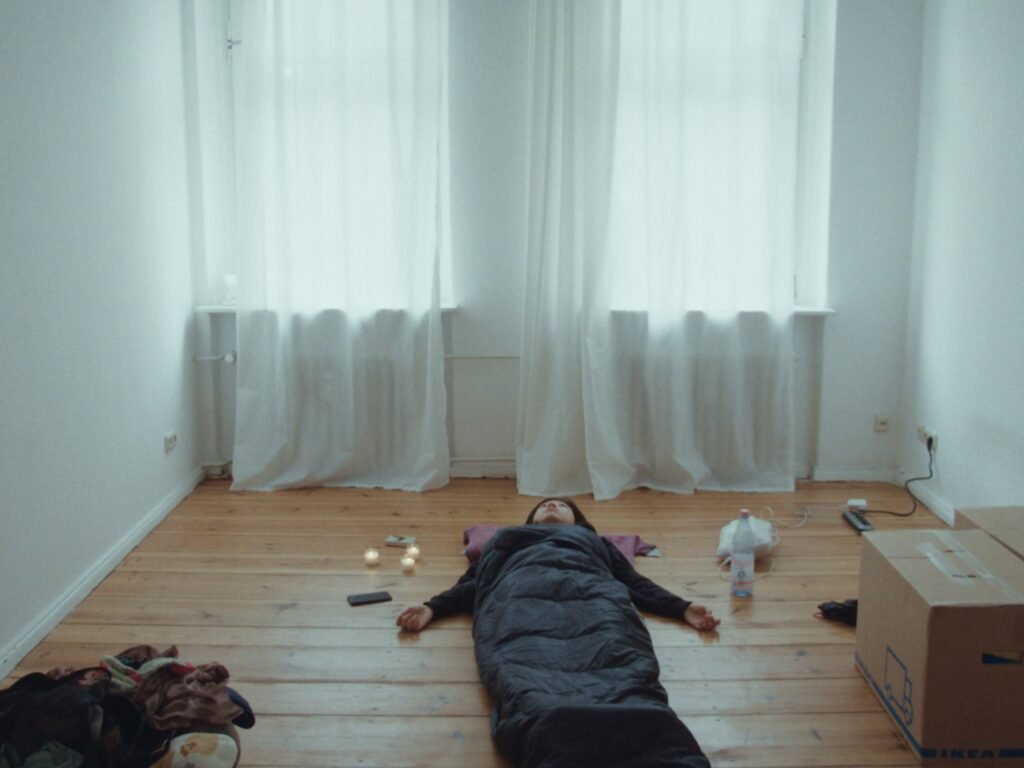
I like how it feels as if, in reacting to the camera, it’s almost a different way of maybe just “when the body says yes” to the camera.
When I was filming “When the body says Yes” [by Dutch artist Melanie Bonajo] with my friends, I felt like it’s more about when the body says no.
I did a little bit of research on the Biennale exhibition by Melanie Bonajo, which was interesting to see alternative ways of connecting because your film also searches for that type of thing. I was wondering if you could talk a bit more about the 300 hours of footage you have and how it takes on a fragmented vignette form. I understand that it could have been a longer film.
I started making the film during the pandemic, and I did not have a concrete form for how it would be. I had a short film as a base, “I Don’t Feel at Home Anywhere Anymore”, purely based on a timeline of going home for nine days. So originally I was thinking, okay, let’s look at the timeframe. My editor [Christoph Bargfrede], who is German and lives in Cologne, watched 200 of the 300 hours. We listed the timeline of the film, and he edited a version true to the story: how I moved to Berlin, got used to it, went back to China, came back, went back again. There was a 10-to-12-hour version and a four-and-a-half-hour version.
We watched the four-and-a-half-hour version with our producer, and somehow we found it really, really boring. I was really confused, because individually all the scenes are very interesting—but together it was just unbearable. We went on an editing retreat in Paris, frustrated, but we had to pitch in Cannes for finishing funds, and they asked for four scenes. So we picked four very good ones—a scene in China, a scene in Melanie Bonajo’s work, a scene in the desert—and put them next to each other in a ten-minute clip. Even though they’re not related in timeframe, they had a really interesting reaction to each other. That’s when I decided to give up on the longer timeline and go for a nonlinear one, only including things that react to each other in an emotional way.
As a person with different cultural backgrounds, living in another country, your cultural environment shifts all the time. Even when I’m cooking here in Berlin, and my mom calls me, I can shift to a Chinese mode immediately, and then shift back to a Berlin mode right away. It’s become a survival system, this shifting—environments and places don’t need to be next to each other in time; you just need your mind to be like that. So we decided on that and came to the 100-minute version, and we found that more interesting. It was not really difficult to abandon the other footage, because we basically just sat there and thought about the most interesting things that happened in my life over the past five years. The things that didn’t stay in my mind were also the footage we didn’t use.
That’s interesting—it’s almost as if the events that didn’t stay have also been relieved from your own memory. It brings me to the title in Chinese, which is a Teresa Teng song (東山飄雨西山晴), and this idea of balance. I also feel there’s absurdity in some of the reactions or conversations, or in how one just accepts climate change. Could you talk about absurdity and humour?
I would recommend you listen to that song. The titles in Chinese, English, French, and German are all different—I don’t like translating a title word by word, because each language means different things. Sometimes I hit a bottleneck when I’m creating and just listen to different sounds, and Teresa Teng’s songs always gave me inspiration. The Chinese title has this mountain relationship with the English one, and the song basically says: you’re on this mountain, the other mountain is sunny while yours is raining, and when you get there, the weather has already changed. Western education, especially American culture, taught me that you can change a lot, you can do everything. But coming from China, it’s like, no, you can’t do anything; everything will just keep going, and nothing will change. As I grow older, I feel like I’m siding more with the Chinese philosophy.
As for the humour, two things come to mind. When I went abroad for the first time, I studied theater in Manchester at 19. I arrived really super excited, and I thought I was gonna make a lot of good friends there. All the other people were British, and I was the only non-British person, and my English was not so good. We had to study Shakespeare, so I was completely clueless, and when we performed, I often made mistakes and didn’t know the lines, and people would laugh at me. I got really embarrassed and kept crying every day. Then my professor, David Butler—I’ll remember him forever—called me to his office and said, “Viv, you know how desperately British people want to make other people laugh. You didn’t even use effort, and you already make people laugh. It’s a difficult thing to do, so congratulations.” From that moment onwards, I just let it go.
Later, I realised that if mistakes can help me, maybe they’re something good. I don’t have a cinematographer or other people there for me, so I had a very committed and limited visual style, and because of that, I could capture a lot of really intimate conversations. The humour just grew from there—I make fun of myself.
The second thing is that when you really cannot do anything, you’re not frustrated in the end, once you accept it. The last thing you can do is just laugh. I was with a friend in Paris waiting for a bus, and an older French lady was holding a dog that kept barking at us, really aggressively. The lady smiled and said, “Oh, just the dog is racist, I’m not racist,” and my friend laughed out loud. Under the humour, you feel a bit of sadness or helplessness. Humour is also a layer of helplessness—on social media, you see a lot of jokes about Donald Trump, and you feel that underlying helplessness of not knowing what to do. In my film, there are certainly a lot of things I don’t know what to do about, and that’s why they’re funny.
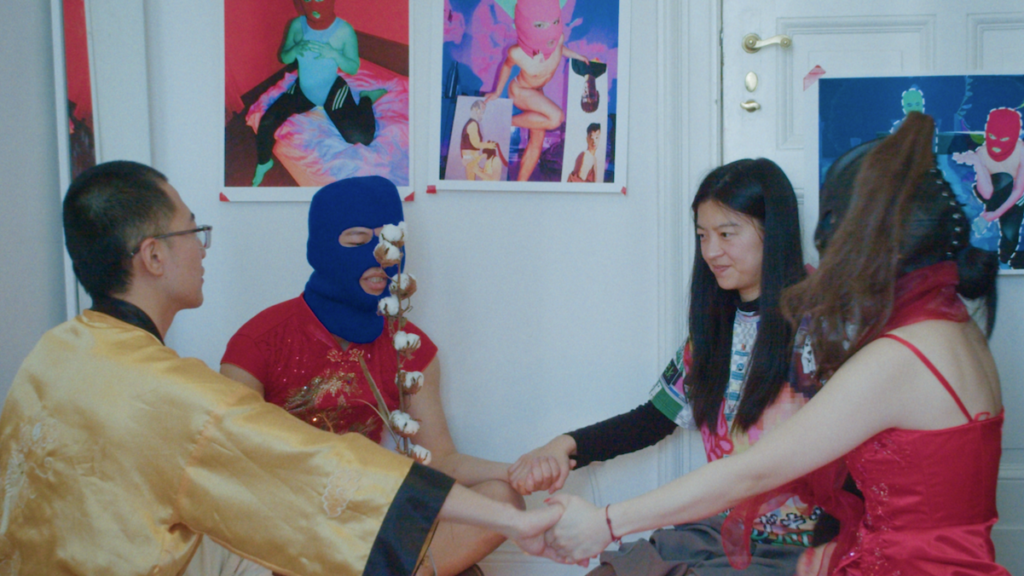
There’s a moment where the version of you in the film talks about the desire to be in communities. Could you talk about that in both the making of the film and its reception as you’ve been traveling with it?
It’s very interesting, because after making the film, I was most scared of the queer community in Berlin—especially of Melanie, who is a good friend of mine. They made a very different film from mine, and we had an agreement to license their material, so I worried about how they would perceive it. I was super nervous, so I did a test screening with all my queer friends in Berlin, and I sat behind them. Afterward, the six of them turned around and said, “Our takeaway is white people are fucking weird”—and they were laughing at themselves as well. They told me it is truly my freedom to perceive however I want. From that moment, I felt the community was truly supportive and open. There are communities that advocate for their own space but close themselves off to other people’s expression. I’m not expressing something to attack them—it’s really more observance.
With my family: I showed the film to my grandma, who was dying earlier this year. I was worried she would feel angry, but she was super calm about everything. She was just worried about the people who don’t wear so much—whether they’d catch a cold. That’s when I realised maybe she really didn’t care: she was poor, she experienced the war and the Cultural Revolution, and compared to all that, my problems nowadays are at a different level. I felt, wow, I underestimated her.
My friend said a beautiful thing—that it feels like watching a film where you go into a room, learn who is there and what game they’re playing, play the game, and then go to another room and meet new people. We’re all shifting between rooms. I believe maybe at one moment my grandma was a hippie as well, and ran around naked—that was the room she stayed in for a moment, and then she went to another one.
Community is exactly like that. I tried to go into the queer community, or the hippie community, or to be with Chinese artists, and all of these things exist everywhere, and we are all just moving around them. No one stays in one community forever. I feel like I’m still floating in this building. I never felt the urge to stay in my room my whole life, but I can also just chill here and feel comfortable.
There’s a scene where Popo Fan [a Berlin-based queer filmmaker from China] jokes about receiving all these questions: “Where do you come from? What do you do? Will you stay after your studies? Why is your English so good?” What would you want someone to ask when you enter a new room?
I hate the question of what you do, because I spent a long time being a filmmaker without a film. For four years, I called myself a filmmaker, but I didn’t really have a proper film out there. Nowadays that’s changed, but I remember all those times when people asked what I do, and I was like, I don’t really do anything. So I would never ask that question—I would ask people what they like to do. I try to practice this now, because in Berlin there are so many unachieved artists, and when you ask them what they do, it triggers so much.
I would like to be asked what I like to do, and I actually really like simple things. I like eating a lot. My editor said all the scenes in China were about food, and after editing the film, he said, “I want to go to China.” He came to visit me, and he just wanted to eat. I think people who do not eat well, or who do not have a good taste for food, are not to be trusted with artwork. I strongly hold that opinion. When I work with people, I eat a lot with them and see what their opinion is about food—it tells you a lot about them.
I also like the question “Where are you coming from?”—the space where you lived tells you a lot. Nowadays, there are more and more definitions. This pronoun game is something I really hate; instead of really respecting it, it becomes a form that has lost its meaning. I would like to be asked what I like to do, where I’m from, and maybe what I like to eat. Recently, my gums have been totally inflamed, so I can’t eat hot pot—but I love hot pot.
*****
Watch the trailer for the film here:


