

C minor chords—careful—hesitantly ascend into something more hopeful. It’s Paris, 2013: the Taubira Law (Loi Taubira) has just been passed, granting same-sex couples the right to marry and adopt children together. Cautious smiles pass between 32-year-old Céline Steyer (Ella Rumpf—whom Francophone cinema now loves to play with as the femme with a gently masc side) and her now-wife, 37-year-old Nadia Steyer (née Hamadi, with Monia Chokri in her third sapphic role of 2025), as they head toward the elevator. Nadia lets out a small sigh and rolls her eyes when Céline insists on moving in for a quick peck on the cheek—in public—and a cheeky wink emerges from the latter in response.
With these opening moments, we’re locked in to Alice Douard’s warm, honest, yet carefully crafted feature debut Love Letters (2025, Des preuves d’amour, literally “Proofs of Love”), which premiered last year in Cannes Semaine de la Critique and played most recently at the 50th edition of San Francisco’s Frameline. The feature is thematically connected to the filmmaker’s César-winning short film Expecting (2022, L’attente); Douard and her partner Marie Boitard produced both films through their company, Les Films de June, and loosely lend their own story. To adopt her own child, carried by Nadia, Céline needs as many photos of the two of them as possible: birthdays, holidays, events, gatherings. Then, she must gather 15 written testimonials from her friends and those around her: the titular letters.
These love letters are—apparently—about seeing whether the child is accepted by the ones around her and how she acts as a mother. Céline’s hesitant nod toward her lawyer means she understands. The greatest bridge to cross, however, is soliciting a letter from her mother, a famous Prague-based concert pianist (an ever-so-gently acerbic Noémie Lvovsky) with whom she had a distant childhood, fermented now into a strained relationship.
With this mother-daughter chrysalis, music organically becomes the film’s connective tissue, relying on a light, bouncy feel generated by short aural sequences. Douard avoids traditional soundtracking with original music and instead infuses the soundscape with gusto, criss-crossing non-diegetic indie electronic tracks—groovy compositions largely by French composers and producers Laurent Dury and Chapelier Fou, individually—with diegetic piano pieces by Beethoven, Chopin, and Satie as well as bass-heavy club dance tracks. Editing by Pierre Deschamps oscillates between montage and shorter moments, as if creating a rhythmic swing in the pacing itself that keeps us on our toes.
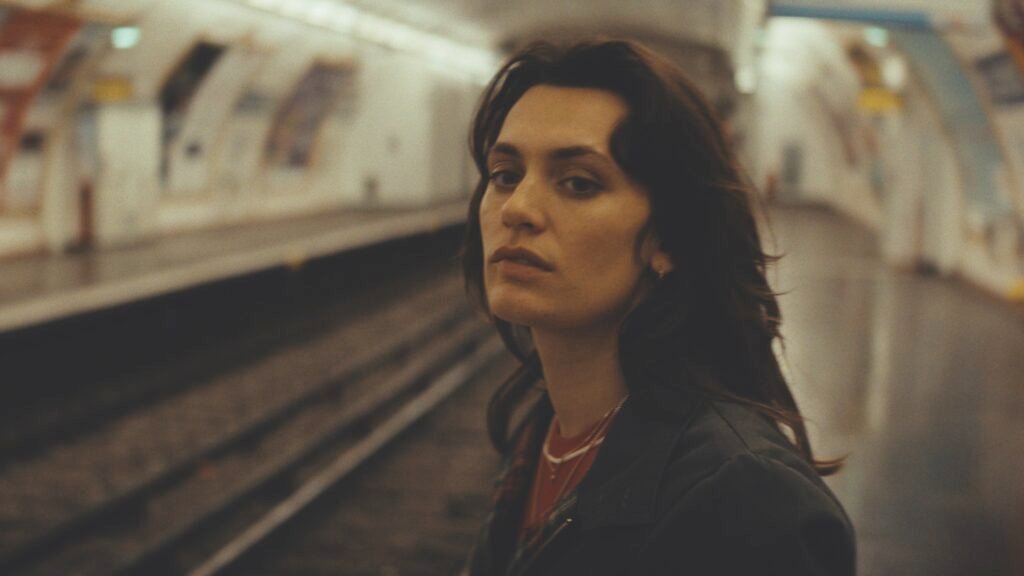
After that first sequence with Nadia, and as soon as Céline’s foot hits the ground outside, a hollow yet melodic percussive beat begins to thump in the background—first, seemingly acoustic, then it turns electronic (Middle Sky Boom and Eliezer’s “A Tricky Time”). There’s something lightly alien about it, but nothing is foreign. Indistinguishable vocalisations expand into electronic chords as Céline enters the Paris metro and grows more confident. The filmmaker is intent on establishing her, first and foremost, as an individual before she is expected to be a mother. Costuming by Pauline Juille surely makes the character the coolest-dressed sapphic of 2025 as she pops Nadia’s blazer on top of a full-zip athletic jacket (her regular wear as a sound engineer and DJ at a concert venue), and a colourful scarf.
Céline’s gaze betrays where the camera travels. In the opening scene, she pries a piece of gum out of her mouth, and the camera moves with her hand as she finally puts the wad into her partner’s outstretched palm. Later, in the couple’s heavily lived-in flat, the camera is seemingly slow to catch up. Instead, it sees her reflection in the glass table, as if Nadia and Céline themselves are the ones to lead. After all, they are told that they are one of the first couples to adopt a child after the passage of the Taubira Law, allowing them to set a precedent.
Cinematographer Jacques Girault’s camera, after it follows their movements, also watches them carefully. The scenes filled most with Céline’s anxiety roll out in the frame’s casual instability, unable to keep her jitters from infecting it. Yet, in the scene where they confront her mother, Nadia becomes Céline’s grounding force; she’s confident and charming, and the camera no longer shakes. The tenseness in Celine’s voice (literally in the timbre—it tightens) betrays how she feels toward her mother. Yet, as the former watches the latter play piano, she can’t help but soften slightly. The lens slowly zooms in on her as she watches.
Douard has spoken about her interest in (re)directing the gaze, whether it be through zooms, looking directly down the barrel of the lens, or otherwise. She also makes liberal use of transitional fades, with some of them more diegetically driven, such as a set of window blinds coming down. The camera is always in close quarters of the two, except out in the city, when they’re shot with a long telephoto lens. With this choice, the cream buildings of Paris seem to stretch far out in a blur behind them, like they’re buffering—waiting, perhaps, for Céline and Nadia’s decisions to come into view and come into clarity.
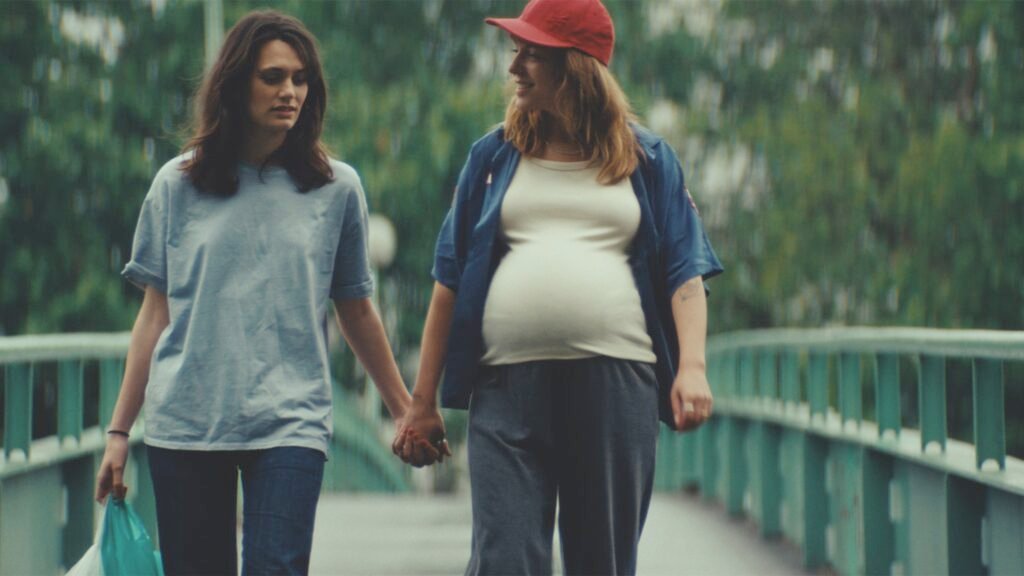
So how did they do it? “We made love,” Nadia cheekily tells her entitled friend, who can’t help but demand answers to their pregnancy. Douard spends significant screen time outlining the arduous absurdity of simply existing as a sapphic couple, which readily applies to the year 2026. Between handling entitled men—including one friend with the audacity to ask why he couldn’t have been their sperm donor and a man at a bar whose barrage of heteropatriarchal verbiage borders on violence—the writer-director shows that Céline and Nadia have to be more ready than anybody else.
Yet Love Letters is no teaching film of same-sex parenting for dummies. Two different women react to the same situations: Céline—closed and deliberate, with her hands half in her jean pockets, and Nadia—open and spontaneous, punching that man at the bar and running. They must play their own roles to get where they need to go, with each complementing the other. When they go clubbing together while Nadia is six months pregnant, we are able to understand how they understand each other. Their relationship is also on the line.
Douard punctuates her scenes with a combination of light humour, long pause. With this choice, the heaviness is dabbed at, but it never takes away from the weight. She wears her heart on her sleeve, but you might need to take off the full-zip jacket first to see it.
*****
Watch the trailer for the film here:


