

Quiet and introverted Rio (Gavrilo Jović) actually has a lot on his mind. Striding with confidence through a coastal Croatian town at night, he moves through the crowd like a slippery fish. Landing on the beach, he scans it quickly before ducking low and stealing the valuable belongings, in one swift and rehearsed movement of the body, of the four young tourists playing in the water. A young woman sits on the rocks above, watching him carefully. In his debut feature, Petty Thieves (2026, Sitni lopovi), Croatian filmmaker Mate Ugrin (read our interview with the filmmaker here) puts forth a compelling cinematographic hypothetical: what if we redirected the gaze entirely? What if others are encouraged not to look—could this, too, be just as intimate?
Petty Thieves received the FIPRESCI Prize in the Proxima Competition at Karlovy Vary International Film Festival in the Czech Republic, where the jury called it “a summer film with a dark twist”. The film went on to play at Croatia’s Pula Film Festival—in the eponymous coastal Adriatic town inundated by mass tourism where the film was shot and where Ugrin was born—and where Olivier Voisin won the prize for Best Sound Design.
Rio and the viewer eventually find that the woman on the rocks is the seasonal worker Andrea (Tea Ljubešić, with whom Ugrin reunites after she starred in his Heart of Sarajevo-winning 2021 short film, Everything Ahead), who develops a curiosity for him and his activities. Rio thrives off of privileged tourists not paying enough attention. In response, Andrea proposes that they team up to burglarise the hotel rooms of wealthy older tourists she recognises from her spa-resort job: he breaks in, she keeps watch.
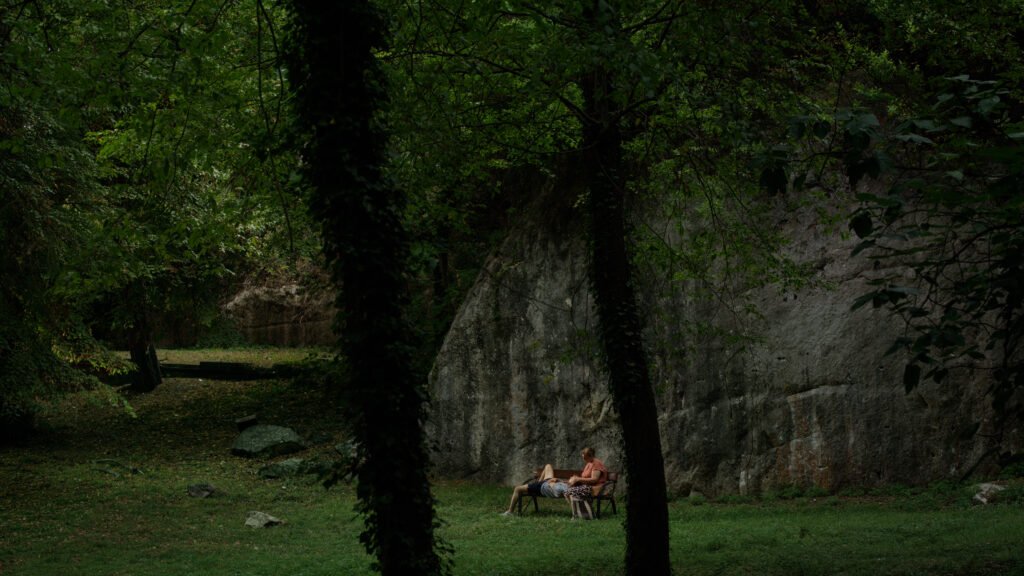
His story with Andrea is one of three parts of his life that hardly cross. He keeps his personal life close to his chest, with a developing resentment toward his grandmother (Snježana Sinovčić Šiškov), who has begun dating an Italian man while preparing to send her aging husband (Izudin Bajrović)—Rio’s beloved grandfather—to a care home. (To return to the idea of looking, Rio takes it upon himself to look after his grandfather when he can.) Finishing out this circular existence are his shirts-off ventures into the nearby woods, which young men, locals and tourists alike, have developed into a cruising spot. While Rio’s ability to compartmentalise may be his coping mechanism, the disjointed nature of the three intertwined narratives doesn’t congeal as satisfyingly as it could.
Ugrin is fond of wide and extra-wide shots during moments in which we might expect to be closer to his characters. But he also keeps us, literally, in the dark, as much of the film is shrouded in the pitch-black of night: see no evil, hear no evil, perhaps. Lulling us into a false sense of security, we begin to forget about the distance that the filmmaker has intentionally created between not only his characters, but also between us and his characters. “Are you always so silent?” Andrea asks him during their first official meetup. We are really only witnesses to Rio’s internal thoughts by the way he acts, except for a moment near the end of the film. He minds his own business. He has a routine. He keeps to himself. Rio’s face and the ringing soundtrack (by Nika Son, who also composed the soundtrack for the 2025 film Strange River) tell us that he doesn’t necessarily do it for the thrill of the chase. He’s in and then he’s out. Rinse and repeat.
Later, Andrea asks Rio about his habits of theft: “Does it turn you on?” Her question seems to be a way for her to get closer to Rio, whose aloofness is attractive to her. Their connection becomes a platonic—or even briefly queerplatonic—relationship of sorts, where they see each other as kin above and beyond because of this secret they share. While she seems to harbour some romantic affection for him, Rio gently makes known that it is not necessarily returned. A man in the forest asks whether Rio doesn’t like to kiss after he looks to the side and walks away from the start of a sexual encounter. Ugrin ultimately refrains from depicting any intensive physical intimacy onscreen. Maybe these acts of thievery are Rio’s true moments of intimacy: bonded forever with a stranger through a fleeting interaction that will never reoccur in the same way. There’s a quietly seductive element to what he does for both Andrea and the spectator—a closeness otherwise unattainable by other means.
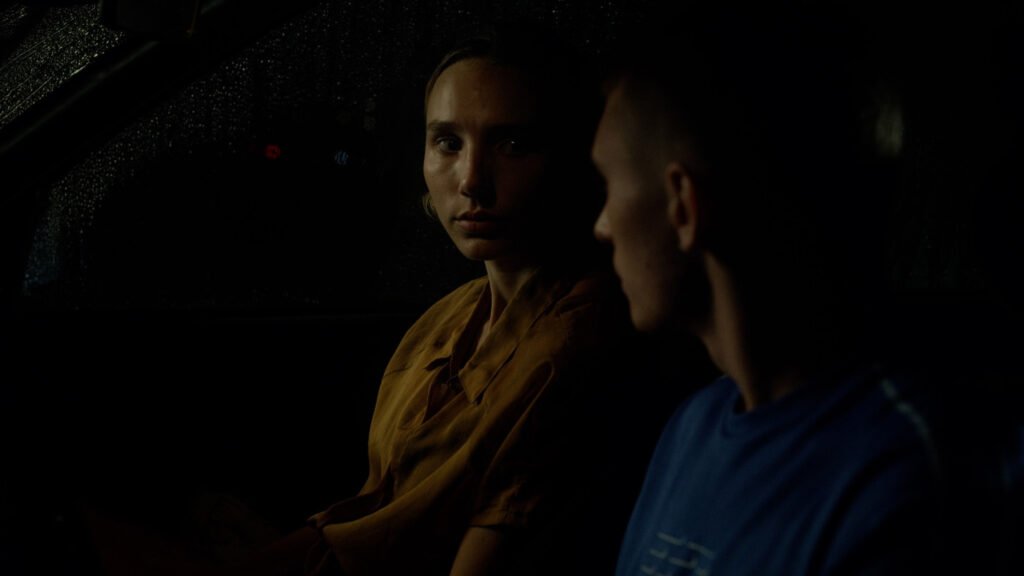
Andrea’s ambiguous relationship with Rio is ultimately more stimulating than the latter’s own more explicitly queer element. Petty Thieves becomes an example of a film that heavily bends the heteronormative framing of their connection to great effect. Rather than simply remaining friends or becoming love interests, their relationship between the two is founded on a certain morally dubious fixation. It’s a shared passion and even obsession, something that could be looked upon as queer-coded—be gay, do crime, even. The debuting filmmaker insists that we meet these characters as they are on the ground, something that we could never do in real life. This becomes the film’s reward, even if we might feel like something’s missing by the end.
Jović is a dancer turned actor, where the movement of Rio’s limbs in certain scenes is almost hypnotic. The camera remains at a distance, tracking him as he walks or runs with purpose, the background blurring into obscurity. Eventually, Andrea joins him during these scenes while the camera follows them, as if chasing a glimpse of two animals running through the woods. Ugrin reuses this evocation with the presence of wild boars, which root up all the vegetables in the neighbours’ garden. They linger ominously in the forest around: heard but never seen, somewhat like Rio and Andrea themselves. Often, all we can hear is the snorting of the boars, making their presence known. Yet, even if they are prey animals in the grand food chain—in the end, they still win.
*****
Watch the trailer for the film here:


