

In contemporary cinema, there has been a lack of memorable sex scenes over the past few years. I don’t mean that there is little sex on screen (although this is also the case compared to the 1990s), but rather that eroticism has been lying low. My trip to Brazil to attend the Festival de Brasília do Cinema Brasileiro reminded me of a film I saw at Woche der Kritik in Berlin in 2022: Venus in Nykes (2021) by André Antônio, a Brazilian mid-length film that impressed me with its ability to combine sexual yearning, queer pleasure, and politics with images deeply rooted in art and film history. The film was unapologetically erotic and honest, made on a small budget and shot in an apartment, with its writer-director playing both the psychiatrist and the patient. Undergoing therapy for a foot fetish, the protagonist cites Walter Benjamin, Pope Francis, and Brazilian poet-songwriter Glauco Mattoso. But it was not only the witty dialogue that made the film memorable; the camera movement did, too. The close-ups and pacing complemented the sophiophilic stroking. With Venus in Nykes still fresh in my memory, I set off to serve on the FIPRESCI jury in Brasília, hoping to encounter queer cinema that would impress me as much as the film I had seen in Berlin a few years earlier. That hope was only partially fulfilled.
Established in 1965, the Festival de Brasília do Cinema Brasileiro is the oldest film festival in Brazil. Originally part of the gigantic modernist project of building Brazil’s new capital city—which itself was laid out in the shape of an airplane—the festival has witnessed the rise of Cinema Novo and the independent filmmaking movements that followed it, each seeking new ways of approaching cinema in the hope of achieving a closer, more powerful engagement with reality. Partially state-funded, the festival continues to struggle with its budget. This year, it nearly had to be cancelled because the disbursement of state funding was delayed. Moreover, whenever an opposition party comes to power, the festival’s team changes, which disturbs the building of recognisable festival identity.
This year, the FIPRESCI jury was responsible for judging not the main competition but a sidebar competition, CALEIDOSCÓPIO, a new section dedicated to films that artistic director Eduardo Valente considered more experimental. The selection proved eclectic, ranging from a black-and-white parabolic tale filmed in 4K, Os vivos caminham a terra (2026, Through the Ground) by Pedro Maia de Brito, to women-centred documentary Mulheres do Bando (2026, Women from the Pack) by Thamires Vieira, and a generic revenge western, Tempo à faca (2026, Time, Knifed) by Diogo Oliveira. Rather than an emphasis on experimentation, the selection seemed motivated by the imperative to represent filmmaking from different regions of Brazil. Interestingly, this gave an outsider like me an insight into some stereotypical cinematic representations of localities. The northeastern states of Bahia and Pernambuco, for instance, often provide the backdrop for stories of parable, timelessness, and ethnographic interest—a tendency not unlike the way western provinces are represented in Chinese cinema.
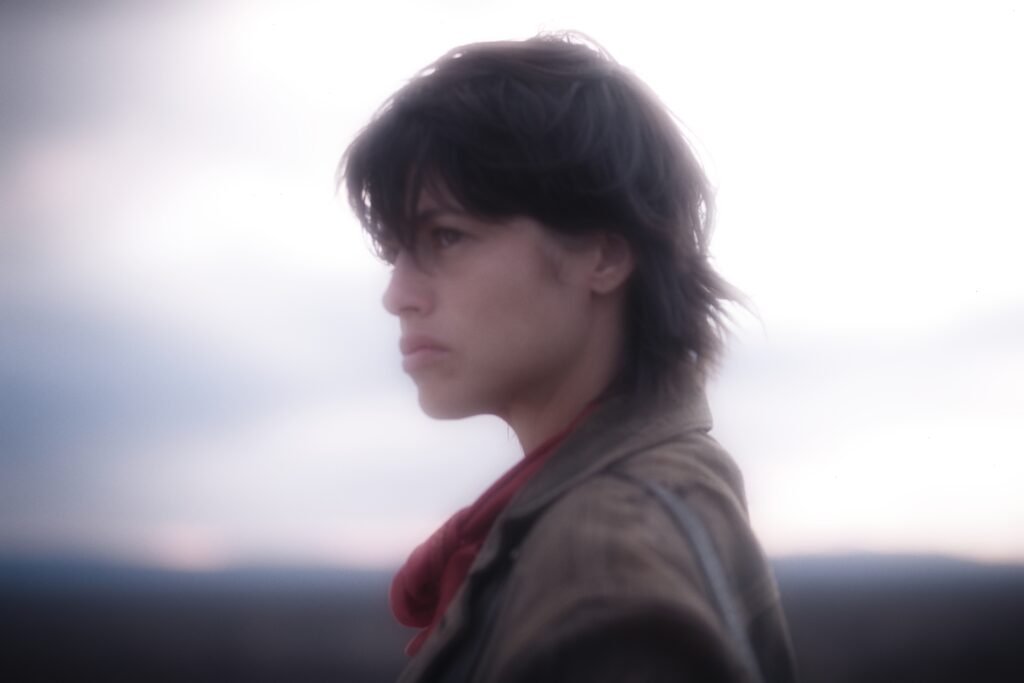 A still from Time, Knifed (2026)
This was certainly the case with Time, Knifed, set in Bahia. The film tells the story of an old outlaw returning to his village to fulfil a promise to his wife, which runs parallel to that of his granddaughter, driven by maternal vengeance and setting out to kill her father. While the plot offered few surprises, what happened in the screening room itself left a lasting impression, particularly the audience’s reaction to the film’s sex scene.
When the tomboyish granddaughter picks up a hitchhiker, their interaction makes it clear that the two women will eventually make love. This anticipation is not necessarily created by the chemistry between the actresses so much as by the way the dialogue is written, characteristic of films that tend towards exposition rather than cinematic expression. CALEIDOSCÓPIO screenings took place every day at 3 p.m. Because of the timing—potential festivalgoers were still at work—the audience consisted mostly of high school students on school trips.
When the sex scene between the two women finally arrived, the teenagers began applauding loudly, feeling awkward at the prospect of watching the scene together with their classmates, some of whom they might have a crush on. Yet the reaction was not necessarily prompted by the sex scene itself, but rather by the way it was filmed. The first kiss was immediately accompanied by rock music on the soundtrack, noticeably louder than the rest of the film’s soundscape. The camera filmed the women from above, from the waist up, offering what was perhaps the most panoramic view possible of their bodies. Their movements were fast and rather violent, particularly those of the protagonist, who was clearly supposed to act “masculine”, marking her as the top.
The encounter felt mechanical and forced. The teenagers’ reaction was not at all out of place, because the film seemed unaware of its own camp sensibility and exploitative undertones. It made me wonder whether queer elements in films from the Global South are sometimes included not because the story demands them, but to secure applause from Western audiences and tick another box on a diversity checklist. At the same time, I can imagine that the reaction would have been similar had the scene depicted heterosexual sex. The crux of the matter lay not in the gender of the participants but in the way the scene was filmed.
It was interesting to compare the reaction to Time, Knifed with the audience’s response to another afternoon screening attended by a school group, this time of Os fantasmas gentis (2026, The Gentle Ghosts) by Caetano Gotardo, which also featured a sex scene. The film revolves around Inês, a woman in her fifties who works as a bank clerk. Once a week, she goes to karaoke to sing a single song, pouring her heart and soul into the performance. One evening, she meets Hélio, an ornithologist who is enchanted by her singing. The film is a chamber piece, shot with a steady camera and built largely around dialogue between characters in apartments and cafés in São Paulo.
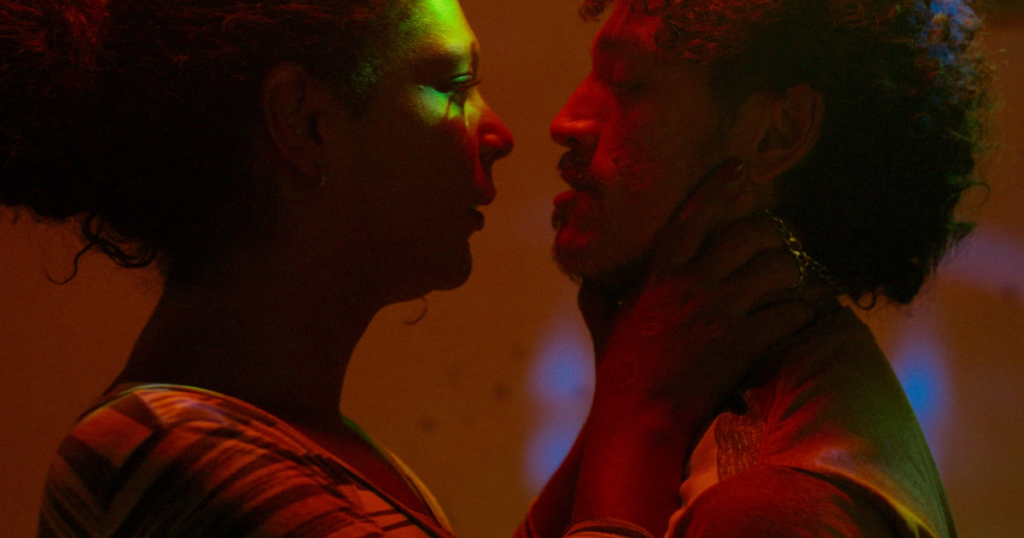 A still from You Know Me, Now Forget It (2026)
The sex scene, however, is filmed in close-up, with the two bodies intertwined so tightly that it is often unclear which body part we are looking at. Rather than using non-diegetic music, Gotardo foregrounds the sounds of breathing and bodies rubbing against the fabric of the couch. The movements are slow, sometimes awkward, as the characters struggle to manoeuvre their joints, elbows, and knees while trying to get as close to each other as possible. Surprisingly, this time the screening room fell completely silent. The atmosphere was heavy, and the high school students somehow found it impossible to laugh or applaud as they had done earlier. I do not believe this was because the sex scene was heterosexual: when one of the protagonists eventually comes out as queer, the audience remained silent throughout the screening.
The difference between Time, Knifed and The Gentle Ghosts, then, seemed to lie in their respective cinematic languages and approaches to reality. Eroticism is humble and honest about its fragility; in the introduction to the book Lesbian Cinema After Queer Theory, Clara Bradbury-Rance writes: “Eroticism depends on what is not shown rather than what is” (2019, p. xii). It is as much mental as physical, and it is not necessarily present during sex, which can be just a performance, a package, or a set of genre conventions. However, it is eroticism that makes us come—to cinemas too. Films like The Gentle Ghosts are increasingly rare in theatrical distribution and on the film festival circuit, partly because distributors assume that audiences want more of the kind of cinema they are already familiar with, considering it a safer bet.
Another highlight of contemporary Brazilian queer cinema that I had the chance to see in Brasília follows precisely that trajectory with regards to the safe bets at the film festival circuit. Sabes de mim, agora esqueça (2026, You Know Me, Now Forget It) by Denise Vieira, which received an award at FID Marseille in 2026, fits more readily into the established international image of queer cinema. In one review, the Brazilian film critic Diego Battle summarises it as a “feminist fable that addresses the sexuality of trans women with elements of fantasy and dystopian science fiction”.


