

Directed by Amy Jenkins and written (and scored) by Adam Sieswerda, Adam’s Apple is a collaborative documentary by mother (Jenkins) and son (Sieswerda) that follows Adam’s childhood to young adulthood, notably as their family collectively changes and grows alongside his transition as a young trans child, teen, and then adult. Rooted in a large archive of family home video, we play witness to the honest conversations and landmark moments between themselves, their friends, and their greater family. The intertwined perspectives of both Amy and Adam offer a cross between an intimate, cooperatively created personal diary (lingering present), a thoughtful note to one’s past self (looking to the past), and a reminder to those with similar experiences that there are beautiful precedents (angling toward the future).
Adam’s Apple premiered at South by Southwest (SXSW) and went on to play at CPH:DOX. In the context of Frameline50, where the film screens next, Purple Hour spoke with Jenkins and Sieswerda to discuss what it means to have a trans gaze in documentary filmmaking, going through a process of retrospection, and the burden of education that their film innately holds.
*****
Purple Hour: The first thing that came to mind when I saw the film is that quote that says something like, “loving someone to the point of invention” or “to the point of creation”. Maybe it’s clichéd to say, but I think it applies here. What does it mean for you to collaborate—personally, professionally, creatively?
Amy Jenkins: Our collaboration has definitely grown and shifted as Adam has matured. We started when he was 14 on a very loose concept. We just really wanted to film for our family archives and for ourselves. As life has progressed, our collaboration has gotten much deeper. Adam is an amazing musician, and he came on to do the music in the film and also went to college for creative writing, so a lot of his abilities expanded as he got older. The underlying principle all throughout is how important communication is: checking in, making sure that we’re both on the same page, asking permission to film. There are certain ways that we’ve tried to always respect each other’s processes and creativity. Those approaches have been consistent throughout.
Adam Sieswerda: Particularly as the writer and telling a story with the film, it was important to show that transition is not a singular experience, at least in my experience of transition—it’s very much a collaborative experience and an experience of our whole family unit. Even though maybe I’m the one who’s motivating some form of transition and transformation—that can mean gender, but that can also mean many other things—it’s like we’re all changing together. That necessitates creative collaboration in the story itself. A singular perspective can’t capture that. It has to be from a collaborative perspective. It was less so thinking of that back when we were just capturing footage for ourselves. It was when we were deciding to actually tell a story that I felt was important to have through the collaboration.
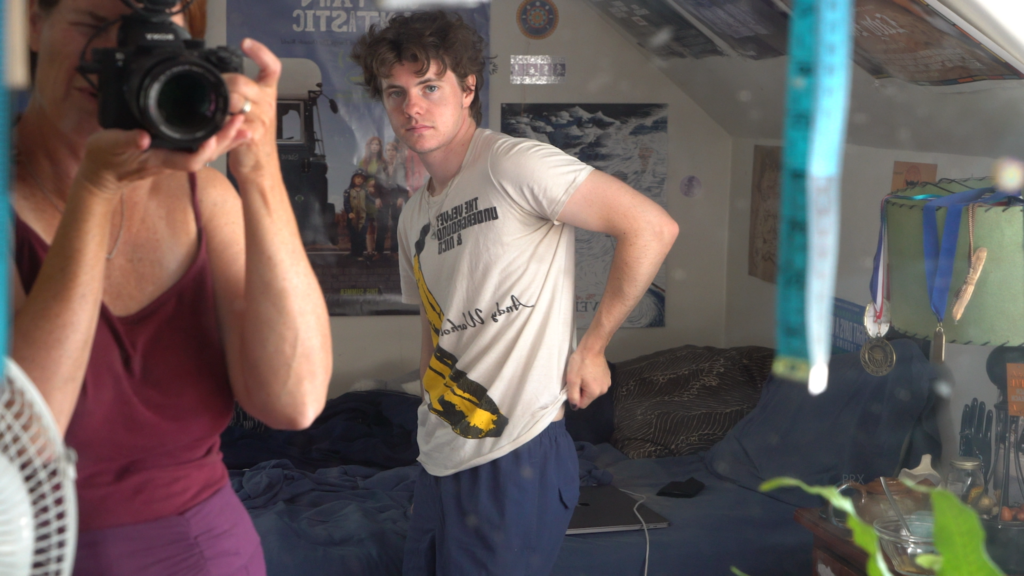
I have read that the story really came together in the editing process. There’s also this idea of a retrospective look or perspective in the film, whether it’s looking at old photos or reading things that had been written when Adam was young. How do you think about this process of looking back?
AS: By looking back on old footage and transcripts of past conversations, I was able to have this type of reflection on my questions surrounding gender and about growing up as a person in general—trying to figure out who I was, how I wanted to express myself, and how I dealt with the binary limiting rules that I had encoded in my mind. I could understand my process of working through all of that more than I could have in the moment. That’s still something I’m working through. We’re forever processing ourselves and how we deal with expectations in the world. Also, [it was through this process that I realised] my parents had memories of me that I couldn’t remember of myself. That was obviously building something in their minds. When these conversations were happening, I don’t think that was something I really had the patience to understand— I don’t think I had to have patience to understand it. I was expressing myself, and I needed to express myself in opposition, sometimes to a certain image of me. In looking back, I can actually understand where that image came from and have greater patience or empathy for them. I can know it’s not something that’s against me. It’s just something that was built.
AJ: I’m coming at it from a mother’s perspective, and a lot of the footage where we flashback to Adam as a toddler and very young child all comes from what I call my “motherhood archive”. One of the things that I always knew in my heart—but to watch Adam’s growth through all those years—was Adam’s consistency in his personhood. From very young throughout grade school and middle school and into high school, his unwavering basis of self was just beautifully consistent throughout. It solidified for me how we really do know ourselves from a very young age. There’s just so much negative rhetoric out there right now about how kids don’t really know themselves, and that they shouldn’t be given access to gender-affirming care at such a young age because they might change their minds. I feel like we don’t respect the fact that kids really do know who they are, and seeing the footage in the long lineage of almost 20 years also just reaffirmed that for me.
Building off of Laura Mulvey’s concept of the male gaze, there is a lot of discourse around a queer or trans gaze in fiction filmmaking, but I think it’s less spoken about in the documentary form. Do you relate to this idea of there being a trans gaze in the film, especially external to the content itself and from a formal or visual angle?
AS: I do feel like I have a trans gaze in the film, and I suppose generally in life, because it’s the way in which I see the world. In my journal monologues, where I’m talking about the progression of myself in teenagerhood in general, and also specifically with my transition—those are moments where I feel like the trans gaze is strongest. You see me trying to figure out how to look at the world, or even just looking at the world through this specific genderqueer gaze and trying to figure out how to be okay with that. I have to figure out how to come to accept that, and I slowly do over time.
What I really want, as we play with this movie in various places, is to show that the trans gaze can be related to by many different people, including people who are not trans. When looking back on my high school life, many of my cisgender friends had the same questions and dealings and everything with gender. Many of my friends, who are cis boys, felt like they couldn’t act in a feminine way because they would not be taken seriously. Those are all gender roles that we have encoded in ourselves. I think there is a trans-specific gaze, but I also want people to see that they have at least part of that perspective in themselves. I think it can act as a bridge, especially now in these times where some people have set up this “us versus them” standpoint. However, we’re all experiencing gender and experiencing this world, and so we have many of the similar questions. Sometimes, it just takes a bit to see that.
AJ: One thing I love about queer cinema is that it’s oftentimes more experimental in storytelling or non-hierarchical in nature. What we were trying to model with our film was having as many queer and trans people on our team as possible. Our story consultant, Carter Sickels, is a well-known trans male author. Our producer, Brit Fryer, is a trans man. Our assistant producer, Ian Madrigal, is also a trans man. Adam and I are so close to the material, so we wanted to have other people watch it with us through the edit. We would have these massive 10-hour Zoom calls sometimes and talk through every scene. To have people like Brit and Carter and others bring their viewpoints really helped a lot. I’m also much more attracted to stories that take some kind of risk with form and not necessarily have a standard arc. Our film is a little bit like this. There isn’t this hero arc—it’s more of a durational storyline.
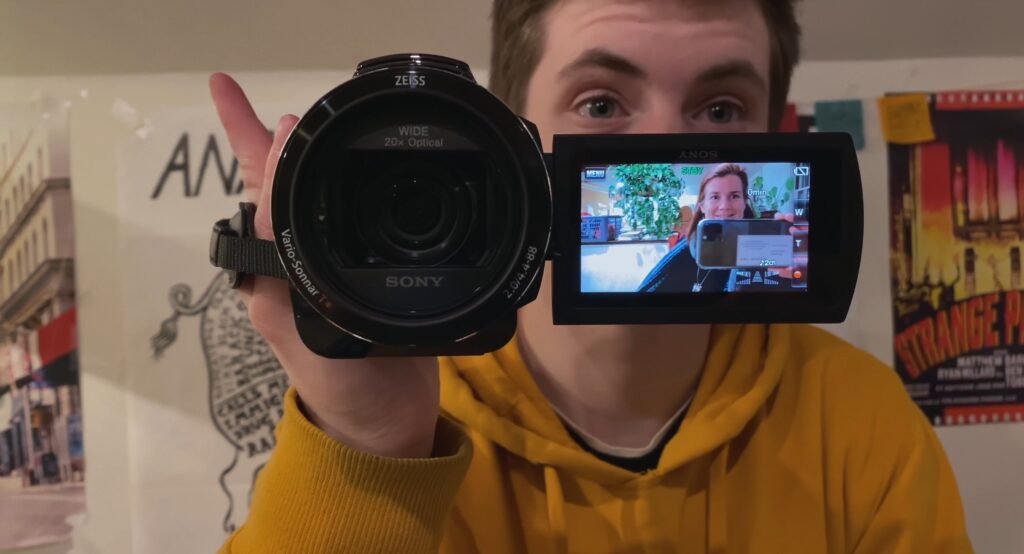
I’m reminded of Kani Lapuerta’s Niñxs, where the filmmaker described a very close melding of film and life because of how the footage was shot over so many years (see our interview)—and with the camera simply integrating into the everyday. How do you relate to the concept of film and life as inseparable in the case of Adam’s Apple?
AS: I’ll say I feel that now, but I don’t think I felt that when we were filming. Almost all of the footage you see up until later in high school, we were kind of filming for ourselves. That pressure of an external audience was not there. Because of that—and I had grown up just being filmed by my mom, too—it didn’t feel like some foreign camera in the room. It was very natural. In the later half of high school, that’s when I really started to be like, “Oh, I would like this to be a story. I would like to contribute to this trans narrative that I feel is lacking in the world.” I think that inseparability is something that will probably fuel a lot of writing for me in the future, because I’m very interested in this question of memory, how we deal with people’s perceptions of ourselves, and people’s memories of ourselves that are different from our own. This film really brings all of that to the forefront of my mind, because I can look back at this footage and see these other memories of me that I don’t have of myself. They’re very much true, but they’re just not maybe true to me—or not in the same way entirely.
AJ: My practice as an artist has been to document my life in some form, and I’ve been doing that since literally my grandfather gave me a Polaroid when I was like eight. I’ve always been very interested in witnessing different moments through time. This is my second feature film, and my first one was also a personal film about my mother, brother, and sister and their cancers, called Instructions on Parting. It’s a very curated thing to build an archive of one’s life. It’s still manufactured in some respects, because it’s what you choose to film and how you choose to capture it. Because I was already an adult, I had a better understanding of what it might be to film and create something than Adam did when he was 14. Perhaps in the back of my mind, I understood that this could become something. But because my camera was—sometimes I wouldn’t even necessarily be looking through it—just like another object in the room, it didn’t really affect the way we behaved with one another. If it had, I probably wouldn’t have filmed all the time.
The film implicitly holds this burden of educating and informing both in the content—for instance, Adam carrying the responsibility as a child to educate his parents—but also in the structure. However, it’s not a didactic film. Can you talk about how you saw these aspects of the work?
AS: Because of how we are in the world today, there is an implicit informing that does happen when people watch the film, if they have not interacted with trans people or have a trans person in their life. In terms of purposeful responsibility, I felt we were shifting the focus onto trans joy and the beauty of growing up while happening to be trans—and not in a way that erased the transness. It is both on the same plane as you grow up: I’m trans, I’m growing up, and I’m joyful. I was very lucky to have a family and live in an area that was accepting enough to make that possible. That is not always the story for trans people. I don’t want it to be seen as universal, either. I want it to be seen as one subjective trans story. There are a lot of trauma stories out there within queer media, and there’s a lot of trauma out there in general in the world. It’s very important to talk about that aspect, and that can’t be the only narrative able to be found. When I was younger, I wanted a joyful coming-of-age story centring a trans boy, even if that meant joy alongside struggle.
AJ: There are so many different levels to what the film can do. I feel like it is so very needed right now in our current society and with the current administration. With the negative focus on trans youth, in particular, the film has become more essential. When we started, we just thought things were going to get better. And so, I think it is an important teaching tool for people who haven’t met trans people, for young trans kids to be able to see themselves reflected, and for parents of trans kids to have a common experience. What I also really love and appreciate about our film is that reckoning with change is a universal experience of all parents—learning how to let go of expectations, loving the kid that you have—regardless of whether you have a trans kid. It’s about constantly adjusting your expectations, letting your kid lead sometimes, and not forcing them to fit the box that you think they should fit.
*****
Watch the trailer for the film here:


