

Brydie O’Connor makes her feature-length debut at the 2026 Sundance Film Festival with Barbara Forever, an archival-forward film about the life and work of Barbara Hammer. Hammer is known as a pioneering lesbian experimental filmmaker and, more widely, as one of the most important figures in queer cinema, particularly in the US. O’Connor peels back the layers of what is known in the public consciousness to grant us an expansive look at her oeuvre and who she was beyond the screen.
Beginning with a bachelor’s thesis on Hammer’s early work, the New York-based filmmaker went on to create a 15-minute short film, Love, Barbara (2022), led by interviews with Hammer’s wife and archivist, Florrie Burke. This film acted as the first inklings for her documentary feature, complete with more material and more depth.
Purple Hour had the pleasure of sitting down with O’Connor to discuss her process into this film from an archival perspective, cultivating queer presence onscreen, and depicting the enormity of the life of Barbara Hammer.
*****
I’d love it if you could start by talking about your relationship to this idea of “queer cinema”, whatever that means to you and either in the context of this film or your work more broadly.
I’ve had such a blast making a film about queer film. I originally gravitated toward Barbara Hammer and her work when I was trying to find lesbian films that were made by lesbians. This was nearly 10 years ago, so I have been in Barbara’s world since then. I’ve learned so much about her life, intentions, and motivations behind her career, but I’ve also thought a lot about Barbara’s place in queer cinema history and what it meant to her to represent a lesbian life on screen. Her lesbian life on screen, specifically, I think I am so drawn to. I’ve been thinking about this idea of how to share with audiences what it means to document a lesbian life from birth to death.
When she was coming out, Barbara didn’t really know where to look in the world to know how to be a lesbian. She was 30. She’s the same age I am right now when she tells us that she first made love with a woman. I was really interested in how such a personal and intimate experience could be translated on film. There is this strong documentary or essay element to her work, but she’s an experimental filmmaker and plays with form. Her work is very much in the avant-garde cinema space. I am just so fascinated by this idea that Barbara says she was living an experimental lifestyle, so she wanted the form of her art to reflect her life. Barbara did that since the late ‘60s, and it’s so inspiring for me as a lesbian filmmaker to think about what interests me and my work. How can I best express that to share a queer perspective – or just a really honest one? That’s certainly the approach I took with this film and its form, and the way that we piece the archive together with the original scenes.
Can you elaborate a bit on how you went about queering this chronology, if you will?
I was very curious about structuring the film when I was first starting to develop it. I was really excited about the idea of moving through time and really letting the past, present, and the future converse with each other throughout the film. To be honest, I wasn’t sure how that was going to work from the get-go, so I really wanted to think about how I experienced time. A documentary about Barbara Hammer deserves an expansive form. She was such an expansive person and an expansive filmmaker. I also wanted it to feel like something that felt true to me as a filmmaker. I asked myself, in terms of queerness, what draws me to Barbara Hammer? How do I experience my queerness in time? Like Barbara says in the film, “I was born when I became a lesbian”—and she felt like that for so long. She called it her “dyke adolescence” through her 30s and her 40s. I wanted the chronology of the film to feel inherently queer and not necessarily only reflect Barbara’s sensibility as an experimental filmmaker.
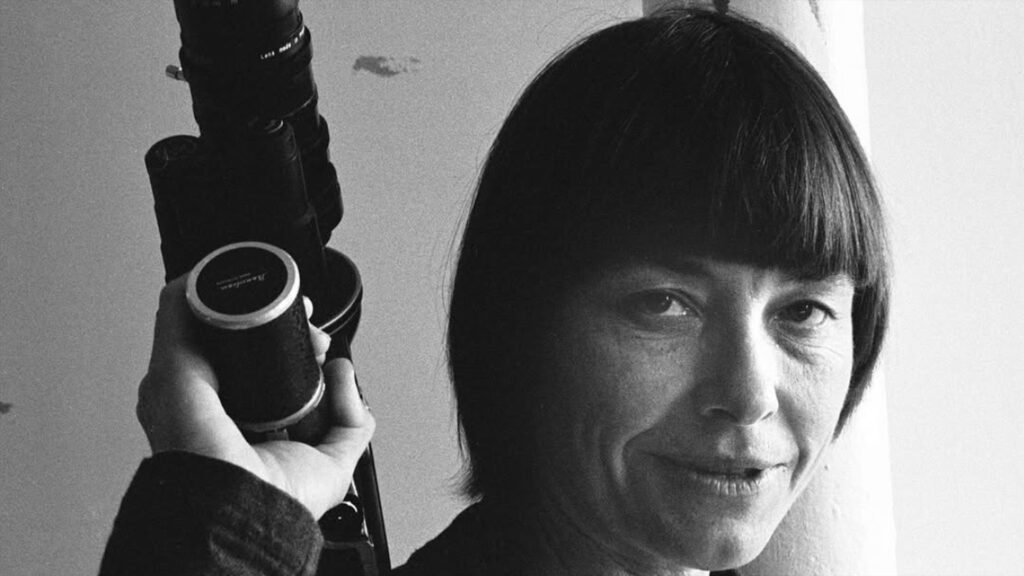
You’ve worked as an archival producer on several projects. Seeing as this film is heavily archival, could you talk a bit about this type of work?
I have a professional background as an archival producer. First of all, I love archival producing. Having this experience of how to organise and work with the sheer volume of Barbara’s archive was so helpful. In my archival producing, my whole job is not only to research and go out and find material and then, down the line, figure out how to license it—but really, how to contextualise and use archival material as a driving force. It’s to make something that stands on its own, rather than just coverage or texture. Personal collections are a lot of what I’ve worked with in my own films, but I feel really lucky to work with other directors as an archival producer and really see how other artists approach editing with archival material and storytelling. It’s such a joy to be able to do that as my job.
I work on a lot of queer films as well. Making Barbara Forever, it’s been fun to see where the crossover in archives happens and how they communicate with each other. For example, I recently archival-produced a film called I’m Your Venus (2024) by Kimberly Reed, about Venus Xtravaganza, who’s in Paris Is Burning and was killed during the filming of that. The context is the queer world of ‘80s and ‘90s New York, and it’s not the same world that Barbara Hammer inhabited, but they converse with each other. You see some of the same people in archives at times, and it is so cool to me to be able to kind of connect the dots through being steeped in queer archives of certain cultural contexts or historical moments.
The presence of Barbara’s partner Florrie Burke reminds me a lot of how Tam O’Shaughnessy, astronaut Sally Ride’s life partner, plays such a profound role in Cristina Costantini’s documentary Sally. Florrie and Tam have such a profound sense of agency in each of the respective films, which is really motivating to see, as public narratives and discourse often tend to erase the importance and vitality of same-sex partners of older queer women. How did you think about Florrie’s presence and the role in the process of making this film?
First of all, Sally is great, and the archives are just so gorgeous. I am friends with Christina Bartson, the archival producer on that film, whom I really admire. Here, my relationship with Florrie is truly at the core of this documentary. Florrie has made this film possible through access to not only Barbara’s story, but also her entire archive and entire filmography. Her trust in me and the creative team gave us the space to figure out what this film is. When Barbara was making films, she did not want to be in any of them. Florrie really wanted to keep their personal life separate from Barbara’s work and from her career, and that’s what worked for them. I think Barbara had so much respect for Florrie in maintaining that boundary throughout their relationship. I see Florrie’s decision to then participate in this film and my process as an act of love to Barbara. She’s told me that her participation and being in front of the camera and talking about Barbara—it connects her to Barbara and makes her feel close to her. Florrie didn’t want to be nude on camera. She had her own career and her own life. Florrie also has no problem letting us know when she’s done being on camera or when we’re done filming. There’s a lot of respect that goes both ways.
Shortly after Barbara died, I reached out to her to send my condolences and let her know I had met Barbara as I had been researching her life and work. We became very close, because in those early days, I would go over to her apartment, and it was the home that she and Barbara had shared in the West Village. We would digitise photographs and go through all these things that Barbara had left behind. I would go over, like, a day a week, and she would call it “Hammer Lovefest”. I think she really appreciates that I was someone who asked her all of these questions about Barbara and her work, their life together and their relationship. At the time, I was young and I was single. Maybe two years into building a relationship with Florrie, I met the woman who is now my wife. I remember asking for advice about longevity and relationships from her. I felt so lucky to have her advice and her perspective.
It’s wonderful to hear that it developed into both a friendship and a mentorship, in a way.
I have to tell you that I just got married in November, and she walked me down the aisle and officiated our wedding.
That’s amazing and really sweet. I often feel like I need someone with that kind of grace and experience in my own life. And congratulations, by the way!
I’m so grateful for Florrie.
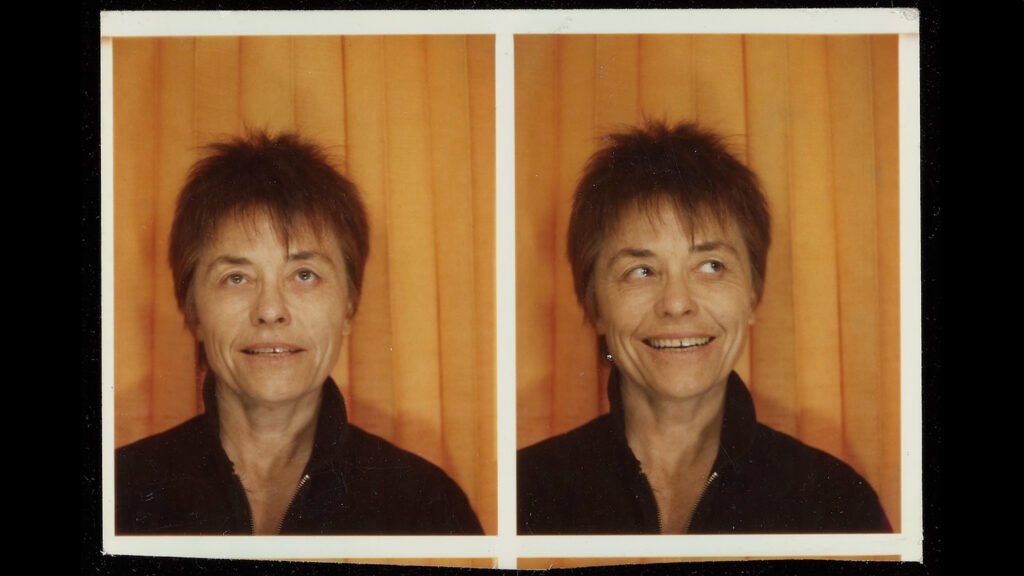
When filmmakers pass, there’s often this memorialisation process when legacies shift and change. Because you’ve been looking at Barbara’s work for so long, I’m wondering whether your own relationship to her and her work has changed.
All of the cumulative time that I’ve spent with her work informs each other. Certainly the editing process has caused revelations in her work as a whole or pieces that are through lines in her work. It’s a very ongoing, living process. Before she passed, I was really focused on her films in the ‘70s, like Dyketactics–I’m looking at the DVD right now on my desk that she had sent me. I had focused on this very responsive, reactive filmmaking style of Barbara. Later in my research, I spent a lot of time with the rest of her filmography and charting how her relationship to her own body changed in her work—or just the body in general. That’s been really fascinating for me. In her early films, she’s documenting her life, love, body, and her lovemaking. It’s a raw look at herself, her surroundings, her community. I’m inspired by how she maintained this intimacy in her work even though she was revealing and showing her own body. In her own words, she was breaking these invisible barriers. I’m in awe of the fact that she continued creating through 13 years of living with cancer. She was able to communicate that experience with the audience in a way that felt true to her and her sensibilities.
There are undoubtedly audiences who will walk into this film not knowing who Barbara was at all. In both a practical and more introspective sense, what are you hoping that viewers will take away from Barbara Forever?
I hope that anyone who sees the film and walks out of the theatre asks themselves, “How do I integrate Barbara Hammer’s way of being and living in the world in my own life? How do I go out and do my own thing?” I hope that she can be a blueprint for anyone who is making art and beyond. We don’t spend too much time on it in the film, but it’s very poignant to me that Barbara reflects at the end of her life that she really just wanted to spend time living. She spent so much time working and creating, and that was so integral to who she was. She created until she died, but she was very aware that she wanted to spend more time thinking about her relationships with other people as she continued to create. That’s something I’ve certainly taken away.
Very practically, I hope that people—who learn about Barbara Hammer’s films through the film—go seek out more of her work. Her films are so moving and speak to so many moments in a queer life and in a lesbian life. There are breakup films for when you’re going through a breakup, and there are films about the beginning of a relationship for those moments.
She was a lesbian filmmaker and a lesbian lover. She was thrilled to be known as the lesbian film pioneer, but she also wanted to be known as more than that. Her her life and her work speaks to a larger queer experience and an expansive queer experience. It’s not just applicable to lesbian artists or lesbian filmmakers—or lesbians in general. Her idea of queerness and her understanding of being a queer person in the world continued to evolve until her death. Our understanding of ourselves and our own communities can continue to evolve. That is such a good thing for us all to remember.
*****
Barbara Forever screens in the U.S. Documentary Competition of the 2026 Sundance Film Festival (22 January–1 February).


