

Go find yourself in nature, you might be told, or even touch grass, as goes today’s Internet slang—which, buried under all its memery, points to the same idea: that nature is enshrined as the environment in which one rediscovers oneself and seeks inner peace. But the buried social and personal truths that come to the surface in Good One emerge more like cicadas after a long period of dormancy or invasive species sprouting once given the space. The film was lauded as one of Sundance’s top indie charmers of 2024 from U.S. writer-director India Donaldson, who made this strong feature debut after three shorts and has already led to comparisons to Kelly Reichardt in her directing style.
17-year-old Sam (Lily Collias) and her father, Chris (James Le Gros), embark on a weekend backpacking trip in upstate New York’s Catskills with his best friend, Matt (Danny McCarthy), and Matt’s teen son Dylan—although an only briefly witnessed spat between father and son leads Dylan to stay home. As the three set off on their trip, Sam quickly falls into the role of the caretaker—for two middle-aged men, mind you—and must navigate the delicate dynamics between the two fathers. This grows more intense as they go farther into nature, and truths emerge between the soft, lush greenery of the forest.
Deep in the trenches of middle-aged male self-righteousness and egotistical behaviour disguised as “knowing what’s right” is thus where we find our teen protagonist, who ping-pongs between the posturing men as part emotional punching bag, part babysitter. Chris and Matt aggressively tease each other as well as Sam, which they seem to get away with (one might imagine either of them shooting back with “it’s fine, the kid’s got thick skin” or something vaguely patronising of the sort). To survive the two fathers’ fantasies about travelling to China and their woeful reflections on their failed past marriages, the teen immediately puts up her defensive wall in a way that feels tomboyish out of necessity. Perhaps she really must be “one of the guys” in order to make it through the weekend.
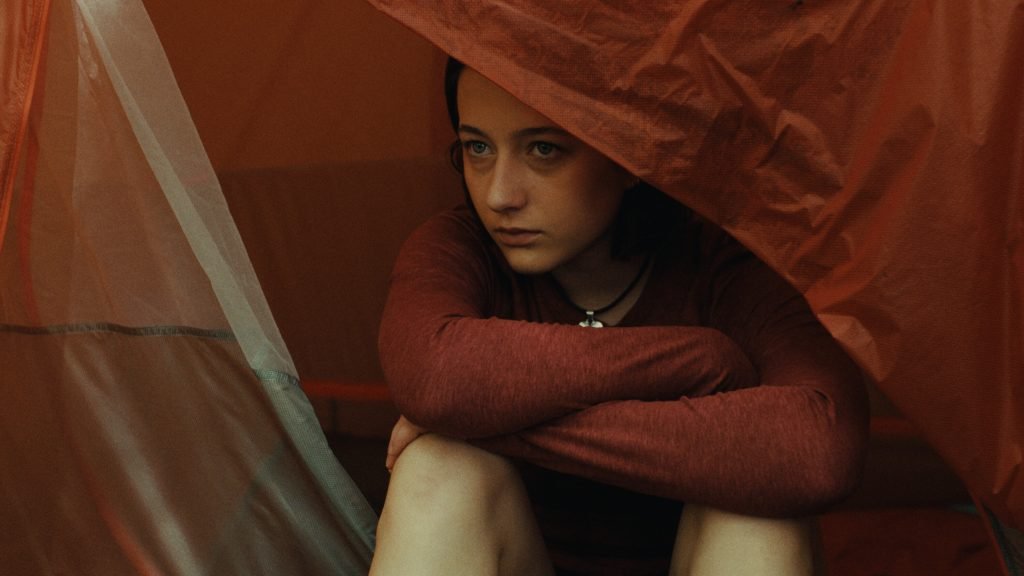
Collias affectingly plays Sam as a girl making the best out of an unusual situation, partly weighed down under a barrage of silent slings and arrows. Making the character even more nuanced is her relationship with another teen, Jessie. Their relationship can be read as queer (and has widely been read as such already) based on their closeness as established in the film’s opening montage as well as the texts that pass between them. Although we never get explicit confirmation that Jessie is more than a friend, Sam brushes off her obvious discomfort over the question when Matt asks about her “lady friend”, which, judging by his half-laughing tone, is intended to belittle the authenticity behind their relationship of whatever capacity. Despite the fact that we never see Jessie after the opening scene, Donaldson leaving their relationship vague is frankly quite empowering. When young people are afforded privacy such that the intimacy of close platonic connections may be read as queer and vice versa, relationships outside of normative standards can flourish, and maybe future generations may feel comfortable enough to live as they want.
What unfolds is essentially a three-hander that could easily act as a stage play, with the dialogue expertly steering its narrative. However, in light of its dialogue-driven feel, Donaldson takes time to include long takes—often of the group walking and hiking—that prevent the dialogue from bloating the film, further allowing non-spoken statements to creep into the film without words ever being said out loud. The camera also frequently lingers far longer on the space in which the three have walked, forcing viewers to feel comfortable in these pauses. Time seems to settle in these moments, making the film’s pacing over its 90 minutes feel more balanced.
Donaldson’s directorial style and the lensing of Donaldson’s cinematographer Wilson Cameron mimics the observational eye of our young protagonist, wandering widely but carefully as if searching for potential disruptions. At one point, Sam peeks out from behind a tree at another trio of hikers as they splash in a river, with this moment made into one of the film’s promotional stills. It slowly but surely becomes obvious why Sam, under a barrage of silent slings and arrows, is so attentive to any potential dangers through which heteropatriarchal norms allow certain behaviours to thrive—but also fester deep down.
“You’re too young to be so wise,” says Matt to Sam, never thinking about the deeper implications of such a statement, such as why this might be the case of the 17-year-old. Sam already deserves so much more respect than either Matt or Chris are giving her, revealing the ragged edges and holes of this social net that allows the two men to be condescending toward her experience—and, worrisome enough, one of them is her father. This quietly harrowing feeling lingers long after the film ends. Donaldson cultivates a dual sense of fierce glee from Sam’s responsive outburst and sadness over the subtle acts of violence that transpired in the forest, even though she’ll likely later be crucified for “acting out”. However, it’s really best to go into the film without further knowledge of the trio’s journey in order to experience the rollercoaster of emotions to its fullest along with Sam.
Good One is a deadly microcosm: we no longer begin to wonder why men everywhere might act the way they do. Instead, we must sit with the dark reality that we, as a society, simply haven’t broken the cycle. Even well-intentioned action is still conditioned by the social system and may ultimately have dark, or at least deeply frustrating, effects. However, the way in which Donaldson uses playful, folksy songs sparingly throughout the film—but primarily at the start and end—reminds us, in a way, that this is life. We mustn’t fall into its bottomless pit of despair.


