

The indie film world hooted and hollered when Sundance multi-returnee and queer film icon Gregg Araki announced he would be coming to the festival with his newest film in over a decade, billed as an erotic thriller. But as we would soon discover, despite featuring Olivia Wilde as your dom-mommy of your dreams and nightmares, the provocatively named I Want Your Sex is resolutely not a thriller and more of a contextually kinky dramedy, framed within a police investigation. Sweeping through Sundance’s Premieres section, Araki went around the festival handing out buttons for attendees that reads “SEX” over a pink background—yes, in capital letters. (Gregg Araki, never stop being you.) This is his newest call to sexual liberation*, with a big, bold asterisk: make sure to pick the right people.
While I Want Your Sex is much less risky and explicit than his delightfully delirious early films, it still carries his trademark bite, even though it bends to a set of more disappointing and conventionally appealing narrative choices by its end. Araki wrote I Want Your Sex with Karley Sciortino, known for her website Slutever, and the two previously worked together on the cancelled television series Now Apocalypse about a group of friend in Los Angeles negotiating relationships, love, and sex (a description that sounds a lot like Araki’s 2010 near-apocalyptic sci-fi sex comedy Kaboom on paper, complete with its neon palette, if we do say so ourselves).
In I Want Your Sex, pop artist Erika Tracy (the “k” spelling and double first name—instant sex appeal, Araki seems to implicitly joke), known for her sexually charged feminist art, is played by Wilde in her gleefully sociopathic dominatrix era. Erika emerges as a fantastic character counterpart to Wilde’s shy, bicurious character Angela in The Invite (2026), which Wilde directs and which also played in the Sundance Premieres strand—this is our Olivia Wilde winter. The film originally featured an older man with a younger woman, a dynamic that now seems unthinkable after witnessing the film’s semi-tongue-in-cheek tone. More pragmatically, this dynamic works well in being able to make jokes skewering Cooper Hoffmann’s boy-next-door—a newly hired art gallery assistant—without having to gesture repeatedly to real-life cases of workplace sexual manipulation involving older men preying on younger women. It jumps from zero to 100 very quickly after Erika bluntly but seductively proposes that they sleep together. Elliot, of course, instantly says yes.
With this freedom, Araki takes Erika’s deviousness and runs with it: she is conniving in more ways than one. Hoffmann anchors the film as the perfect everyman, freshly aged from his role in Paul Thomas Anderson’s Licorice Pizza (2021), leaving Wilde to run off the rails with her portrayal. As Elliot embraces his role as Erika’s submissive, we are privy to various montages of him eagerly getting tied up and spanked. However, they’re shot more like brightly coloured, fast-paced music videos and feel out of context from the plot—simply put, we fast-forward past most of the sex, which almost feels out of character for Araki. Several appearances by Charli xcx as Elliot’s bored girlfriend Minerva swing us to the complete opposite side of the sexual activity spectrum, as she prefers to focus on studying for her medical school exams than heed him at all, let alone be physical with him. Somewhere in the middle is Elliot’s flatmate Apple (a magnetic and dynamic Chase Sui Wonders, who shines in a riotous scene of a failed threesome initiated by a vicious Erika), who clearly likes him but becomes devastatingly sidelined in the process.
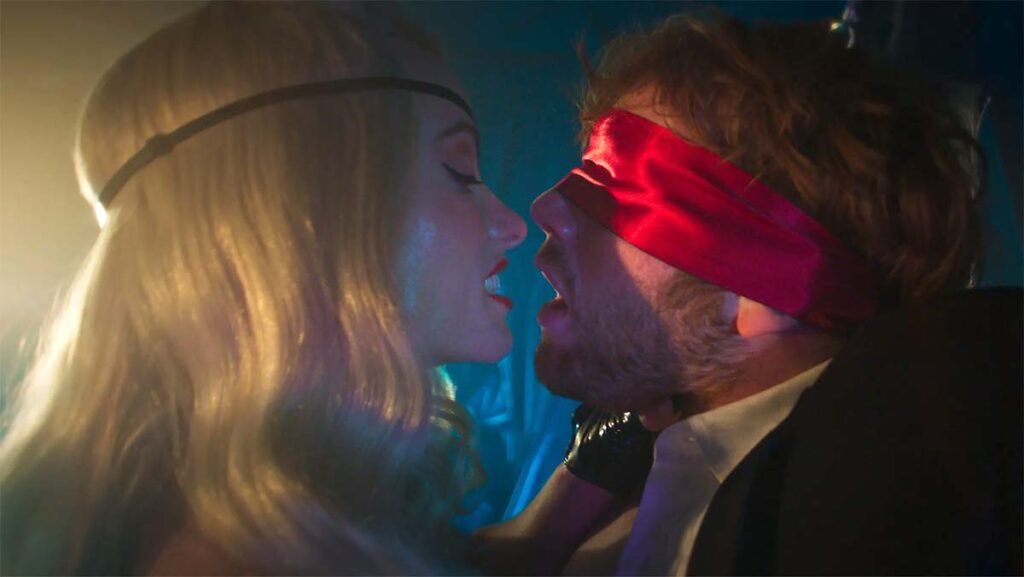
It becomes increasingly clear that Erika is predominantly interested in getting what she wants and using the starry-eyed young man to do that, despite displaying some amount of aloof empathy. As Elliot’s colleague Zap (Mason Gooding) warns him: you’re not the first one. Araki’s directorial hand feels closest to the film when Erika begins to completely unravel, demanding that Elliot submit to her when he doesn’t want to, all while she plays it off as a game. Through character behaviour, he subtly but clearly denotes that what Erika does is absolutely not appropriate in a consensual BDSM setting. Araki draws a line in the sand to demonstrate that consent to domination does not equal consent to do anything, ensuring that the film never creeps into territory suggesting a misunderstanding of kink. Under its light-ish comedic exterior in an extenuating circumstance, I Want Your Sex thus presents a very real scenario of young people falling prey to powerful figures using their insecurities.
The film is at its sharpest when it leans past the border of believability, playing with viewers and their own naïveté right alongside Elliot. For instance, Erika demeans pop art and then doubles back again in the next instance, building a world of artificiality and performance around her: in one moment, lauding her own creative brilliance, and during the next, guffawing at anyone who swoons over her so-called insightful critique of feminism and sexuality, in her own words of disdain for believers in pop art. However, this becomes a standalone character quirk that hardly filters in the rest of the film’s meaty delivery, leaving viewers wondering where to go. Araki leaves us hanging with this otherwise relevant take on the potential over-valuation of art for art’s sake, thriving off of a provocative brand image.
I Want Your Sex never slows its pace, but it instead loses its thematic steam once it begins to focus more on being too realistic and empathetic to its characters, in an ironic twist. Its satirical pinch is what it thrives on, whereas when it grows more dedicated to trying to find a clever close, the story grows unbelievable in a way that doesn’t match its original brand of absurdity. It’s a film that advertises one idea, starts as something else, delivers another concept, and ends up as a chimera of all of the above. Regardless, once you give in to this mish-mash, it’s hard to deny that Araki brings the fun, led by a glorious new era of Olivia Wilde.


