

At some point in our lives, our desires becomes heavily shaped by the world around us: what we’re told is important to want, what is demonstrated as the “right” way to love. Childhood is perhaps a time when desire is able to flourish with fewer restrictions—a moment when perspectives are sometimes less imposed, or when societal influences haven’t sunk in quite so deeply. In Angelica Ruffier’s La belle année (literally “The beautiful year”), which enjoyed its world premiere in the 2026 International Film Festival Rotterdam Tiger Competition (29 January–8 February) and picked up a Special Jury Award, it is hard to isolate the director’s desire into one category: romantic, platonic, sexual, envy—or desire to be that person. As she tidies up the home of her late father in the south of France, she revisits the fervor she had at the age of 16 for her childhood teacher, the 40-year-old Mademoiselle Bresson, or Sylvie, through a series of passionate and impassioned journal entries she wrote. Although this is only one part of this journey of rediscovery, it is crucial to how the filmmaker reckons with the past and the passage of time.
“Forgetfulness is a survival strategy,” she says in one of the film’s most memorable lines. And yet, as we learn, so is the act of rediscovery. La belle année could be described as a combination of essay film and documentary self-investigation, using the death (and funeral) of her estranged father Eric Ruffier as an in-road to unpacking a larger story with no particular start or end. However, we can track that the film’s chronology spans at least a period of two years: from 2021, when her father passed, and to 2023, when her grandfather Henri Ruffier passed. Through archival home videos of their family (filmed by her mother, Anna-Lena Holmqvist), we learn of the quietly abusive behaviour from her father, whose presence echoes throughout the film but doesn’t interfere in all aspects of her life. At some point when she was young, her mother took Angelica and her brother Tom and left. (Ruffier was born in Sweden, raised in France, and has been living again in Sweden since 2017.) But Tom suggests that she thinks a lot of men remind her of their father. “Trauma,” she laughs with a bit of discomfort.
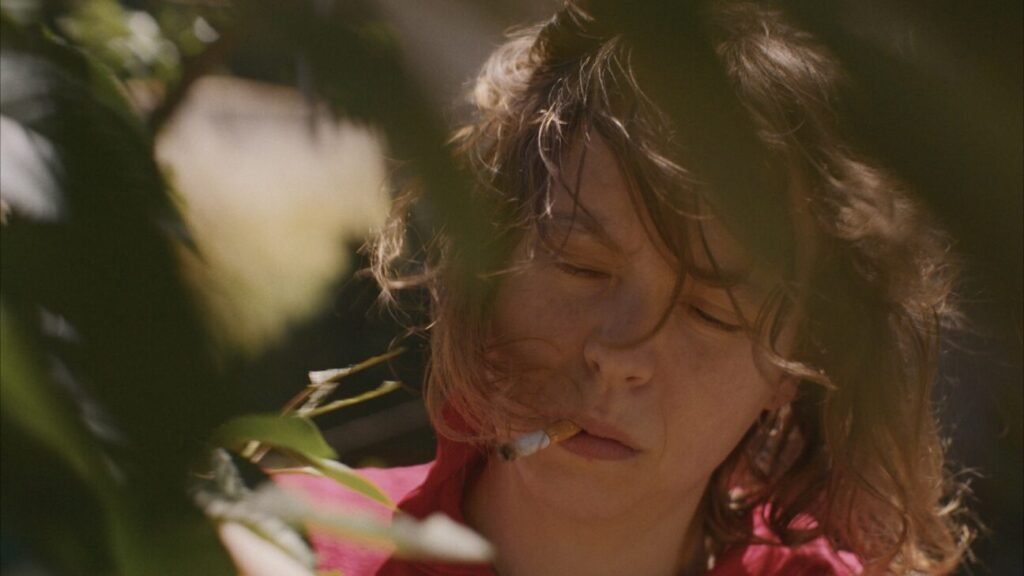
One of the viewer’s first toe-dips into the waters of the past is when the now 36-year-old Angelica begins to dig through childhood belongings sitting in her father’s house, revealing a journal page covered in scribbles of the name “Sylvie”. She reads from the journal from voiceover, so full of deep emotion that they almost feel fantastical. “You’re too beautiful for a man! You need the sweetness of a woman,” wrote teenage Angelica. “You need a woman like me.” But every entry has a diary date: these are undeniable emotions that were felt at one point in time and describe how much she thought of Sylvie and her beauty, physically and mentally. “I wish you were my friend, my lover, my mother” —then, “I want to be you.”
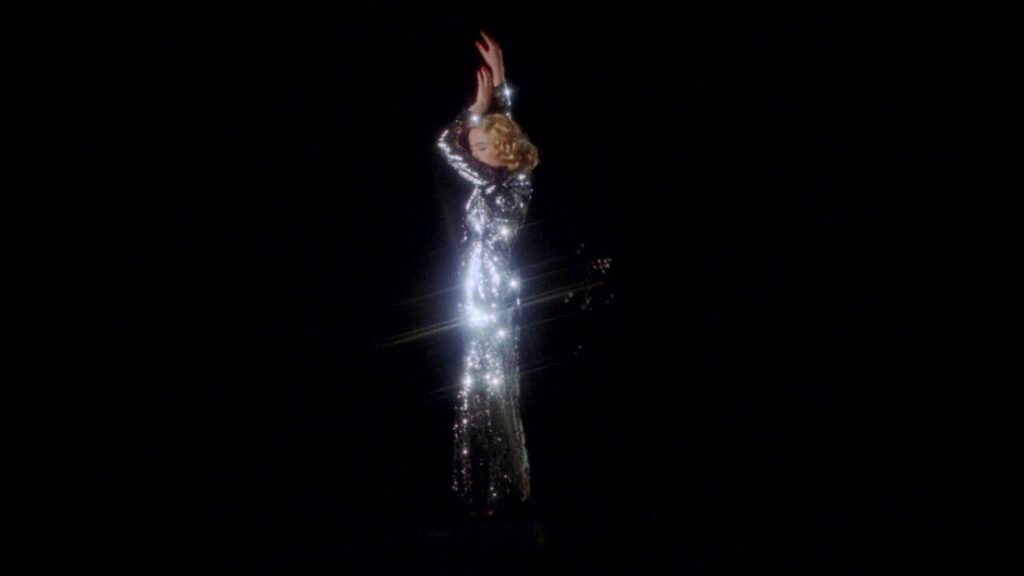
Ruffier avoids full immersion in the essay format by moving between documenting moments in her present-day life, recitations of her diary, and ruminative sequences reflecting her filmic investigation. As she writes a note to Sylvie, she calls her desire for Sylvie “confused” in the sense that she couldn’t understand what her feelings were at the time, noting the fluidity of desire. How much she remembers is something different: present-day director Ruffier is a mere conduit to these memories, reading them out and recalling them but never creating a vocal commentary on them—and certainly never a normative one. In the documentary’s middle portion, the director turns to more experimental sequences to capture the extent of her emotions—in one, Ruffier sparkles in a silver dress, rotating silently on the screen in a blonde wig to the sound of a nostalgic chanson française (Léo Ferré’s “Il patinait merveilleusement” (1964), from a poem written by Paul Verlaine). This is the first of two memorable needle-drops accompanied by a minimalist original score by Leo Svensson Sander, the other being Jeanne Mas’ “En rouge et noir” (1986), when Angelica begins to celebrate the impending meetup with her teacher.
La belle année is a reflexive documentary that actively makes you think about its form. Ruffier is the director but not the cinematographer (hats off instead to DoP Simon Averin Markström), but this is what makes it an interesting study. She turns the camera on herself but not literally, never using herself as an active cameraperson. It’s thus fascinating to see where the camera leads us—for instance, in moments in which it feels impossible to predict what might happen, the lens sometimes shifts to a particular hand fidget or unexpected movement of different characters. The effect of this cinematographic choice evokes Ruffier’s own composite of recollections, videos, and writings that offer no singular view of reality and are instead an amalgam of many ideas offered by many people.
Ruffier’s work emerges as a free-floating documentary sibling of Dag Johan Haugerud’s Dreams in which both not only take teenage desire—in particular, sapphic desire—seriously but also take the teens themselves seriously when they believe that the teacher, too, must have understood something profound about this desire. Contrary to conventional viewpoints, both real and fictional teens weren’t just projecting or imagining, a key point that speaks to the intuition of young people and the subversion of this idea of youthful infatuation. When Ruffier finally meets with Sylvie after so many years, she casts a quick glance at the camera, her face nearly in tears—but with that, it’s a visage full of triumph.
*****
La belle année screened in the Tiger Competition of the 2026 International Film Festival Rotterdam (29 January–8 February) and picked up a Special Jury Award.


