

Teenage Sex and Death at Camp Miasma is a film that you either fully feel—or you fully don’t. But cool kids like Camp Miasma, we say, and US filmmaker Jane Schoenbrun continues their unbeatable grasp of self-referential world-building, now brought about in an utmost psychosexually irresistible way. In a pitch-perfect casting, Hacks star—made a sapphic icon in her own right through the show—Hannah Einbinder plays a Schoenbrun-esque director who quickly makes reference to her interest in cultural depictions of queerness and childhood connections to monstrosity. The film world-premiered to a thunderous standing ovation as the opening film of the 2026 Cannes Film Festival’s Un Certain Regard strand, where Schoenbrun called upon the joy and play embedded in the creation of the work.
“Sundance wunderkind” and young sapphic filmmaker Kris Williams (a pseudo-Southern-accented Hannah Einbinder) is brought on to revive the slasher franchise Camp Miasma. To the studios’ dismay, she becomes obsessed with connecting with the reclusive Billy Presley (Gillian Anderson), the original film’s final girl, in order to understand the true roots of the series. Venturing out for a rare meeting with Billy in her mysterious forest home, Kris becomes entangled in a personal reckoning of her sex life and the pursuit of connection in an intimate setting, desperate to find the feeling behind “that look” Billy gives in the first Camp Miasma film while having sex for the first time (fitting, one might say, to be in Un Certain Regard). Viewers are also privy to a portion of this film-within-a-film, which we watch along with Billy and Kris.
Camp Miasma is less accessible and less directly didactic than Schoenbrun’s previous effort, the trans-centred I Saw the TV Glow (2024), which made their style familiar to massive audiences worldwide. While Camp Miasma has a trans character’s mythology (played by I Saw the TV Glow star Jake Haven) baked into the story, the filmmaker’s newest work is more resonant to those where themes of spectatorship and a hesitation to confront dark desires float to the surface. Schoenbrun places these themes in a Venn diagram with sapphic desire, with Camp Miasma at its very centre, making a film that could be characterised as a queer coming-of-age for adults.
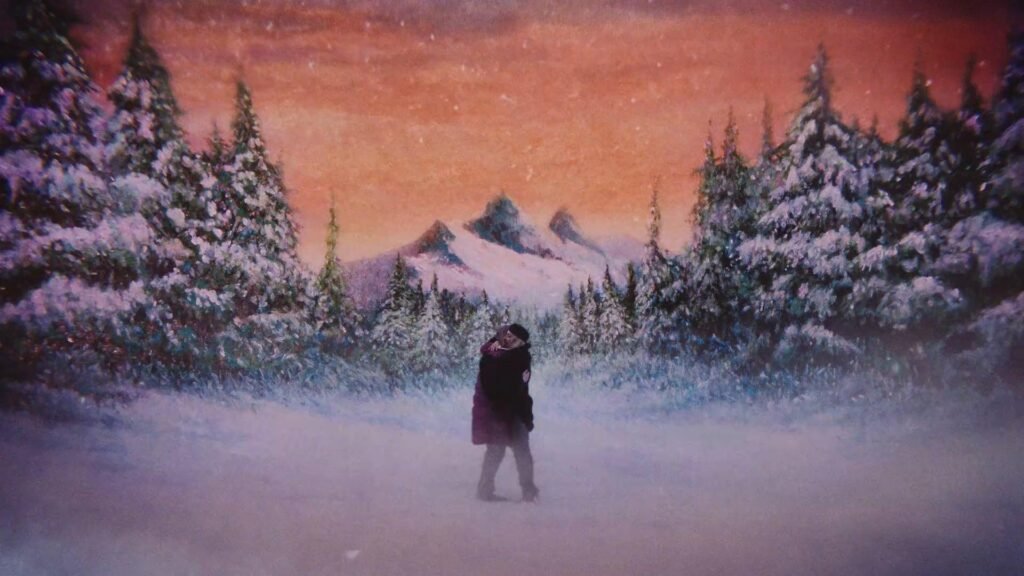
Using painterly backgrounds that act as a set, Kris is plunged into a world that is already far more fantastical than reality, accompanied by a sweeping, haunting score by Alex G. The mountains are too bright and the snow on the trees sparkle too much, yet the glow of the gorgeous backdrops contribute to the sense of being carried into something entirely new, which we experience along with Kris. The film is stylistically hard to place, which will frustrate some and delight others. It flirts with the slasher and horror genres while simultaneously relying on the camp comedy aspect—but, unlike many more conventional genre films, it never settles into one or becomes an exemplar of either. Instead, Schoenbrun switches rapid-fire between laugh-out-loud moments and the warmth of sapphic discovery as an adult.
The first half does become dragged down with expository material as well as the film-within-a-film, as Schoenbrun overuses the meta aspect in a way that feels more like delivering on a brand than assisting with the story. However, the film never loses its rhythm, broken up by stylistically luscious moments of varying degrees of seriousness. These seem to, delightfully, come from the recesses of Schoenbrun’s mind, including one honouring the sexual power of fried chicken and oral play that must be seen to be believed and another of a wild Zoom call that becomes a highlight of the film’s cringe-comedy touches. As Kris, Einbinder delivers in spades in this film, where the root of desire is to watch oneself and to experience pleasure through spectatorship of oneself. She bounces between relatably awkward, vulnerable, and over-the-top, allowing us to experience the erotic through her character without creating a sexual or objectified figure out of her.
At approximately its midpoint, the film—like Kris—bends to its impulses and starts to cave to desire, when it becomes pure queer ecstasy delivered as a fever dream. The metaphor is inherent in the film’s so-called villain, Little Death (think French!), yet any tendency to overintellectualise this aspect will quickly lead to cynicism of Schoenbrun’s honest attempt to capture the complexities of desire and release. Forget the name of the character—the director’s triumph is how they land on a trio of themes entangled with desire: spectatorship, play, and darkness. All are heightened in a specific way in the sapphic and queer experience, with Schoenbrun leaning in to how the taboo and subversive together become a core component. It’s easy to link this to the obsession with sapphic villainry in media, where these characters are the most enticing of all. The fear of confronting something monstrous is also naturally linked to a social fear of queerness, something to which Schoenbrun subtextually alludes. This fear may also manifest as arousal and pleasure, which take centre stage in Camp Miasma as something that we should not reject in order to completely access all of ourselves.
As Kris gives in and discovers how to reach that pinnacle of pleasure with the (psychosexual) help of Billy, the viewer’s perspective starts to melt into the film, encouraged to take part in the pleasure of watching and being watched. This is also what it means to be out-of-body, suggests Schoenbrun, something that also connects the lore of their Screen Trilogy, beginning with We’re All Going to the World’s Fair (2021). You have to surrender completely to Schoenbrun’s vision of Teenage Sex and Death at Camp Miasma to feel it—and maybe that’s the difference between those who understand it and those who don’t.
*****
Teenage Sex and Death at Camp Miasma is in US cinemas on 7 August 2026.
Watch a teaser for the film here:


