

“I declare that, no matter how I die, my death has nothing to do with Xia Yutong.” These words, accompanied by the imagery of a colourful and immense metropolis, enunciate 1 Girl Infinite (2025), the debut of Chinese-born, Los Angeles-based director Lilly Hu. Also penned and produced by Hu—and described as being based on a true experience—this rebellious first feature just had its world premiere in the Tiger Competition of the 2025 International Film Festival Rotterdam.
Yin Jia (Chen Xuanyu) and Tong Tong (played by Hu herself) are two high school graduates sharing a flat in chaotic Changsha, southern China. Following the typical, but sadly true and common, structure of girlhood depicted by codependent homoerotic friendships, Yin Jia and Tong Tong’s bond is on thin ice as the latter falls in love with Chen Wen (Bo Yang), a controlling and rich drug dealer. As Yin Jia learns of Tong Tong and her boyfriend’s plan to escape to the United States for freedom and wealth, her life—and sanity—spiral into a void of desperation.
Left alone but still devoted to her best friend, Yin Jia tries everything she can to keep her by her side, risking her own life and safety. But Yin Jia knows no better, as she never met her father, and her mother abandoned her years ago. Both girls grew up in poverty and loneliness, which inevitably led to finding solace in their unhealthy companionship. While focusing the film’s gaze on this hunger for belonging and affection, Lilly Hu also plays with a raw and uncensored analysis of girlhood in its most obsessive and lonely way.
Chen and Hu show great chemistry on screen, perfectly embodying a codependent yet distanced relationship. Both of them rely on each other but for different reasons: Yin Jia, lonely and frail, is willing to go to extreme lengths for companionship, while Tong Tong, bored with life and herself, strives for opportunities and adventures.
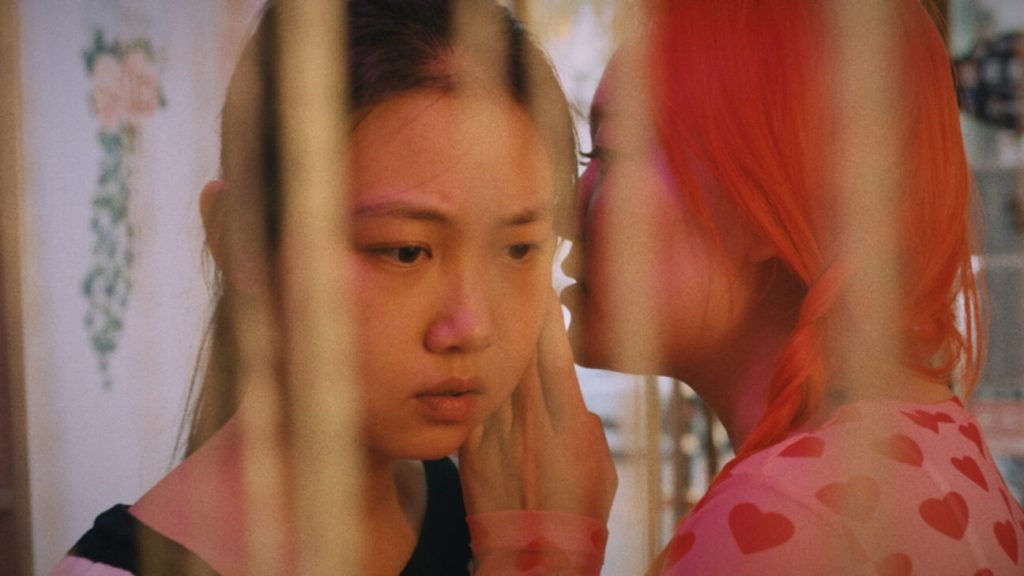
Like in the relationship between the two teen protagonists of Céline Sciamma’s debut Water Lilies (2007), Yin Jia is destined as the primary spectator of Tong Tong’s absence, gradually witnessing her departure by her side as she falls in love, emotionally and physically, with a guy—an attachment destined to create turmoil and discomfort. This theme is quite common across the broader sapphic sphere; however, it could be considered refreshing inside the Chinese independent and contemporary cinematographic world.
Despite the filmmaker’s excessive use of bright colours perhaps signalling otherwise, teenagehood is not a game, and the film triumphs through the more raw and horrifying. It does not shy away from depicting darker sceneries of drugs, violence, and abusive behaviors. In simple words, the film tells life like it is while still giving space to the audience to develop a personal gaze.
1 Girl Infinite further stands out thanks to the way it plays with both the editing and the photography. As tension builds up, Hu’s mise-en-scène thrives on whimsical technical choices, as if the environment were slowly drifting away from reality to, instead, become engulfed in an overwhelming, sensory-overloaded environment. However, despite these bold choices, the feature sometimes wavers as its sense of desperation and obsession falls into a void of repetitiveness. The film’s continuity is otherwise held up thanks to the sudden strikes of playful lights and music as if they were trying to hold the characters’ sanity together.
Hu’s film emerges as a sharp first feature that contributes a different perspective to the themes it centres on. The depiction of low-class and bored teens engulfed in the messiness of Changsha effortlessly draws attention and interest to audiences unfamiliar with such scenery. As the portrayal ends, Hu’s depiction of the two teenagers’ anguish leaves a bitter aftertaste—or, to better put it, a powerful gut feeling for the audience: the claustrophobic sense of dreaming of being somewhere else.


