

Brazilian filmmaker Marcelo Caetano’s sophomore feature Baby, which he co-wrote with Gabriel Domingues, first made a splash at Cannes in 2024, where it world-premiered in Semaine de la Critique. At the festival, Ricardo Teodoro collected the Prix Fondation Louis Roederer de la Révélation for his role as Ronaldo, an older gay man who becomes a mentor, lover, and father-esque figure for the titular late-teen character, played by João Pedro Mariano. Our hero, Baby, has just been released after several years in a prison for juveniles—and he’s on the streets of São Paulo by himself, learning just how to be an adult and get by.
On the occasion of the film’s screening at the 24th edition of Pink Screens (30 October–10 November 2025) in Brussels, Belgium, Purple Hour sat down with the director to talk through intergenerational connection, creating a portrait of a city, and building a world not defined solely by the experiences of one community.
*****
Purple Hour: I first saw Baby when it had its world premiere at Cannes in spring 2024, and now it’s playing at Pink Screens, a queer film festival in Brussels. What strikes me is how distinct these contexts are. As a filmmaker, how are you thinking about different collections of viewers seeing your work?
Marcelo Caetano: Years ago, you could attend a general festival and not see many queer movies. Today, I think it’s changed a lot. I think we can make movies that move queer audiences as well as arthouse and cinephile audiences. This is something that was very important for Baby, because we are not doing only a queer niche—we are doing the queer community, proudly. We are also doing arthouse cinema, proudly, because independent and arthouse cinema are in a very difficult moment worldwide.
I see a lot of directors asking, how can you marry both strategies? How can we find both audiences who go to the movies? As a director, you should travel to festivals, do press, do Q&As, and view yourself as a filmmaker, but as someone responsible for the image you produce of your community. It is very complex. There are filmmakers who do movies for queer audiences only, and they are, as the French say, pointu, but I like to think that I make films for both audiences.
Have you had any conversations with an audience member or somebody in a Q&A that surprised you?
I was in Liège, and the first question was from a straight guy with his girl, and he said, “I don’t understand what your film is about. Is it about gay rights? Is it about human rights? Is it about freedom and the problems of sex?” I said to him, “I think it’s about everything, but it’s especially about love. It’s about how you can build a family and about the difficulty that exists when you try to rebirth yourself in a new city, in a new place, in a new social structure.” It’s a universal question.
This kind of question interests me because you can see that the film somehow touches the heart of the problem of how we promote a queer movie: how can we get to these people? We have to convince them that it’s not only about queer questions. We are people with the same questions. We have our particularities, but in the end, we are searching for love, for friendship, et cetera.
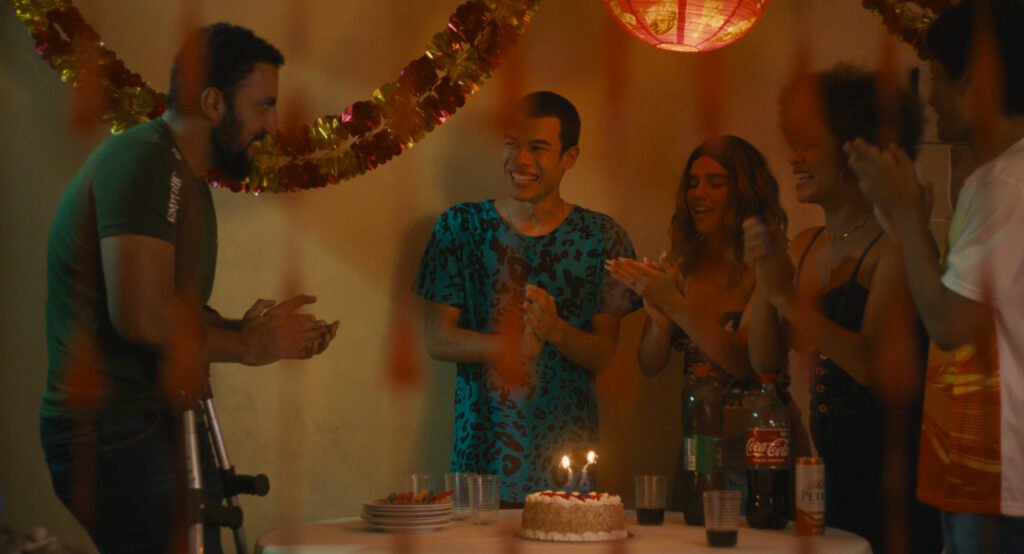
I love the depiction of family in the film—for instance, we see Baby happily hanging out with Ronaldo, his ex-wife, and her current wife. Could you talk a bit about this blended family?
We now have this extinction of our rights internationally. The concept of family is in the middle of a big war. I think in the US, as in Brazil, all the evangelists and far-right religious groups want to arrange families in a very, very traditional way. It’s mother and father; it’s biological, monogamous, Christian families. What I try to do in Baby is confront this kind of perception. When you see Ronaldo’s family—that’s Jana (Bruna Linzmeyer) and Priscilla (Ana Flavia Cavalcanti) and this flamboyant thing they have—this encounter with the lesbian couple is like a breath of fresh air in the movie because all of the characters live very troubled lives.
What we’ve learned now that the far-right has [gained traction] in many countries is that we cannot do anything politically if we’re not united: women, gays, Black people, migrants. We have to start producing images for this union, this community. I’m thinking that my next movies will probably be broader in this way, because that’s the kind of image that we need. We have this power to represent, but we also have the power to invent a world. How many films can we name that have protagonists who are lesbian, gay, and trans where we see this kind of construction of family or community? It is rare.
As the older men take in Baby, there is often a strong psychosexual dimension to each relationship. Could you speak a bit about this depiction of the older generation?
At the beginning of the film, my first inspiration and my first desire was to talk about when I arrived in São Paulo—I was 18 years old. My first relationships when I arrived there were with mature men—15, 17 years older than me—because it was before the internet. We didn’t have a lot of information about what [it meant to] be gay. It was an adventure. The knowledge I gained came from these intergenerational relationships. This kind of relationship reproduces a lot of asymmetry of power and economic conditions. The origin of the project and the name of the project are Baby because I was remembering this baby phase of my life. I was trying to understand who I was by looking to another generation.
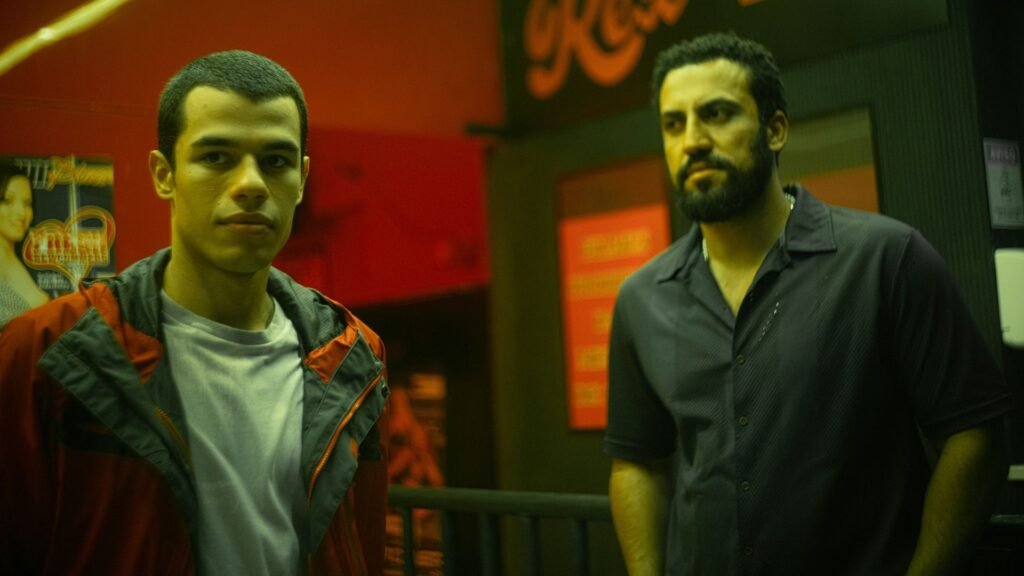
This is really conflictual because the generations don’t share the same desires. However, I tried to be fair and not build a toxic relationship. The easy way out was to say that they are toxic older guys, like a vampire sucking Baby’s blood and his youth. I try to somehow capture the moment in the movie where Baby is also someone who can take care of Ronaldo. When we work with actors who are 18, 20 years old—you learn a lot about them. Unlike my generation, they are not into intergenerational relationships. They have more information and different tastes. There’s not listening to Madonna; they’re not reading Oscar Wilde.
I hope they are!
I hope they are, too! But generally, they live in the universe of a different generation, and they’re more critical about it. In the end, I think we got a balance. Baby meets different older guys and it is important for his formation, but it’s also important for him to build his individuality and not mirror himself in Ronaldo. He can find another kind of family; he doesn’t need to be in a biological, traditional family. He can transform his friends into his own family. That’s something he learned: to stay with Ronaldo, but not to be him.
How important is it for you to have these conversations with your actors?
I think it’s the moment when the script comes to life. I have partners who write with me, but when the actors go to the rehearsal room, and when you put this text in conflict, this is interesting. The rehearsal is the moment you can put the screenplay in crisis. You finally have the voices, the bodies, the minds, and the intuition. I remember in one of the scenes of Baby when he meets his mother, and in the script we had a very melodramatic scene with dialogue, tears, and everything. When we started to rehearse the scene, the actress playing the mother of the Baby told me, “I don’t believe that this mother can say these words, so I want to do the scene in silence.”
What type of research did you do for the film?
I started to write in 2017. During the pandemic, there were a lot of people who started living on the streets. As I live in downtown São Paulo, I started conducting interviews with people who were living on the streets—a lot of trans people, queer people, people who came from the prison system. Half of the people who live on the streets in São Paulo come from the prison system. After that, [I talked with] sex workers, but the film originally was about neither sex work nor prison—it was more about dating a different generation, as that was closest to my experience, past, and memories. When I insert these kinds of things, it’s really important [to research], because I think that sometimes when you want to shoot something that’s close to you, you can lose your direction.
Making Baby someone who came from prison and someone who is a sex worker was far enough from my life. Sometimes I think our first movies, and maybe our second, are so close to us that we protect the character. What I did in my research was try to distance myself from my characters. João Pedro Mariano and Ricardo Teodoro, the two actors in the movie, were very good researchers. João Pedro went to the detention centers to stay with the boys. He did a lot of interviews with sex workers. Ricardo did the same thing—he went to the saunas and the cinemas.
The crew is not from São Paulo, so there were many people who were not from the city. One of the first things I did was I invited people from the crew or the cast to walk through the city so they could see it. I’m from an anthropological background—it is a very anthropological film, but I try to be imaginative in the mise-en-scène. So it’s real, but the camera movements, the colors, and the music are not naturalistic. They are not fantasy either, but there’s something a bit artificial, melodramatic.
Could you talk about the music specifically?
From the beginning of the filming process, I thought about percussion, as it’s not something that is automatically associated with queer people. I love percussion because it’s the rhythm of the city. We have two characters, and they are moving all the time. They sell drugs, they meet families, they dance. This kind of movement is really important to the film, and I think that percussion marks this compass. I chose one song by a Brazilian composer and percussionist called Naná Vasconcelos. We have samba, classical, bossa nova, and dance disco, but we tried to figure out which kind of music could be in dialogue with percussion. This song that we see at the beginning of the movie was inspired by Brazilian percussion that has a lot of Afro-Indigenous influence. In Brazilian art, the three groups that formed the country really have some chemistry and make very powerful music. I think the cinema in Brazil is too white. What I tried to do with the movie is bring in a lot of these Indigenous and Black elements through music.
In this way, Baby is also a tribute to the city itself.
I think it’s a very important outcome of cinema. We are also producing documents about our city at this time. Baby is a film about what it is like to be a queer person in 2023. We can have the cinema as a document and as a testimonial of what life was.
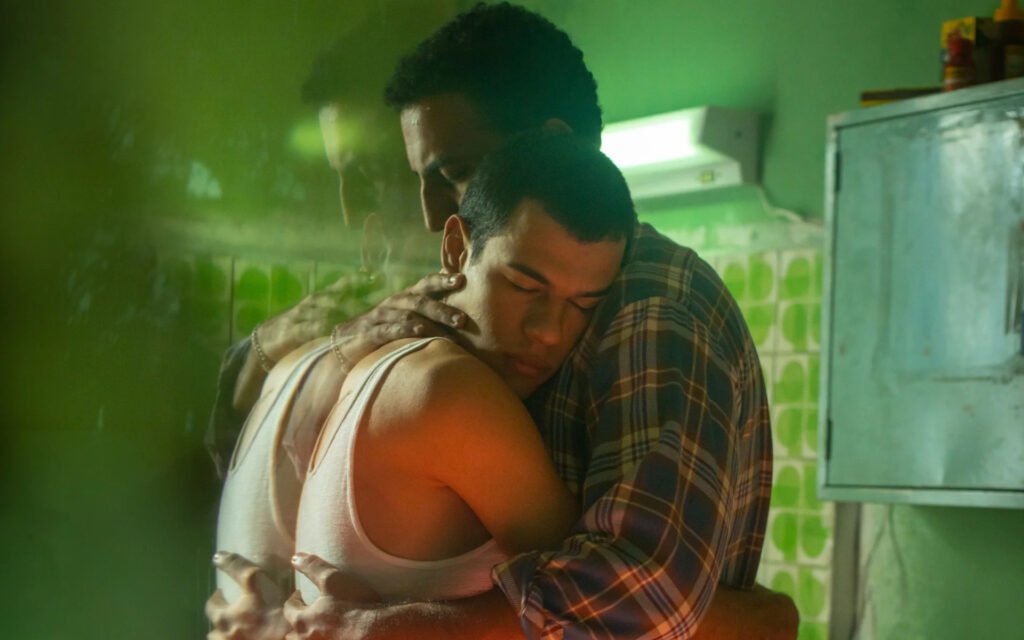
Even embedded in the so-called fictional frame, there are a lot of documentary elements.
We used a lot of hidden cameras. We put cameras inside cars, in the shop stalls, and on the [balconies]. While studying how I would shoot the movie, I rediscovered Agnès Varda’s Cleo from 5 to 7 (1962, Cléo de 5 à 7), and what she did in Paris was amazing because most of the film is set on the streets. I started to study how she did that. She put the camera inside restaurants; she never used extras, and she never protected the actress. The actress had to deal with the streets and the public energy. I tried to do that in Baby by inviting the city to be in the movie.
We never did rehearsals with extras. All the extras from the movie came from the communities where we shot. The voguing extras come from voguing. The people from the older gay nightclub—they’re from there. We are building landscapes and human landscapes. It is really important to know how you build human landscapes and not be repetitive. It’s about writing, casting, costumes. You have to work with everybody together. Today, we [frequently] discuss power structures in cinema, but films are still very dependent on directors and their position.
The idea of “auteur cinema” seems out of fashion because of this innate structure of domination. There are more and more films that are co-directed or directed by multiple people or a collective.
It’s very contradictory, because at the same time, when you see what makes arthouse flow, it’s the name of the directors. Cannes is part of this idea, and Venice is not any different. How can I, as an independent director, be distributed all over the world without submitting myself to that? In my first film, I refused to put “A film by Marcelo Caetano”. It’s not fair—it’s not a film by Marcelo Caetano; it’s a film made by many people. But for Baby, if I’m entering Cannes DNA as I did, then [I have to acknowledge that] its DNA is auteur cinema, and Cannes is very important for international distribution. However, being an “auteur” is not authorisation for abuse. You’re not a genius. You are a worker. You have to think of yourself as a worker.
*****
Watch the trailer for Baby here:


