

If the Brothers Grimm have taught us anything, it’s that fairytales are definitely not fantasies. Despite the subtextual association of fairytales with whimsical romances, defeat of evil, and happily-ever-after endings, a more folkloric interpretation puts them in a category with fables and morals. Wicker (2026), which premiered at Sundance, and 100 Nights of Hero (2025), which played in Rotterdam’s Limelight section, divorce themselves from this first conception and return to the fairytale as a way to teach us a lesson. Namely, they both demonstrate the force required to create a rupture in a heteropatriarchal social system, rooted in a queered pairing of true desire. Both take place in fictional lands where men are explicitly and systematically in charge—and, in an odd coincidence, Richard E. Grant ties the two films together as the village doctor in Wicker and dictatorial leader Birdman in 100 Nights of Hero. The existence of both of these films can hardly be called a trend, but they mirror each other in undeniable ways in their approach to the shattering of patriarchy, which makes way for something more loving and free.
Wicker is the newest film by the US directorial duo of Alex Huston Fischer and Eleanor Wilson, who blend a vivid visual style with oft-crude, oft-cheeky humour to create their adaptation of “The Wicker Husband”, a short story by Ursula Wills-Jones. Together, they poke fun at the darkness in their fantastical world by picking at relatable truths that are stretched to their extremes: it’s all funny and fantastical, until it’s not. Instead of a wedding ring, women are made to wear a metal collar at their marriage ceremony, which led the Sundance audience to break into a rip-roar of laughter. Almost as if a balm for this deep cut, the second part of the tradition is for a goat to chew off a carrot dildo strapped to the newlywed husband. The woman almost always takes the name of her husband’s or closest male relative’s profession, the film’s version of the adoption of a husband’s surname.
When the single Fisherwoman (a delightful Olivia Colman) commissions the Basketweaver (Peter Dinklage) to make her a Wicker Husband (Alexander Skarsgård), the townspeople are horrified, but not because he has come to life. In this world where gender roles are very clearly demarcated, the Wicker Husband takes care of her, fixes her roof, gives her sexual pleasure, and does as she asks—quelle horreur! The ostracised Fisherwoman’s newfound happiness inspires the snobbish Tailor’s Wife (Elizabeth Debicki) to imagine increased agency from her husband (Nabhaan Rizwan). She is bound up by the Tailor’s silent oppression, who refuses her the ability to sew her own clothes, despite no threat against his livelihood. The Butcher takes a much younger woman as his wife and mistreats her; at the same time, even the love-based marriage of the bar Dishwasher and his wife goes sour quickly after a mishap. Breaking the norms of the heteropatriarchal pairing by taking a non-human as her spouse, the Fisherwoman is the only person in a joyful marriage.
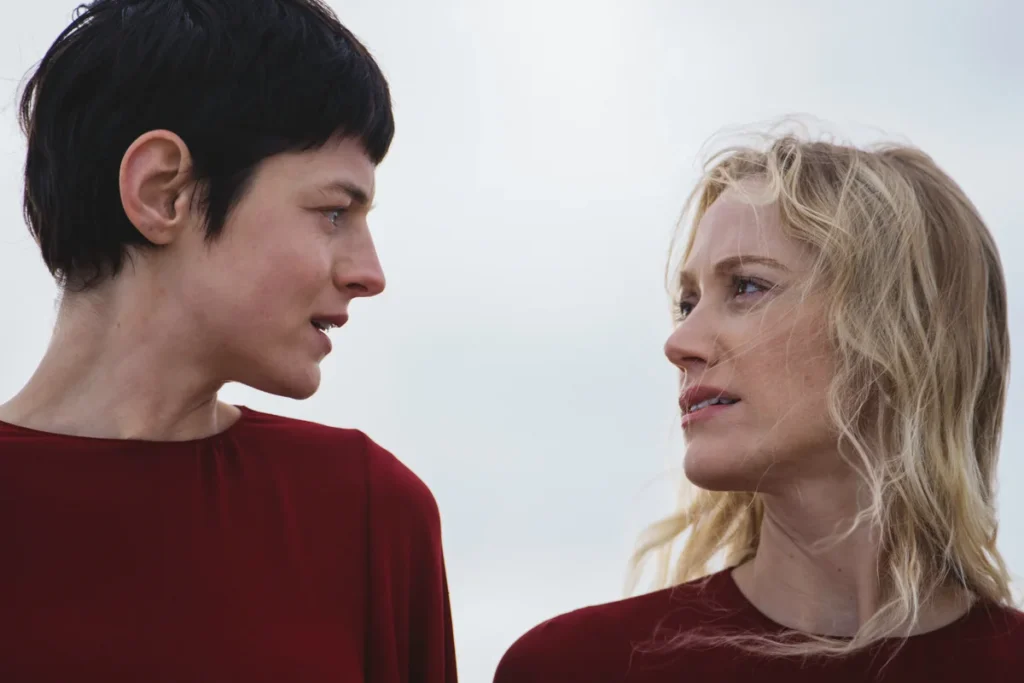
Canadian filmmaker Julia Jackman’s 100 Nights of Hero takes a considerably more serious tone, using an offbeat type of storybook-esque fantasy to make its case. Based on the graphic novel by Isabel Greenberg, the director bends to the semi-dystopian feel of this three-mooned medieval world while never trying for full realism in tone. This becomes clear in her visual depictions of the setting, including the extravagant castle as the main environment, where fair maiden Cherry (Maika Monroe) lives with Hero (Emma Corrin), her maid and closest friend. The land’s mythos is haunted by the tales of women who misbehaved, hardened into memory through the castle’s stained glass as a warning. In this take on the One Thousand and One Nights tale, Manfred (Nicholas Galitzine), the sexually conniving friend of Cherry’s husband Jerome (Amir El-Masry), bets that he will be able to sleep with Cherry.
Women are forbidden to read or write in this world, which we slowly learn as the film goes on. However, Hero has taught herself how to read and tells Cherry stories over 100 days and nights to get her out of Manfred’s grip. This brings them even closer together, leading Cherry to begin to fall for Hero, who has her every wish at front of mind. Birdman demands an heir of Cherry, but she is neglected romantically by Jerome, who is, frankly, more interested in men. She is thus caught between a rock and a hard place: Manfred would give her the so-called manly attention she thinks she wants, knowing that this is also at her own expense. Hero offers her a way out of the system by presenting her with a way out of compulsory heterosexuality entirely, on her own time and of her own will. Forbidding women to read or write creates the same function as the removal of wifely agency in Wicker, and Cherry’s romance with Hero is just as unthinkable as the Fisherwoman’s with her Wicker Husband. By being in these relationships that break all norms, they grant themselves the imagination of something better.
However, while the central conceit of both may be “women who misbehaved” in a positive light, the goal of each film is not necessarily to resolve each respective patriarchal system or unravel it altogether. Through the actions of each pairing, each film culminates in an explosive finish by the end, leaving the post-film world at a place in which a further rebellion may be sparked. Notably, the choices are also ones born of desire instead of acts of heroism or martyrdom: the Fisherwoman strives to simply be with the Wicker Husband, while Cherry wishes to be with Hero, no matter the cost. Removing themselves from this system does not necessarily mean violence, and the pursuit of their own desires is enough to create this disruption. Curiously, neither film is depicted in a conventionally dystopian way, such as in The Handmaid’s Tale or The Man in the High Castle‘s alternate history. Instead, the rules that silently govern our own societies are blown up in hyperbolic proportion, creating a reflection not only onto each other, but also onto ourselves and how we might approach breaking out of the systems around us.


