

Purple Hour: The English title is Love Letters, but in French it is Des preuves d’amour. Did you have a say in the English title?
Alice Douard: Actually, the distributor decided it—but we discussed it. They quickly told me that “Proof of Love” wouldn’t sound nice as a title. We looked for names, and someone suggested Love Letters because of the collection of all the letters. And I found it resonant—melodic—though I can’t quite gauge the effect on an Anglophone audience.
When I asked my friends, people wrote me extraordinary letters. There was really something akin to a proof of love that came out—people had genuine support to express. Some wrote beautiful things. My father did what he could, but I have friends who wrote really moving things for me.
There’s a whole history of LGBTQ+ representation that ends in tragedy, but the film, I think, sits after “all those conversations”—and I wanted to ask you about your writing process, if you can talk a little about that.
Yes, I told myself I wanted to make a joyful film—to show a difficult journey, but to show it with joy. And precisely because, as you said, LGBT films are often very dark. We know why; we’ve lived through difficult things. But I told myself: I don’t want to give a platform to people who are against our families and us. I want to show that it’s beautiful and that it’s possible. And so the question of joy was at the center.
And the question of love, too, was at the heart of the work. It’s a love story. And afterward, the writing came fairly spontaneously because it’s partly autobiographical. I really transformed all those realities into moments of comedy or more intimate moments—with, for example, the character of the mother (Lvovsky), who is a pianist. That, for its part, is not autobiographical—it’s pure fiction, because I really wanted to film music, and I felt it was important to film the generations, to show the parents of these people.
The dialogue is so natural. Did you improvise with the actors, or was it scripted?
No—the dialogue is all mine, and I like the text to be closely respected. It’s a text-heavy script because I genuinely enjoy writing dialogue and comedy scenes. I grew up watching a lot of funny films—I have two brothers, and that’s what we did. And then it’s also funny because the actors are wonderful and bring their own interpretation to the text.
I also found there’s something very educational in each encounter with the others. I approached the film thinking about the mask of masculinity in general, and the idea of educating others through encounters, like the character [played by] Félix Kysyl, the expectant father. Can you talk a little about that?
I felt it was important not to make a film against men, against straight people—to stay in the realm of questions, awkwardness, misunderstandings, without condemning anyone. Ella Rumpf’s character is on the side of fathers in a way, like the fathers waiting for their child. There’s no opposition. We share a common experience, and through that, the question of gender fades a little.
She’s like them—but unlike them, she could have been pregnant. I wanted to question gender without being accusatory, and I wanted fathers to allow themselves to say that it’s hard being the accompanying partner in a pregnancy. I have many male friends who confided in me: “I’m really scared, it’s hard.” Things they wouldn’t say with their male friends, they did with me. So it’s also a film that invites men to speak, to admit that it’s difficult. And the film was received that way—many men have come up to me after screenings to say that they identified strongly with the character. I found that wonderful, because I think identification is the only way we reach the other. For me, education comes through an outstretched hand, not through violence.
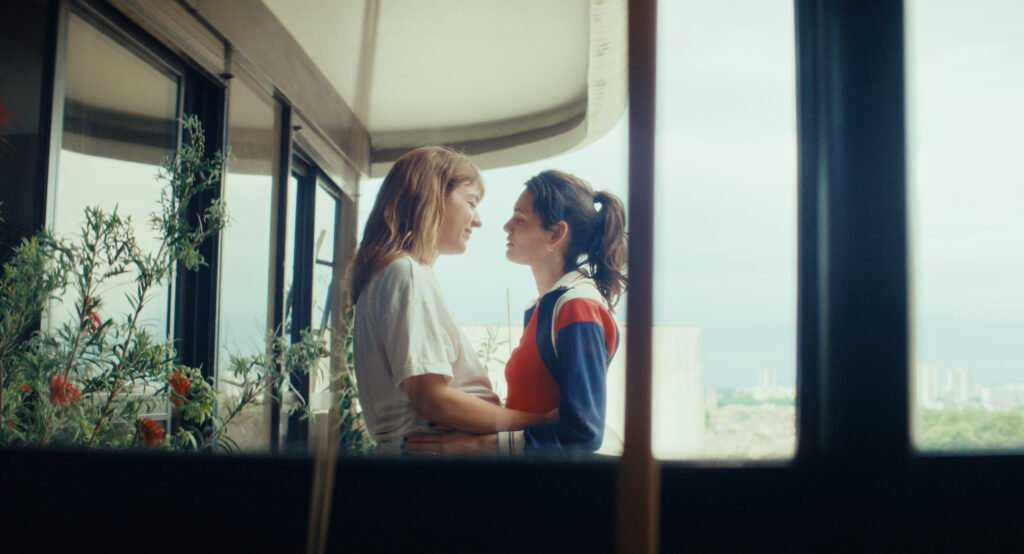
Can you talk about the choice of “bold” scenes and how you decided to include them? I think it’s the first time I’ve seen a film where a pregnant woman goes clubbing. There’s also a sex scene with a pregnant woman—things that might shock some viewers, and yet, in the film, it felt so natural.
I wanted the couple to really be in the world of partying—that’s where they come from, and I found it beautiful to show a pregnant woman dancing, continuing to live. The love scene, actually, I hadn’t written—I didn’t allow myself to. And Monia [Chokri] said to me, very firmly: “These women don’t make love? But it’s incredibly important to show that!” And I said: “I think you’re right.”
What interests me is filming desire—because desire is love too. Women together are not together because they’re rejecting men. They’re together because there is desire. And that’s what I wanted to show—for people who say “lesbians don’t exist”: actually, yes, they do.
We had to make a prosthetic belly that I could film from every angle—it was very expensive, but we did it because I told the production director, “This scene is really very important.” And since the production director is my wife (Marie Boitard), she agreed.
In terms of financing, you’ve recently received several awards, including a César for your short film L’Attente (Expecting, 2022). Can you talk about financing your first feature? Does running a production company with your wife help?
I made five short films, all of which were recognized in the film world. So I had, let’s say, the right to make a first feature under the right conditions. Of course, I would have to write something good, but I was among the people who could legitimately aspire to make a first film. That said, we made it within the economy of an LGBT auteur film—it’s not a very expensive film, but I still had the right to make it.
And indeed, the fact that we won the César just before shooting began helped. We had significant additional funding that allowed us to employ the filmmaking techniques we wanted, which were originally too expensive. For example…I really love zooms. There are a lot of zooms in the film, small and large. And having a zoom lens on a shoot is very expensive. So, I was able to afford that.
Producing the film yourself is at once a great freedom—because I know where I want to put the money, and really the money is the mise en scène—but it’s also an enormous amount of extra work. I tend to restrict myself, meaning I tell myself, “I don’t have enough money, I can’t.” I do a lot of my directing through the money—that works for me, because I feel free in my choices. But I think other directors would find that terrible, or anti-creative. For me, it’s actually very creative.
Co-producing with Marie, my partner, helps me with that creativity because she’s very strong at finding the right idea and the right location. People like her. So she goes to people, “Come on, we’re going to do this, we’re going to do that.” She has something unifying about her.
The apartment was so beautiful—where was that?
We shot in a city in the south of France called Bordeaux—that’s where the wine is—because we had funding from there. So we had to shoot a portion of the film there. The apartment is in Bordeaux. But just for that, I visited thirty apartments, and each time I told Marie, “But that’s not it, that’s not it, that’s not it.” And she’d say, “But the location scouting budget…” When you look for sets, that’s where we really spent a lot of money. I told her, “But this apartment has to be cinematic, otherwise the film will be terrible.” And when we saw the one with the balcony and everything, there was really something there. But it was completely white inside, so we employed a lot of set decorations. It was a real mess, but you can’t tell—nothing shows afterward, normally.
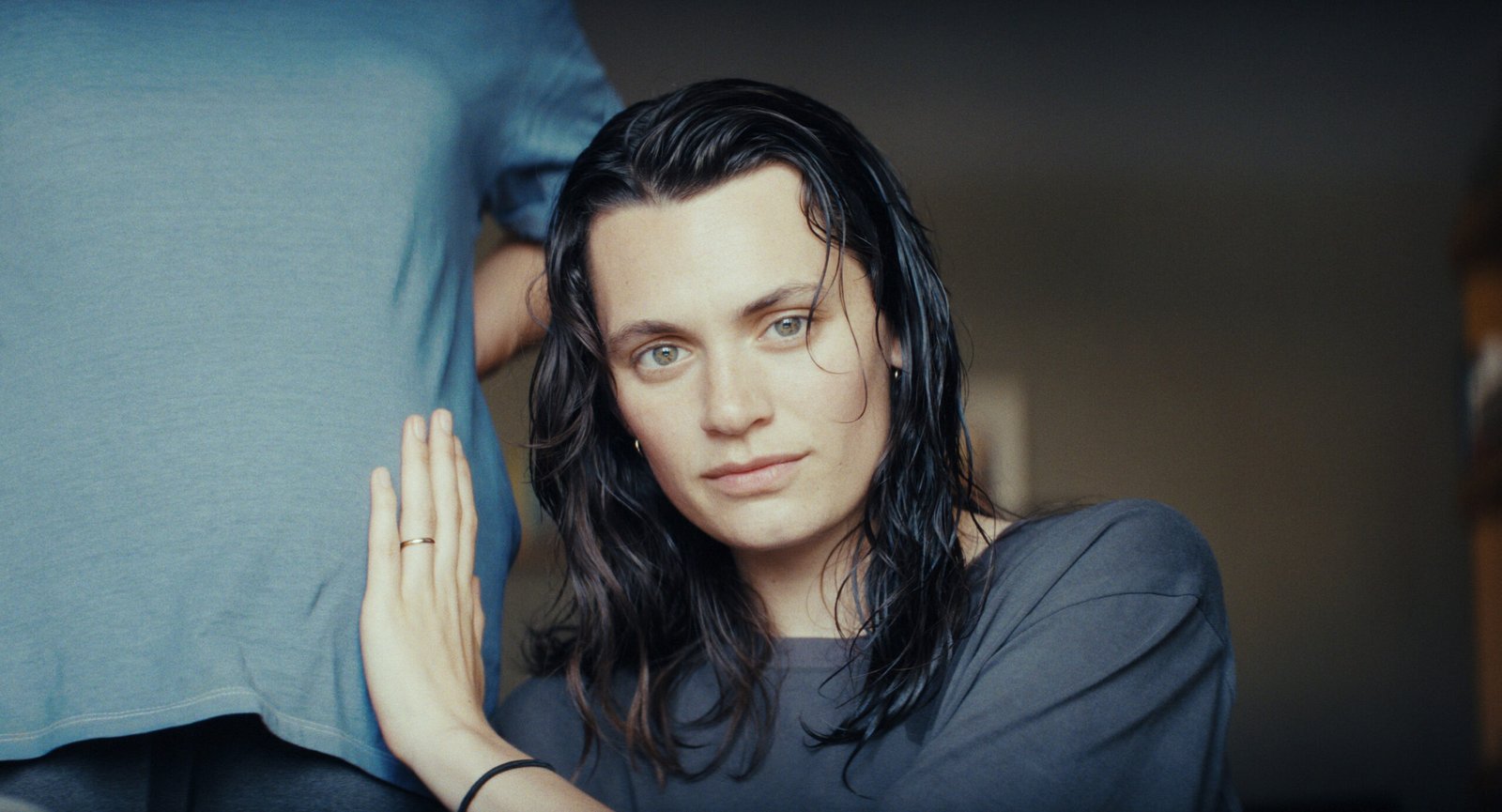
You mentioned the zooms—and in many shots, either Ella Rumpf or Monia Chokri looks directly into the camera, and we know they are looking at each other. Can you speak a little about desire in the gaze?
For me, filming is always about being at the right distance from the character, using the right lens, and keeping the line of sight in the right place. And if that’s there, there’s emotion, there’s empathy, and you can project yourself into these people. And I’m very uncomfortable when I go to the cinema and the eyelines aren’t in the right place. It really is a total obsession. But also because direct looks to the camera are something I find very beautiful. I think music is far more interesting than cinema. Literature too—the emotions it provokes are extraordinary. In cinema, a look directly at the camera…something happens for me there. So I look for those moments—a little grace.
In a shot-reverse-shot, the question of where you look completely changes the frame. On set, I would tell Monia, “Look there. No, look there. No, there.” We’d find the spot where something happened, put a piece of tape on the camera, and she’d act with that piece of tape.
I feel like a lot of your characters, if we are to say they suffer from something, they suffer because they love too much. Love gives rise to their anxiety. There is a moment when Chokri’s character says, “What if our daughter wants a cat? I’m allergic”—little things like that.
I’d never formulated it like that, but that makes sense. We’re very anxious about things that hurt or are dangerous, but we’re also very anxious about things that succeed and are beautiful. On the question of waiting for a child: Will I love them? Will they love me? It’s a question everyone asks at some point.
Finally, are you working on something now?
I’m working on two very different films—both still at the very beginning of the writing process. I don’t know which will move faster. There’s a personal project and an adaptation of a book. Again, it’s about the bond between parents and children, but in a completely different way.
I think there’s nothing more interesting to question: how do we receive love and violence, and how do we avoid transmitting the violence while trying to pass on the love? It’s an obsessive question—how do we make a family?
Purple Hour: Le titre en anglais c’est Love Letters, mais en français c’est Des preuves d’amour. Est-ce que vous avez eu un choix pour le titre en anglais ?
Alice Douard: En fait, c’est le distributeur qui choisit—mais évidemment on en discute. Ils m’ont dit très vite que Proof of Love, c’était pas joli. On a cherché et quelqu’un a dit Love Letters, parce que c’est ce recueil de toutes ces lettres. Et je trouvais que ça sonnait bien—c’était mélodique. Après, je ne me rends pas compte de l’effet sur un public anglophone.
Quand je l’ai demandé à des amis, les gens m’ont écrit des lettres incroyables. Il y avait vraiment quelque chose de l’ordre de la preuve d’amour qui est sorti—les gens avaient un vrai soutien à exprimer. Certains ont écrit des choses très belles. Mon père, lui, il a fait ce qu’il a pu—mais j’ai des amis qui m’ont vraiment écrit de très belles choses.
Il y a toute une histoire de la représentation LGBTQ+ qui finit par des tragédies, mais dans le film—je crois qu’il est après « toutes ces conversations »—et je voulais vous demander votre processus d’écriture, si vous pouvez parler un tout petit peu de ça.
Oui, c’est vrai que je me suis dit que je voulais faire un film joyeux—montrer un parcours difficile, mais le montrer avec joie. Et justement parce que, comme tu disais, les films LGBT sont souvent très sombres. On sait pourquoi, on a vécu des choses difficiles. Mais je me suis dit : je ne veux pas redonner la parole à des gens qui sont contre nous et nos familles. Je veux montrer que c’est beau et que c’est possible. Et donc la question de la joie était au centre.
Et la question de l’amour aussi—c’est une histoire d’amour. Voilà. Donc ça, c’était au cœur du travail. Et après, l’écriture s’est faite assez spontanément parce que c’est en partie autobiographique. J’ai vraiment transformé toutes ces réalités pour en faire des moments de comédie ou des moments plus intimes, par exemple avec le personnage de la mère (Noémi Lvovsky) qui est pianiste. Pour le coup, ça, ce n’est pas autobiographique, c’est vraiment de la fiction, parce que j’avais très envie de filmer la musique et je trouvais important de filmer les générations, de montrer les parents de ces gens-là.
Les dialogues sont tellement naturels. Est-ce que vous avez improvisé avec les acteurs ou est-ce que c’était scripté ?
Non, pour le coup, les dialogues, c’est vraiment moi, et j’aime bien que le texte soit très respecté. C’est vraiment un texte assez écrit, parce que j’ai un plaisir à écrire des dialogues et des scènes de comédie—j’ai beaucoup grandi avec des films drôles. J’ai grandi avec deux frères et on regardait beaucoup de films drôles. Et après, c’est aussi drôle parce que les comédiens sont formidables et qu’ils apportent leur interprétation à ce texte.
Oui, parce que j’ai trouvé aussi qu’il y a un côté très éducatif dans chaque rencontre avec les autres. J’ai abordé le film en pensant au masque de la masculinité en général, et à l’idée d’éduquer les autres à travers des rencontres—comme le personnage de Félix Kysyl, le nouveau papa. Est-ce que vous pouvez parler un peu de ça ?
Je trouvais important de ne pas faire un film contre les hommes, contre les hétérosexuels—d’être uniquement dans des questionnements, des maladresses, des quiproquos, sans condamner. Le personnage joué par Ella Rumpf est du côté des pères d’une certaine manière—elle est comme les pères en attente de leur enfant. Et je trouvais ça assez joli de dire : en fait, c’est assez proche. Il n’y a pas d’opposition. On a une expérience commune, et grâce à ça, le genre s’efface un peu.
Elle est comme eux—mais contrairement à eux, elle aurait pu être enceinte. Je voulais questionner le genre sans être à charge, et j’avais envie que les pères s’autorisent à dire que c’est difficile d’être l’accompagnant dans une grossesse. J’ai beaucoup d’amis hommes qui se sont confiés à moi : « J’ai vachement peur, c’est dur. » Des choses qu’ils ne faisaient pas avec leurs copains, ils les faisaient avec moi. Et donc c’est aussi un film qui propose aux hommes de parler, d’avouer que c’est difficile. Et le film a été reçu comme ça—beaucoup d’hommes sont venus me voir à la fin des séances en disant qu’ils s’identifiaient beaucoup au personnage. Je trouvais ça super, parce que je crois qu’il n’y a que par l’identification qu’on arrive à aller vers l’autre. Pour moi, l’éducation passe par une main tendue, pas par de la violence.
Pouvez-vous parler des actes audacieux et comment vous avez choisi de les mettre en scène ? Je crois que c’est la première fois que je vois un film où une femme enceinte va en boîte, et aussi une scène de sexe avec une femme enceinte—des choses qui peuvent surprendre certains spectateurs, et pourtant dans le film c’était si naturel.
J’avais envie que le couple soit très dans la fête—c’est de là qu’elles viennent, et je trouvais ça beau de montrer une femme enceinte qui danse et qui continue à vivre. La scène d’amour, en réalité, je ne l’avais pas écrite—je ne m’y autorisais pas. Et Monia me dit, très autoritaire : « Elles ne font pas l’amour, ces femmes. Mais c’est hyper important de représenter ça. » Je lui dis : « Je crois que tu as raison. »
Ce qui m’intéresse, c’est vraiment de filmer le désir—parce que le désir, c’est l’amour aussi. Les femmes ensemble, elles ne sont pas ensemble parce qu’elles rejettent les hommes. Elles sont ensemble parce qu’il y a un désir. Et c’était ça que je voulais montrer—pour les gens qui disent « les lesbiennes, ça n’existe pas » : si, en fait.
On a dû fabriquer un faux ventre que je pouvais filmer sous toutes les coutures—c’était très cher, mais on l’a fait parce que j’ai dit à la directrice de production : « Cette scène est vraiment très importante.» Et comme la directrice de production, c’est ma femme (Marie Boitard)… elle a dit « D’accord ».
Au niveau du financement—vous avez eu beaucoup de récompenses, récemment le César—mais pour votre premier long métrage, pouvez-vous parler de financer un film comme ça ? Et avec votre compagnie de production, avec votre femme, est-ce que ça aide ?
J’ai fait cinq courts métrages, tous reconnus dans le monde du cinéma. Du coup, j’avais—disons—le droit de faire un premier long métrage dans de bonnes conditions. Il fallait que j’écrive quelque chose de bien, mais je faisais partie des gens qui pouvaient prétendre faire un premier film. Pour autant, on l’a fait dans une économie de film d’auteur LGBT—ce n’est pas un film très cher, mais j’ai quand même eu le droit de le faire.
Et effectivement, on a gagné le César juste avant le début du tournage, ce qui nous a donné un financement supplémentaire important—ça nous a permis de déployer des envies de cinéma que j’avais et qui étaient trop chères. Par exemple, j’aime beaucoup les zooms. Il y a beaucoup de zooms dans le film, petits ou grands. Et avoir un zoom sur un tournage, c’est très cher. Donc ça, j’ai pu me le payer. Ce sont des choses comme ça, en fait.
Donc le fait de produire le film, c’est à la fois une grande liberté—parce que je sais où je veux mettre l’argent, et vraiment l’argent, c’est la mise en scène—mais c’est aussi un travail supplémentaire énorme. J’ai tendance à me restreindre, c’est-à-dire à dire : « J’ai pas assez d’argent, je peux pas. » Je fais beaucoup ma mise en scène avec l’argent—moi, ça me va, parce que je me sens libre de mes choix. Mais je pense qu’il y a d’autres réalisateurs qui trouveraient ça terrible, anti-créatif. Pour moi, c’est très créatif en fait.
Et c’est vrai que le binôme avec Marie, donc ma compagne, m’aide dans cette créativité—parce qu’elle est très forte pour trouver la bonne idée, le bon décor. Les gens l’aiment bien. Donc elle va voir les gens : « Allez, on va faire ça, on va faire ça.» Elle a quelque chose de fédérateur.
L’appartement, c’était si beau—c’est où, ça ?
On a tourné dans une ville du sud de la France qui s’appelle Bordeaux—c’est là où il y a le vin—parce qu’on a eu de l’argent de là-bas. Donc on a dû tourner là-bas en partie. L’appartement est à Bordeaux. Mais ça, par exemple—des appartements, j’en ai visité trente, et à chaque fois je disais à Marie : « Mais c’est pas ça, c’est pas ça, c’est pas ça. » Et elle me disait : « Mais l’argent, là, dans le repérage… »—le repérage, tu sais, c’est quand tu cherches les décors ; c’est là qu’on met vraiment beaucoup d’argent. Je lui dis : « Mais il faut que cet appartement ce soit du cinéma, sinon le film va être nul. » Et quand on a vu ce truc avec le balcon et tout ça, il y avait vraiment quelque chose. Par contre, il était tout blanc—donc il y a eu beaucoup d’interventions de décoration, c’était un vrai bordel. Mais ça ne se voit pas—rien ne se voit après, normalement.
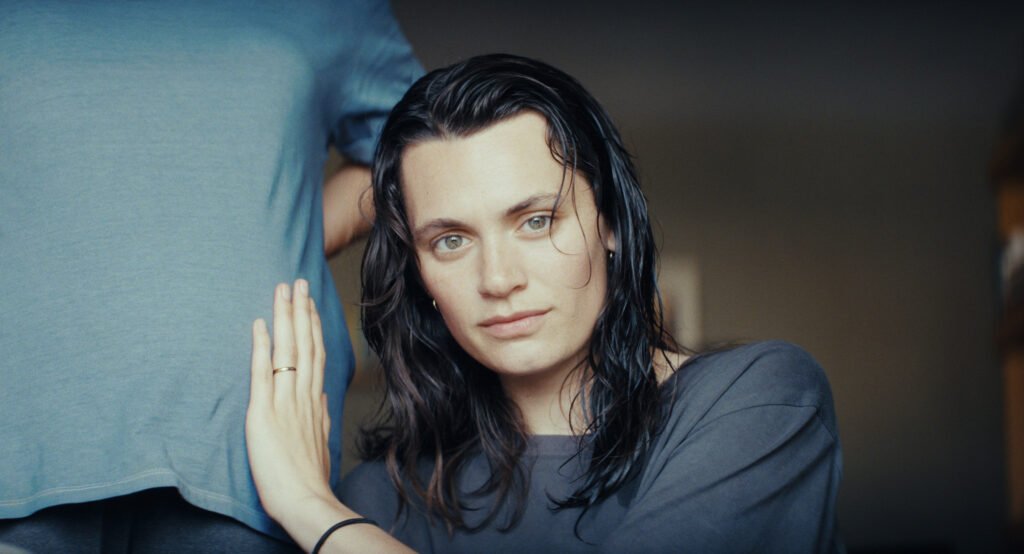
Vous avez parlé du zoom—et dans beaucoup de plans, il y a soit Ella Rumpf soit Monia Chokri qui regarde directement dans la caméra, et on sait qu’elles se regardent. Pouvez-vous parler un peu du désir dans le regard?
Pour moi, filmer, c’est toujours être à la juste distance du personnage, avec le bon objectif et une trajectoire de regard au bon endroit. Et s’il y a ça, il y a de l’émotion, il y a de l’empathie, et on peut se projeter dans ces gens. Et moi, je suis très gênée quand je vais au cinéma par les regards qui ne sont pas au bon endroit. C’est vraiment une obsession totale. Mais aussi parce que les regards caméra, c’est quelque chose que je trouve très beau.
Je trouve que la musique, c’est bien plus intéressant que le cinéma. La littérature aussi—les émotions que ça provoque, c’est incroyable. Au cinéma, un regard caméra… là, pour moi, il se passe quelque chose. Donc je cherche ces instants—un peu de grâce.
J’ai l’impression que quand on fait un champ-contrechamp au cinéma, la question de l’endroit où on regarde change complètement le plan. Si la caméra est comme ça—si je regarde par là, c’est pas pareil que si je regarde par là, tu vois ? Et moi je suis un peu obsédée par ça. Sur le plateau, je disais à Monia : « Regarde là. Non, regarde là. Non, regarde là. » On trouvait l’endroit où il se passait quelque chose, on mettait un bout de scotch sur la caméra, et elle jouait avec ce scotch.
J’ai l’impression que beaucoup de vos personnages, si on peut dire qu’ils souffrent de quelque chose, souffrent parce qu’ils aiment trop. C’est l’amour lui-même qui génère leur angoisse. Il y a un moment où le personnage de Chokri dit : “Et si notre fille veut un chat—je suis allergique.” Des petites choses comme ça.
Je ne me suis jamais formulé ça comme ça, mais c’est très juste. On est très angoissé par les choses qui font mal ou qui sont dangereuses, mais on est aussi très angoissé par les choses qui sont réussies et qui sont belles. Sur l’attente de l’enfant : est-ce que je vais l’aimer ? Est-ce que lui va m’aimer ? C’est une question que tout le monde se pose à un moment.
Finalement, est-ce que vous êtes en train de travailler sur quelque chose maintenant ?
Je travaille sur deux films très différents—c’est vraiment le début de l’écriture pour chacun. Je ne sais pas lequel ira plus vite. Il y a un projet personnel et l’adaptation d’un livre. Il est à nouveau question du lien entre les parents et les enfants, mais de manière tout à fait différente.
Je crois qu’il n’y a rien de plus intéressant comme questionnement que de se demander: comment on a reçu l’amour et la violence, et comment on fait pour ne pas transmettre la violence et pour essayer d’être dans l’amour avec les suivants. C’est une question très obsédante—comment on fait famille?


