

Shot in her grandmother’s home, the third feature of filmmaker Leyla Bouzid, In a Whisper (2026, À voix basse) had been out in Tunisian cinemas for over five weeks at the time of the film’s Brussels preview. This is something that the Tunis-born, Paris-educated writer-director said with the tiniest hint of pride—given that homosexuality is criminalised in the country under Article 230, which In a Whisper also discusses in detail. The film premiered in the Berlinale’s main competition and most recently played at the 50th edition of Frameline: The San Francisco International LGBTQ+ Film Festival.
Bouzid assembles an impressive cast, supporting the intricate thematic base of her film with an ensemble that reflects the intersectionality innate to telling this specific story. As her protagonist is breakout French actress Eya Bouteraa, in her first leading role after a supporting part in Lotfi Achour’s Red Path. Accompanying Bouteraa is the great Palestinian-French multihyphenate Hiam Abbass and Salma Baccar, known as the first Tunisian woman to make a feature film, with her work largely featuring feminist themes.
In a Whisper begins with Paris-based Lilia (Bouteraa) returning home to Tunisia for the funeral of her uncle, Daly (Karim Remadi), bringing her French partner Alice (ballet dancer turned actress Marion Barbeau) to stay at a hotel nearby. In Sousse—south of the country’s capital of Tunis—Lilia is reunited with her mother Wahida (Abbass), her conservative elderly grandmother Néfissa (Baccar), and other members of the family. However, before we discover the circumstances of Lilia’s dilemma, we are confronted by and plunged headfirst into a long sequence of Daly’s traditional Tunisian funeral. DoP Sébastien Goepfert’s camera is always gracefully in motion—first in Lilia’s car, then around the house—as if Lilia is trodding, quite literally, in the footsteps of those who have lived her reality before.
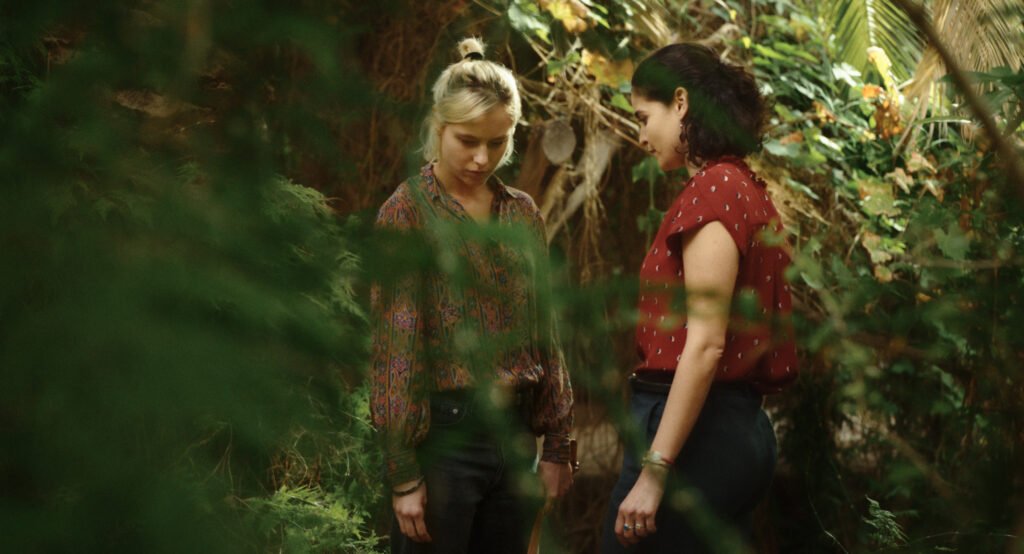
Just as she hesitates in telling her mother about having a girlfriend, she learns that Daly himself was gay—“in this country, it’s a curse,” says Wahida, as the late man’s sister. However, while Lilia is torn in multiple directions, Bouzid makes clear that it was never really a battle exclusively concerning social values around queerness—nor is it a poisoning of traditional cultural systems. We begin to observe how many of both mother’s and daughter’s choices are driven by fear, inside a generationally enforced panopticon, as the film weaves between the younger woman’s personal conflict and her search for the truth around Daly’s life as a gay man in Tunisia.
The writer-director’s most profound invention is Wahida, portrayed with just as much nuance by Abbass. Abiding by familial pressures that now hold her back, she chose to remain in Tunisia and became a successful doctor—regardless, she was always looked down upon by her mother because of a divorce. Furthermore, as Wahida encouraged Daly to be himself and embraced her brother as gay, she sees her actions as fueling his own suffering. As Lilia decided to leave and reject her family’s gendered expectations, her mother now receives the worst of both worlds. She suffers from pent-up resentment toward her own daughter’s autonomy—which seeps out, despite her immense love—while also suffering from continued flak from her own mother.
Curiously, Lilia’s own story with Alice by her side is a coming-out tale; mercifully, the narrative never falls into that generic trope that relies on admitting something verbally. Nonetheless, Alice’s behavior is written, at times, like a cautionary tale about having a partner outside of one’s culture. The conflicts between them typically resolve too simply: a passionate kiss, a dramatic profession of love. The film’s most potent sequences throw away the explanation of homophobic actions and, instead, loiter in what happens when one oversteps an unspoken boundary of the other.
This leads to the double-edged sword of In a Whisper: Bouzid has constructed a thoughtful conceit that is surprisingly overcompensatory in its attempts to demonstrate its politics, including many dialogue-first scenes and its small epilogue sequence. However, the film also holds a number of moments that deserve to be remembered, particularly resonant reflections about embedded contradictions of queer life and the actions that people might take in order to balance cultural norms, social pressures, and a preservation of personal autonomy. One such decision is the active choice to not come out to certain family members, often older like Néfissa, to preserve their perception of reality—an act of grace, in many cases, for queer individuals around the world.
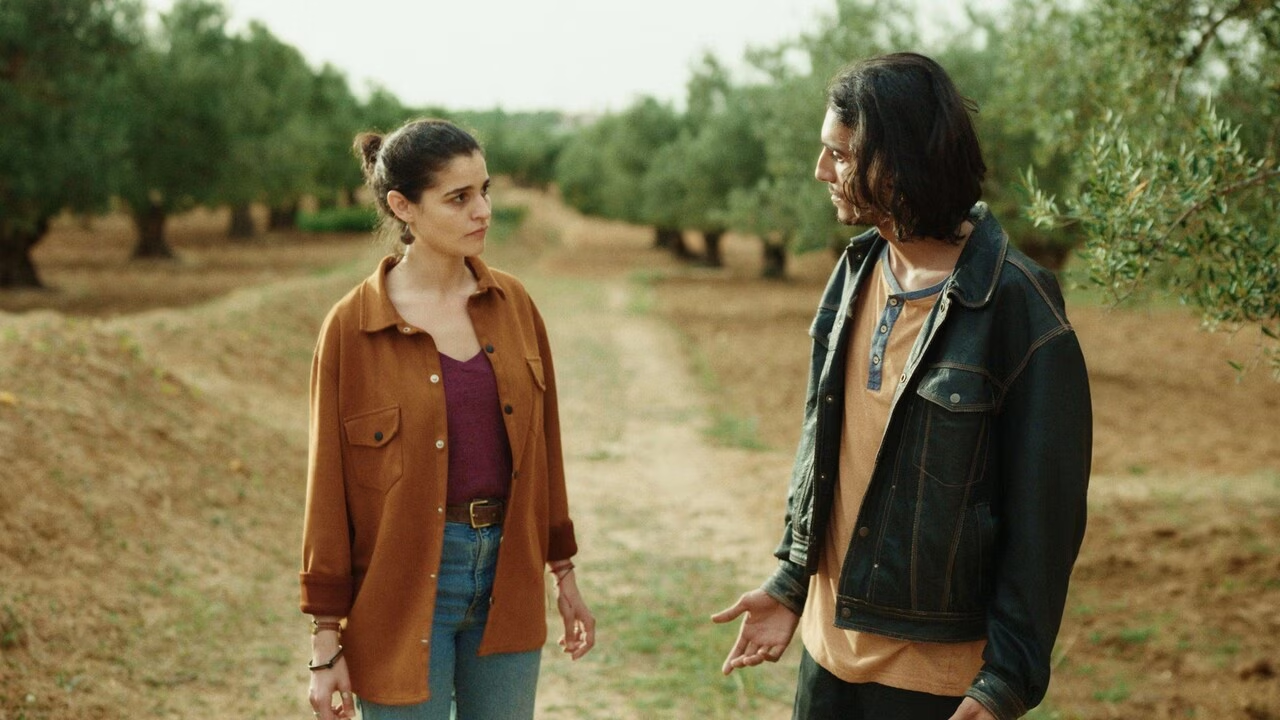
Despite the danger of provocation, Lilia wields it like a pocketknife, snapping forth on occasion from her otherwise soft-spoken façade. Attempting to elicit some sort of reaction, she shock-reveals twice that she is dating a woman to people—mostly men—who can’t reach her on a personal level. In both cases, nobody believes her, even when such a statement coming from a man, such as Daly, might mean something much worse. Here, Bouzid touches on what other recent queer films have also poked and prodded in tandem: the so-called inconsequentiality of (queer) women because of heteropatriarchal norms—going hand-in-hand with even harsher consequences for queer men, who may thus be forced to never come out at all.
While heavily weighed down by didactic dialogue, In a Whisper also contains two remarkably vivid, memorable scenes: a formal technique choice and a demonstrative scene. In the first, Bouzid chooses to depict Daly’s wedding through black-and-white still photographs. Without pageantry, dialogue, or explanation, everything is quickly and movingly conveyed through the sadness in his eyes and what happens in the images—his own avoidance of his newlywed wife and a man who attempts to confront him.
In the second, a police officer pushes Lilia to her emotional edge after she is pulled over with Alice while driving under the influence. As if silently asking whether she’s been corrupted by her life in Paris, he tests her to see what she will do—is she still really Tunisian inside? Near defeat, she covertly slips him a bill. Satisfied and ever so slightly smirking, he tells her she can go—and hands back the cash. Alice is aghast; Lilia is flustered. This is Bouzid’s perfect scene, without a single line of direct dialogue about the social dynamics at play—queerness, heritage, gender—she says it all.
*****
In a Whisper screened most recently at Frameline50 in San Francisco and is receiving releases in territories worldwide.
Watch a trailer for the film here:


