

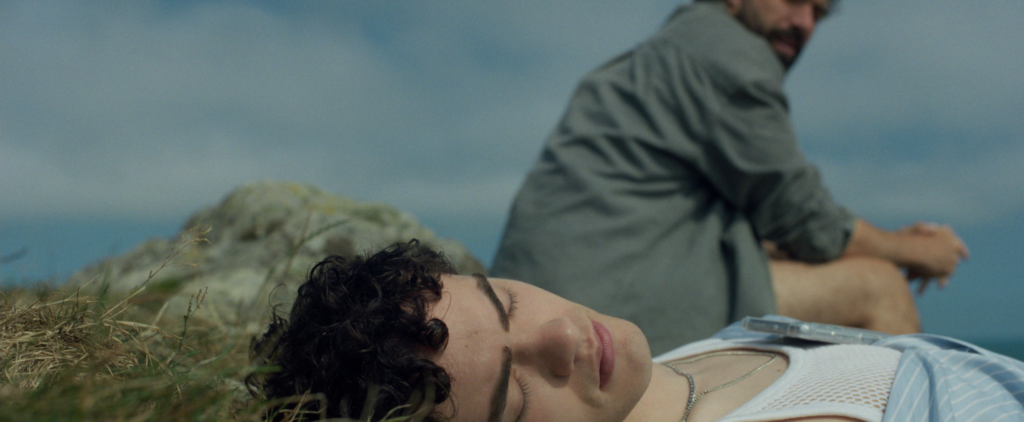
Rhys Marc Jones makes his feature film debut with Black Church Bay, a self-described mystery-thriller about the fallout following the disappearance of 18-year-old student Jasper (Joe Locke) after a secret, intimate weekend getaway with his schoolteacher, Barry (Tom Cullen). Set in a small Welsh town, the film brings into question Barry’s moral boundaries as well as how the system fails queer people in several ways.
In the context of the Zurich Film Festival, where the film makes its premiere in the Feature Film Competition, we chatted with the writer-director to take a closer look at his approach to the film’s perspective, letting the personal guide a critique of the institutional, and expanding the boundaries of what’s expected of queer cinema.
*****
Purple Hour: I wanted to start by discussing the intriguing final scene of the film. It not only leaves the film with an ambiguous ending but also really resonates, to me, with discussions about social repercussions enacted by a community in which justice fails, such as sexual assault cases that have been made public.
Rhys Marc Jones: There was a big deliberation as to how we end the movie. The script was in development for a long time. As a debut feature going through the UK system, which is quite rigorous, the ending was debated a lot all the way through the script stage. I will say that this ending is a lot closer to what I had originally anticipated it to be than perhaps the shooting script was. I won’t say what the shooting script’s ending was, but there was something that gave slightly more closure to the case originally and lean toward the idea that Barry would be caught, legally.
However, I didn’t really feel comfortable with that in the script. But you know, financiers and whatnot—they lean towards slightly more clear-cut and less ambiguous endings. When we were cutting the movie, these images, which were actually going to be the second-to-last scene, just seemed a far stronger way to end it. The film isn’t really about whether he will or will not get away with it. It’s almost about how much of himself he is willing to give up. How much of his decency and humanity and his soul will he give up in order to get away with it?
It felt like the dramatic question wasn’t, “what happened to Jasper?” or “will he get caught?”. The dramatic question felt far more internal. The film has this interesting mix between a subjective internal dilemma that Barry has and a slightly more objective kind of sociological response and how these mirror each other. I think that’s what you’re speaking to: the ways in which people can suffer for their crimes, whether that’s through cancelling or public shaming or whatnot. I liked this image. It felt like both a weird catharsis for him but also a punishment. It’s almost like he accepts what he’s done for the first time but is also punished. There’s something in that duality that I found very interesting.
Some of the hints in the first third or even half of the film give rise to the suggestion that the investigation will be the focus. However, the school dynamics and politics of queerness begin to take centre stage. I’m curious whether this was always the case or how you decided on this balance.
My work is always more interested in the human and the internal struggle. I also think it’s fun to play with aspects of genre—we’ve all seen the movie that’s from the parents’ or police’s side, right—so we can imagine an alternative movie that follows the case that way. We could all put together what those scenes would be without seeing them. I think it’s fun to dip in and allude to those things, but it was all very much rooted from the beginning in Barry’s perspective and rooted in the school being a framework for the investigation.
I felt like this school building supported the institutional procedural structure quite nicely and embedded it more in what I was trying to say, which is that I think all institutions ultimately fail the people within them. It’s not because they’re necessarily made up of nefarious or bad people with bad intentions. They’re just clunky apparatuses that can be easily exploited on a wider level, like how Barry does as well. The film definitely speaks to the culture wars in a way and where we are now. I do think that schools or education are at the front line of these culture wars as well as what we’re seeing with Cornell University [and the case of the Cornell 7], where these kinds of things come to a head and within the student body.
There have been a lot of exciting queer genre films recently—horror, thriller, crime—and I was wondering if you’re inspired by these works in particular ways, even if it’s not your central stylistic reference.
I always thought the film was quite a dark, twisty, mystery-thriller that’s very much rooted in reality. I think it’s really good we’re now in the space where we can do this. The last decade or 20 years has very much been obsessed with the love story, and it was getting a little bit tiresome. There are so many interesting voices there, and there are so many opportunities for reinvention that can speak to sexuality at a deeper and more profound level. I think serious work doesn’t have to be solemn. We can mix those things up. We don’t have to have this “academic good taste” all the time in order to say something profound. I love these kinds of movies, like The Talented Mr. Ripley (1999), or survivalist films where someone’s doing something bad but you can’t help but keep watching them. I think I wanted to make a queer version of this, essentially, and also have a protagonist whom we aren’t necessarily rooting for. There are quite a lot of queer-affirming stories, but I’m not sure if that’s what is happening in the world right now. I think we are regressing slightly again. As such, I think there’s a place for both [types of stories].
Barry weaponises structural homophobia to deflect blame, which I find a very fascinating and devious device. That aspect reminds me a bit of Jonathan Etlzer’s Bad Apples—where both protagonists mobilise the community to avoid looking culpable, and both for a missing student, interestingly.
I watched the film last week, actually! They have the same head teacher [played by Rakie Ayola], if you noticed.
There are underhanded comments by the police, but you leave the majority of the homophobic sentiment as implied and systemic.
I think that’s how homophobia is more embedded in reality, right? I very rarely go down the street and hear someone shouting slurs at me. There are microaggressions, yes. There’s a kind of lip service that’s paid that also rubs people the wrong way and comes back against you, in a way, like the Pride celebration that happens in the film.
Do you feel like you have your own relationship to queer cinema?
We’re kind of in a golden period of queer cinema. It looks like La bola negra [by Javier Calvo and Javier Ambrossi] is going to be an Oscar contender, and then Coward has come out—Lukas Dhont is doing great work. Andrew Haigh also has a new film. There’s a whole generation of auteurs. There were 13 [queer] films in Toronto or something like that. But also, it’s tricky to navigate what financiers are looking for and what people are scared of. I haven’t seen it, but Blue Film is obviously getting a lot of buzz, and it’s controversial [read our interview with the film team]—this kind of thing. When I speak to gay filmmaker friends of mine, there is this kind of feeling that only certain sort of palatable narratives about the queer experience are allowed, or stuff that is slightly more affirming and celebratory, for fear of it being homophobic. However, that also comes across as somewhat patronising.
Joe Locke is in this film, and Heartstopper [the series and film] has been this sensation—it’s extremely affirming and extremely positive. But there was nothing like that on television 10 years ago, so it is quietly radical in its own way. What I don’t want is a complacency of work where we’re no longer thinking outside of the box or thinking bout how it can push forward representation on some level. I don’t think representation necessarily needs to be that all characters are positive. That’s my relationship to queer cinema. I lean toward the dark and twisted, and I hope we are allowed to have more narratives in that space.
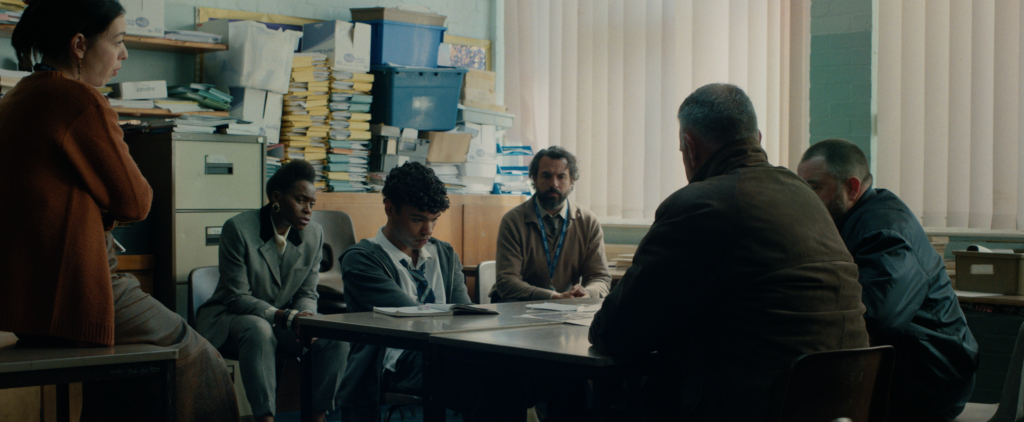
Barry moves from a lingering sense of guilt into doing whatever it takes to protect himself, even though the shift can be read at different points. What was most important to you when trying to keep Barry as someone we can still connect with, even though he’s in an extreme moral grey area in so many ways?
Ultimately, this was the exercise of the movie: how long can we extend our empathy for this person? I think audiences will have different cut-off points. Some audience members will be cutting off at five minutes! For some, it will be five minutes from the end, and for others, it might be the end. I think that’s very interesting. When I’m watching a movie, I’m very empathetic—do I like a character? I love films where people are whole pieces of shit and just interesting characters to follow. It wasn’t necessarily about making Barry likable. The question was, how do we put an audience into his dilemma, and how do we humanise his plight?
He does very harmful things, and I don’t think the film condones anything that he does, but it also doesn’t condemn him. It doesn’t take a very harsh stance. I give a lot of credit to Tom Cullen. It was also in our casting of Tom because he brought so many aspects to the characters. In the scene where you see him teach, he comes across as a great teacher and very motivational. Tom found these places that aren’t necessarily related to the case that really humanise him in different ways. I do think that is why we extend our empathy as far as we do, but it’s hard. Sometimes I watch it and think, oh God, and shake my head. Then sometimes I watch it, and it really gets me at the end. I’m interested in humanising transgression and understanding transgression as much as possible.
******
Black Church Bay is vying for the Golden Eye in the Feature Film Competition of Zurich Film Festival (24 September–4 October 2026) and will play next at BFI London Film Festival (7–18 October 2026) in the “Thrill” strand.


