

A stream window with a live chat. A camboy flexes his naked torso in front of the camera for an audience who submit their funds when he tells them to. He’ll get his cock out next, he says—if you pay up.
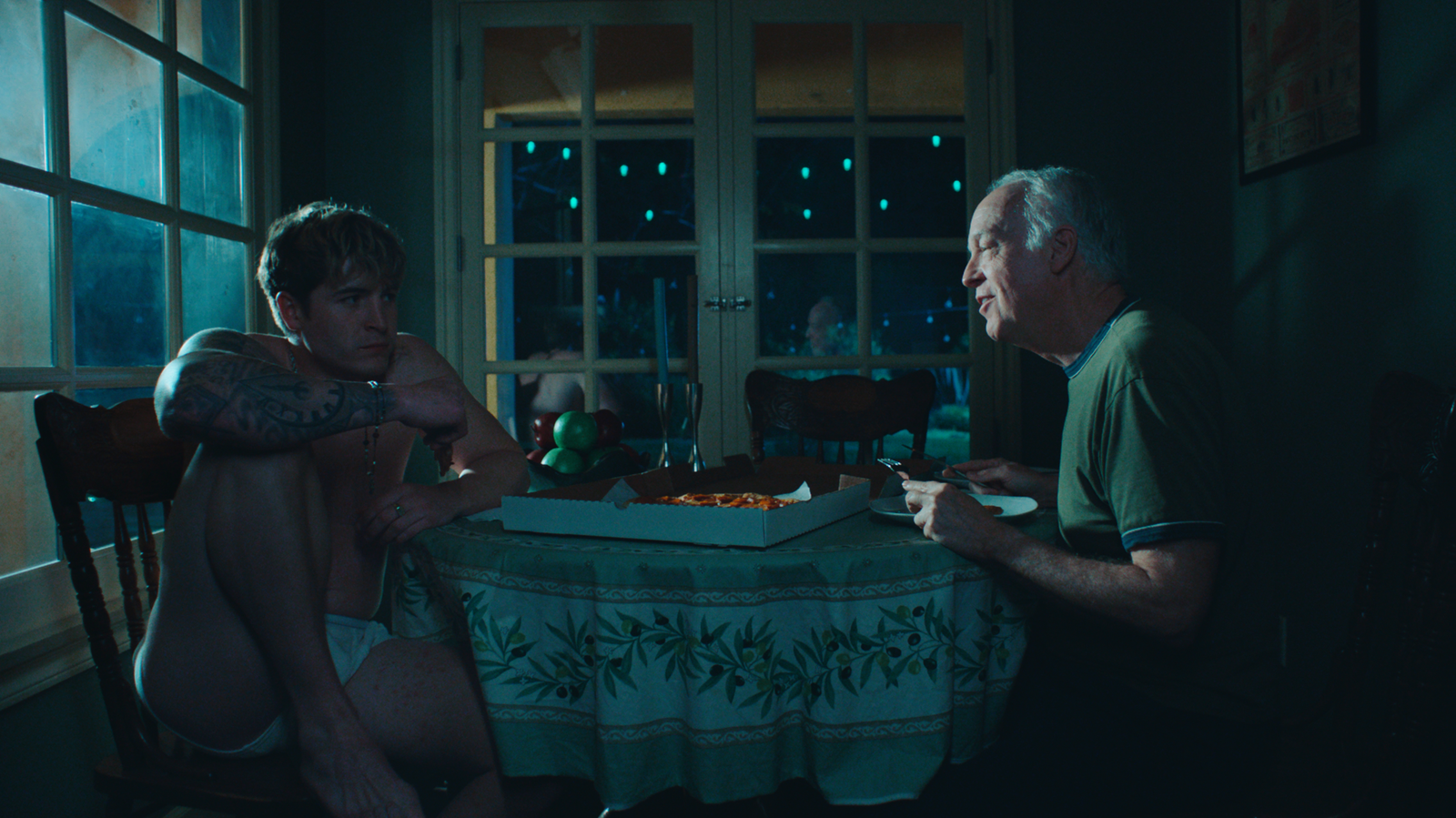
Financial domination is the name of the game, and Aaron Eagle (Kieron Moore) believes that he’s won it when he’s offered $50,000 to show up at an anonymous user’s house for the night. When he arrives at the showroom-like rental property, the paying man keeps a balaclava on, his own camera framing Aaron on the sofa. He wants to know about the younger man’s past; Aaron would rather separate his work from his past. Things grow heated. Aaron pulls off the balaclava to reveal Hank (Reed Birney), a former middle school teacher—and everything changes.
Blue Film, the feature directorial debut of American independent filmmaker Elliot Tuttle, is a complicated film that offers more questions than it does answers. A rich queer character study with a sensitive eye and an open heart, it recalls Atom Egoyan’s Exotica (1994) in its approach to its subject matter far more than it recalls, for example, Gregg Araki’s Mysterious Skin (2004). His film is frank, unflinching—it’s more than a little surprising that Blue Film made it to North American cinemas, with a VoD release now following.
In our own stream window over Zoom, Purple Hour had the pleasure of speaking with director Elliot Tuttle and the film’s two leads, Kieron Moore and Reed Birney, ahead of the VoD release. The creative trio proved as open-minded, frank, and curious about people as the project that they realised together.
Purple Hour: Elliot, this film is very much its own beast, but it fascinates me how much it feels like you’re picking up threads from other films and seeing where they lead – whether that’s Gregg Araki’s Mysterious Skin or Paul Verhoeven’s Elle (2016). I’m curious about what films sparked and fed this project.
Elliot Tuttle: A lot of Catherine Breillat films. 36 Fillette (1988) specifically. In a Glass Cage (1986), the Agusti Villaronga film, is also one that I thought about a lot. I’m a big Gregg Araki fan. Coincidentally, I hadn’t seen Mysterious Skin until about a couple of months ago—right before this film came out. So many people had mentioned it to me. I understand why people bring it up. It’s a wonderful movie.
There are shots in Blue Film of Aaron lying on the bed, staring up at the ceiling, that reminded me a lot of Nowhere, specifically.
ET: Well, I think he’s tapping into the ennui of the gay man, which I tried to do also.
There’s a distinctly horror genre element within this film. The digital camera, the balaclava, the way that the initial situation almost resembles a Saw film.
ET: Yeah, I think those exist kind of inherently, because it’s a dangerous kind of premise. But I like the idea of this being a Trojan horse of a genre film; I like the idea that it can be a thriller, or then reveal itself to not be. Or that it can be many different things, scene to scene. Yes, it has standard trappings—it sets you up with a masked man, and there’s a threat of danger—but it comes from a place beyond genre. I really think of this film as a drama. Whenever someone asks: is it a horror movie? I’ll say: it’s pretty much a drama. But it’s a freaky movie in many ways, so it does lend itself a little to some of those genre descriptions.
You talk about it as “a drama”, but how do you go about pitching a project like this? I imagine it’s quite hard to.
ET: We made the film so cheaply that I didn’t really have to… How did I do, guys?
Reed Birney: How deep do you wanna get into it? [laughs]
ET: I sent a pitch deck when I first sent them the script. At the end of the “about the filmmaker” section, there was a photo of me naked—
RB: —in a bubble bath, covered strategically in bubbles. I sent it to my manager, and said “I’d like to do this”—and he said “I’m a little worried about…” In later pitch decks, you removed that, I believe.
ET: Yes, I did. I’m having to pitch it more now that the film is out than I ever had to before. So now I’m learning how to pitch it.
Kieron and Reed, this is a physically and emotionally vulnerable film. How did Elliot work with you to develop that onscreen dynamic before you began shooting?
RB: I fell in love with Kieran at his audition. It wasn’t any effort. We flew to Los Angeles and had dinner with Elliot the first night we were there, and that was a great evening. We had a lot of fun. The next day, we read in his apartment.
ET: We read the script, and then we started filming. It was fast and furious.
Kieron Moore: We all cared about it from the very beginning. I got that pitch deck too, of Elliot in the bubble bath. It was a statement of “Look, I know I’m going to be asking whoever does this for a lot. I want you to know that I’ll be there for you; that I’ll jump on the grenade with you”.
ET: It was honestly very out-of-character for me to take too revealing of a photo. It was me trying to say that.
KM: We’d read the script. We knew what it was going to take to do it. It wasn’t like you show up and you’re like, “Oh, this needs to be naked? I didn’t know that was going to happen!” I’m very lucky that this movie brought these two into my life. Elliot wrote something genius, and I don’t know if I’ll ever have chemistry like I have with Reed with another performer—I’ll be seeking that feeling everywhere I go. It’s such a luxury as an actor to really sit in flaws and humanness, and the vulnerability that comes with that. It’s quite cathartic. We don’t get to sit in our emotions that much, or that heavily, and really navigate them—whereas in a movie like this, you’re encouraged to. There were days that were heavy, but I always came out of the other side feeling lighter.
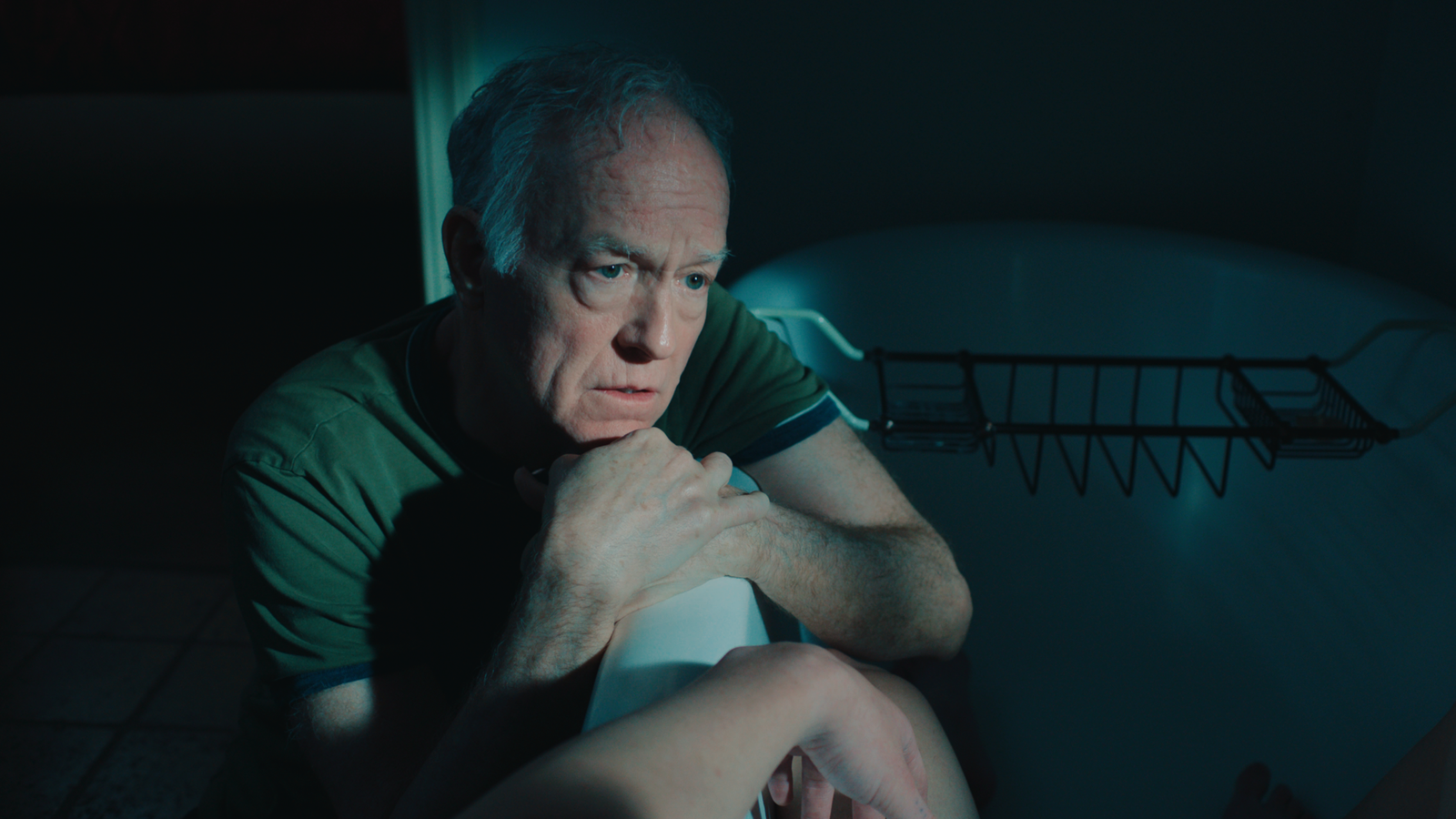
RB: Yeah, nourished in a way. But I don’t think I ever thought about what it would be like for an audience to watch this thing. What would it be like for my family to watch it? I never thought that until I was literally in the movie theatre with my family. And then I thought, “Oh dear, what have I done?”
Could you elaborate on that experience?
RB: Well, we all agreed not to sit together. My wife had already seen it. My daughter was off in the corner. I texted my wife afterwards and said, how did Gus do? And she wrote back and said, “She’s completely traumatised.”
KM: Which is incredible, right? What an achievement. My mum loves it.
RB: She said later, “I don’t want you to think you’re not fantastic—you’re fantastic in the movie—but it was a lot for a daughter to watch.”
ET: Poor Gus.
Elliot, what’s most striking about the film is its tenderness and sympathy. It’s fascinating that what makes this film potentially controversial is not that it’s particularly harsh or shocking, but instead that it’s gentle and understanding towards people whom one doesn’t typically extend gentleness or understanding to.
ET: I’m doing what I think every writer should do, which is to try and make their characters as human as possible. Like, this needs to be a person that exists, and walks around, and talks to someone. If you spend a lot of time trying to inhabit a character when you’re writing, you can’t help but make something very human. I think the conversation around the character of Hank is: Is [the film] asking us to empathise with him? Is it humanising him? I would hope that the character is well-realised enough on the page. Reed has brought so much to it just by virtue of treating the character as a human. It was never my intent to make a character that was completely villainous, cartoonish, or caricature—that would simply be poor form.
RB: Elliot told me to watch the documentary Pervert Park (2014). That was incredibly instructive for me, because here were ten to fifteen fellows who had all done horrible things, who were just guys—and broken in ways that a lot of people are broken.
It’s a more obvious question, Elliot, but could you tell me about the blue that permeates the look of the film?
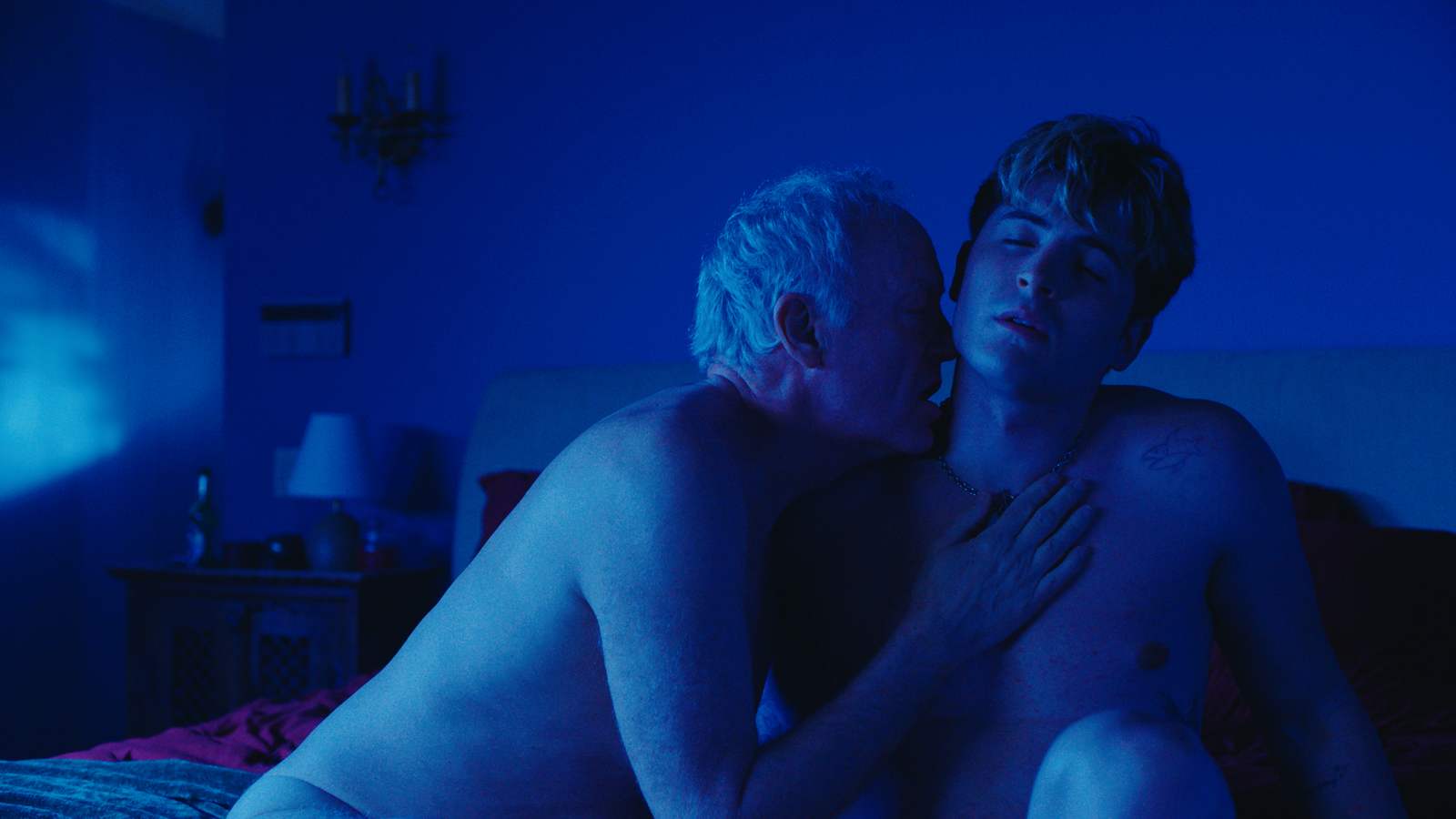
ET: I love this piece of film lore—that blue was used to mark up film cells during the Hayes code to reference anything that was taboo at that time. Obviously, “blue film” has a pornographic connotation. Porn films internationally are referred to as “blue film”—searching this film on Twitter is very difficult. I like referencing something that feels dangerous and pornographic, and is steeped in a more complicated and engaged understanding of taboo.
What I find most extraordinary about the film is how transportive it is, in both memory and in fantasy. When the characters talk, we’re taken to places and memories that we don’t see on screen—these are the events at the forefront of the film. What’s it like to write and perform a drama where the most intense beats have already happened, far away from our view?
KM: What a question. I mean, how much of our lives do we spend telling people what has happened to us? That’s real life. We don’t get to see it. When I tell someone a story, I sit in my head, and I think about the colours, the smells—and all I can do is give my experience vocally. So for me, that was a very human thing. An easier way to make this movie would be to flashback, but you would have lost what it was. This is my first feature, so I’m like hawkeye in how it’s like landing. The responses are so varied because they are all dependent on who you are as a person, and where you are with yourself, your own ideas, your own memories—your own scars, your own conscience. I think that’s what really lends the power to Elliot’s incredible writing. The audience becomes the final entity that completes the movie.
RB: Hank is talking about one of the best times of his life, so it’s very active on his part. It’s not at all back-footed and reflective. It’s very much: the more time I can spend in that study hall with twelve-year-old Alex, the happier I am.
KM: How interesting though—that audiences have brought stuff to me that I didn’t realise until later. One of the major dynamics of this movie is that of different generations—their ideas of love, sex, and intimacy are different. And it’s really interesting, this fight of memory. Aaron denies that part of him, whereas Hank is formed by his – in a way that is the only way to understand him. Every time we speak about this film, we’re still figuring new things out, what it could mean, and challenging it. Reed and I hang out and we’re still like, what do you think? How do you feel about this now? And that’s a real gift.
Elliot, what’s it like to have been such a conversation starter with this film?
ET: It’s so rewarding, because you make something with the hope that people will get to see it. And then that they’ll have something to say about it, or it will make them feel something. Aside from stirring controversy, I love to hear that people were energised by the film—that it made them want to talk to me or someone else about it.
RB: It’s a miracle that the movie is even being seen! It was an ultra-low-budget movie about a paedophile. In what world would that movie ever get a release and play in the movie theatres for a month?! And then the fact that it’s inspired these incredible conversations—good and bad—people who are violently upset about the movie, and then people who say: I felt seen for the first time.
KM: The movie is finding its way to become its own thing now, which is really exciting—and, in a way, bittersweet. You’ve got to let it be its own thing now—it’ll defend itself. And we can’t defend it, because we’re not there to tell anyone how to feel. All of our ideas change constantly. How many times do we go to the movies and it tells you: you’re meant to cry here. My acting coach always says that the questions are more important than the answers. And I feel like it’s so exciting to leave a cinema and go, I have more questions. I think that’s where a lot of the discomfort with this movie sits. I think a lot of people are so used to answers.


