

Debuting at Pordenone Docs Fest and then landing in Prague at One World, My Boyfriend the Fascist (2025, My Boyfriend El Fascista) is an immersive experience into the daily life of Matthias Lintner, the director, and his boyfriend Sadiel Gonzalez, whose political identity clashes with their queerness. This sense of immersion does not rely on spectacle, but rather on the film’s deeply personal construction. Both Matthias and Sadiel are not only subjects but active participants in shaping the narrative (with Sadiel also credited as a writer), and much of the footage unfolds in very close proximity to the couple, giving the documentary an intimate, first-person perspective.
In fact, Matthias aligns with the left, while Sadiel is a Cuban activist finding his voice on the right-wing side. The documentary explores, in a raw and straightforward way, the reasons and emotions behind Sadiel’s stance, rooted in his personal past and the struggles he experienced growing up in Cuba. This rawness is conveyed through an unpolished, observational style marked by extended takes, minimal staging, and a sense of spontaneity that allows conversations and tensions to emerge organically.
The country’s communist regime’s consequences influenced his intense radicalisation, thanks to which he’s politically active to aid the people in his country. The Italian democratic dream excites him the most, as he is finally able to vote. However, the abovementioned democratisation brought him to the more right-wing side, especially to the support of Giorgia Meloni, whose stances unsurprisingly clash with the rights of his queer identity.
The story follows the couple with thorough and unfiltered care, exposing the emotional tensions between them without imposing a predetermined judgment. For both of them, this documentation becomes a journey in which opposing political perspectives are forced into dialogue, confronting their own contradictions and limits. Through this sincere portrayal, Lintner also unintentionally captures the contemporary disillusionment that some queer individuals feel toward the left.
At One World 2026, we had the opportunity to discuss with Matthias the making of his documentary, political identities, and the sense of queer community.
*****
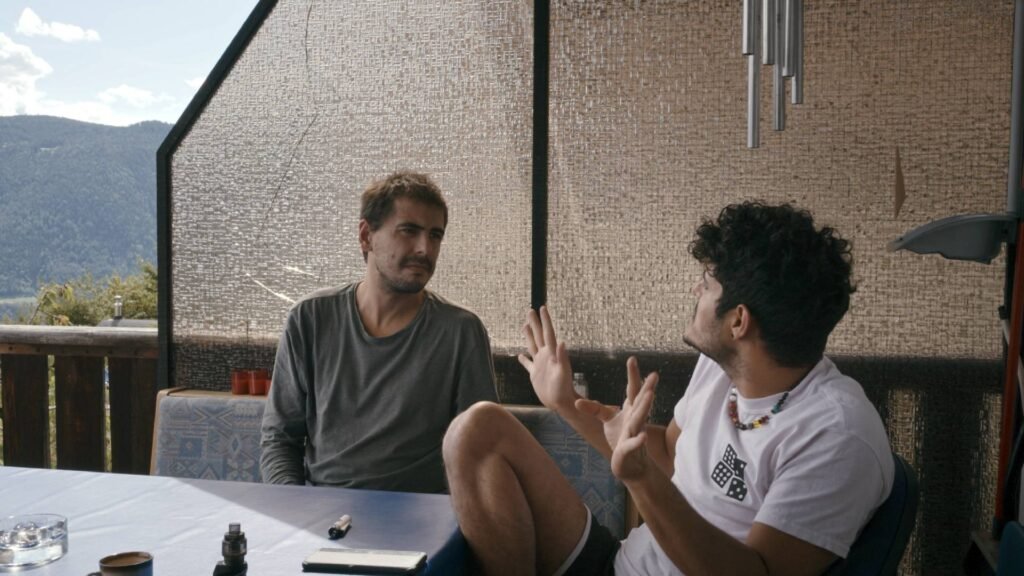
Purple Hour: In the film, you expose something very intimate—your relationship, your arguments, everything. How did this idea come about? How did you decide to film and tell this story?
Matthias Lintner: The story started a bit earlier, when in 2020 I spent a month in Cuba as a tourist, just before the lockdown. A friend told me, “Go see Cuba before it’s too late, before Western influence changes it and it’s no longer authentic.” So I went, but I ended up off-road, in places where a tourist shouldn’t be, and I had a very bad experience. I immediately got into trouble with the authorities.
Back home, I reconnected with Sadiel. We already knew each other and had an affair, but we saw each other rarely and didn’t talk much. This time I saw him again and finally had something to talk about: my experience in Cuba. Around that time, he was also beginning his activism, trying to raise awareness in Italian society that maybe communism in Cuba wasn’t as great as many older left-wing people still believed. This hurt him, so he wanted to change their minds and also push the government and some Italian regions to stop sending money to Cuba, because he and other exiled Cubans had evidence that the money never reached the people but went straight into the government’s pockets.
So I started following him in his activism, just like you see in the first third of the film. And then came all the gossip, the drama—Cuban exiles fight all the time, they’re very chismosos, they argue, they insult each other. It was intense. That’s where it all began. But at that point, I didn’t know yet that Giorgia Meloni would appear in the picture.
For a moment, it felt like, “I have to listen to her voice again for two hours?” At first, you followed Sadiel’s activism, but later, you filmed your daily life together. When did it click that you wanted to take the film in that direction? To portray his life, his way of seeing things, his activism, and also the reality of many queer people disillusioned with the left?
At first, I wanted to follow his activism. Then I started encountering many contradictions—in him, in the Cuban exiles, and in what I saw in Miami, like Latino people voting for Trump. I didn’t understand why they would vote for a man who wanted to build a wall on the Mexican border, considering their own migration history.
All this pushed me on a journey where I wanted answers. It wasn’t a dramaturgical decision—it was a process. And it was also about me. I had to re-evaluate my own political identity, which, honestly, wasn’t very developed, because I never had to fight for anything. I considered myself a liberal leftist, but I had to question which values of the left I actually identified with. And I discovered things I didn’t like. Talking with Sadiel gave me another perspective. Not because he convinced me, but because we tend to seek confirmation of what we already believe, surrounding ourselves with like-minded people. I wanted to get out of that bubble.
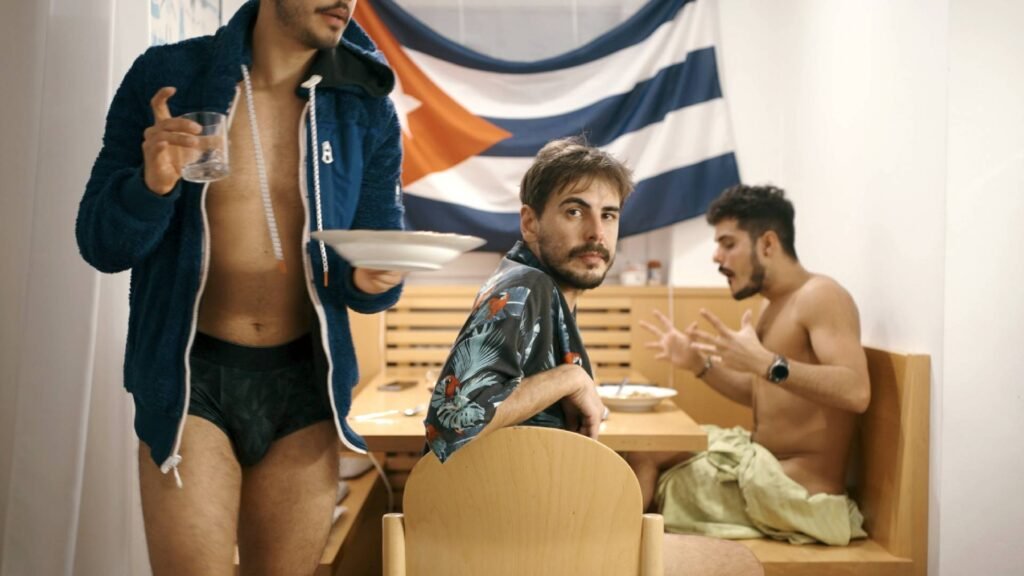
This makes me think about compromise. In queer communities, especially in relationships, we’re often very attentive to each other’s political beliefs. But if we stay in our bubbles, nothing changes. What is your relationship with compromise, considering you were close to someone who was politically the opposite of you?
Good question. As queer people, we often need to compromise to fit in somehow. I always look for a bridge when someone thinks differently, especially if they don’t know much about queer life. I come from a village where people often think queer people are flamboyant, screaming, effeminate guys—what they see on TV. When I talk to them, and they see someone “normal”, that exotic image disappears. That’s building a bridge.
With Sadiel, I was also interested in his mindset. The biggest contradiction was that he would vote for a party that doesn’t support queer rights—a party whose leader, Giorgia Meloni, stands for traditional values and attracts people who fear giving more freedom to queer communities. But, in the film, he explains why he would still vote for that party: partly opportunism, partly because he and other exiles knocked on many doors on the left and were always ignored. The right saw their frustration and wanted their votes.
Also, when you flee a communist regime, you usually reject anything associated with the left. One extreme creates the opposite extreme. I understood this only gradually. And when I realised he would vote for Meloni, I knew we had a problem. I would never vote for her. In my media bubble, she was the fascist demon. But he would tell me good things she had done. He lived in a completely different information bubble.
Considering the rise of far-right politics in Europe, and the fact that more queer people seem to be moving in that direction, do you think disillusionment with the left is a major factor?
Yes, disillusionment is a big part of it. And the left is partly responsible—they’re losing people because they’re not getting things done. I remember a demonstration in Madrid around 2002, where gay men held signs saying to the left: “You need to earn my vote.” It’s not a given that queer people vote left. In Italy, after same-sex unions, nothing happened for ten years. It’s not easy—there’s the Vatican, a special situation—but still. The left should ask itself why it’s losing votes, even among workers. Why are so many left-wing voters now academics, doctors, people with 100,000-euro salaries? As Sadiel says in the film, they talk about Marx but drive BMWs. It hurts to hear, but there’s truth in it.
The right is not only a problem—it also forces us to discuss these issues. I’m not talking about the extreme right. Sadiel would never vote for a party that wants to eliminate queer life from public space. Meloni is far-right, but not extreme. And in the end, she didn’t take away any queer rights—she simply didn’t advance them. She got the votes she wanted. It was contradictory that he voted against his own queer interests, but at the same time, I found it almost heroic—putting a greater cause above your own. I wondered if I could do that. Sometimes it seemed brave, sometimes stupid. It changed constantly.
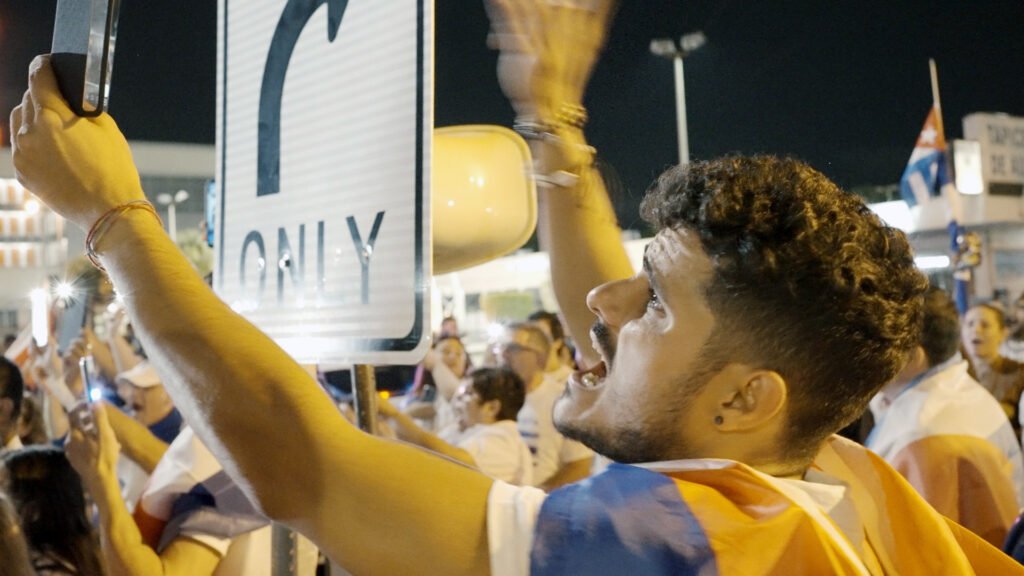
In the film, Sadiel is often angry and frustrated. When editing, how did you decide what to highlight emotionally?
His outbursts come from the psychological damage caused by the Cuban regime. Even after leaving, Cuba stays in your head. Exiles call it “anthropological damage.” I wanted to examine that. That’s why I turned on the camera during crises, not during peaceful moments. A film looks for drama. In editing, we had to counterbalance that, searching for quiet moments—which were hard to find. The result is a portrait of him in that period: restless, intense, always at 120%. But it’s a picture, not the whole person. And now he’s different. Some viewers say Sadiel is insufferable. That’s their opinion, but it’s not a critique of the film’s content. It’s just a reaction to his personality. The film doesn’t invent anything. Everything happened, even if it’s constructed like any film.
Would you consider this a queer film?
Yes and no. Yes, because we see two men, and the film screened at many queer festivals. But, in the end, we’re just a normal couple, reflecting a conflict many couples face today: being together while voting for parties that attack each other. Many straight viewers told us they experience the same. So in that sense, it’s not exclusively queer. And I’m happy that at One World, it’s seen more through a human rights and political lens.


