

Everyone’s gathering for the hottest ticket in town: tonight, there’s a show by the band La Mamba Negra, led by the elusive musician El Callegüeso. Where else would the band be playing but the dive bar by day, nightclub by night known by the name of Babel? It is, of course, the favourite haunt of sleazebags, oddballs, drunkards, and those looking to gamble with Death herself: a beautiful trickster of a woman by the name of La Flaca. Let us not forget a talking salamander by the name of Rosa, drag performances, and hand-to-hand combat with fetish-geared security guards to round out this tale. This is debuting writer-director Gala del Sol’s (head over to read our interview with the filmmaker) slick, retrofuturistic fantasy Rains Over Babel (2025, Llueve sobre Babel)—a new divine comedy of epic proportions—which wholeheartedly celebrated its world premiere at Sundance with an exuberant drag performance during its end credits and then zipped across the ocean to Rotterdam for its European premiere.
“God died in a Shakespearean tragedy, dressed as a woman…it was Shakespeare’s revenge,” says Claudio Monet (John Zapata), a recently deceased man begging to maintain his corporeal form. With a single twitch of the pen, the young Colombian filmmaker turns traditional mythologising on its head by reinventing strands and characters so boldly they could stand as their own new fables. We begin the film with an introduction by El Boticario (Santiago Pineda Prado), the hippy-esque Devil himself who serves as occasional narrator and the bartender at the infamous titular club-cum-purgatorial-realm, accompanied by his non-speaking partner Erato (Sofia Buneaventura).
Rains Over Babel quickly expands its ensemble as we meet new faces hanging in limbo, both living and dead. We first encounter the feisty Uma (Celina Biurrun), who’s busy betting years of her own life for her ailing daughter’s, and is also the caretaker of Rosa the salamander—whose presence sits quite comfortably in this slightly bizarro world. We also get to know the smoky-eyed Dante (Felipe Aguilar Rodríguez), a dead queer soldier with amnesia now bound in servitude as the “debt collector” to La Flaca (Saray Nohemi Rebolledo Ospino), where he retrieves an amulet from individuals who are about to pass away, letting them move into the next realm.
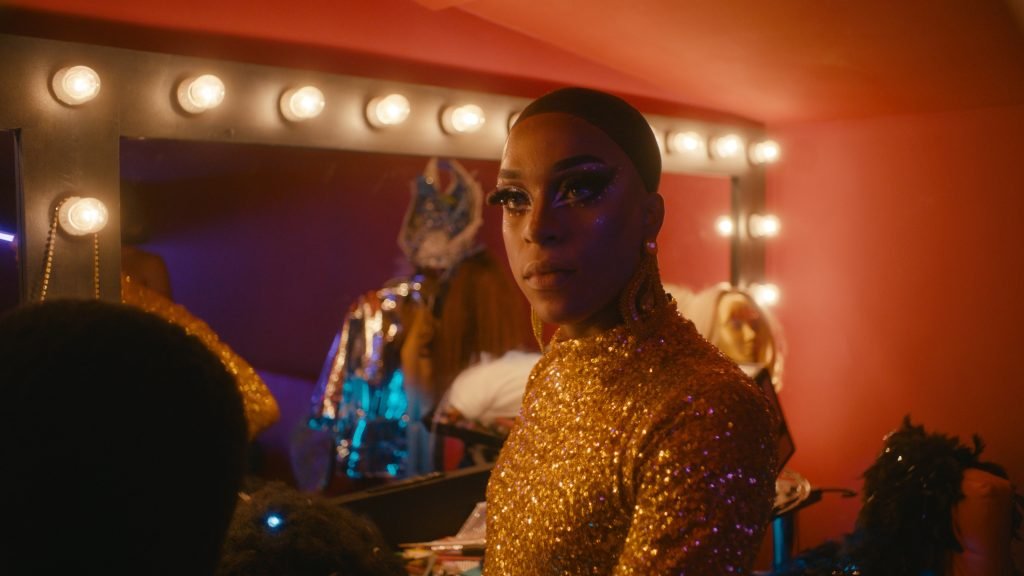
But of course, del Sol’s world isn’t just an anarchic, non-heteronormative utopia: the homophobic, uptight Salai (John Alex Castillo) who runs the bar must contend with his son Timbí (Jose Mojica), who teams up with Uma to fetch El Callegüeso before that evening’s show. Likewise, an orthodox pastor’s son Jacob (William Hurtado), who is an emerging drag queen, experiences stigmata on his hands and—you’ll never guess it—is terrified of the world finding him performing onstage as Andria Luxury.
If you’re overwhelmed, just stay with me. Rains Over Babel easily could have been much messier and more jumbled than it is, but upon an attentive watch, it’s surprisingly quite neat. The lasting impact of the two-hour spectacle of is the filmmaker’s ability to bombard viewers with storylines and audiovisual stimuli without losing track of a single thread. In very short spurts of time, she creatively uses distinct, symbolic scenes for select characters that stick to your brain: Uma when she gets thrown out of Babel early in the film, Jacob when he gets interrogated by his father. With these moments, you’ll immediately remember who each character is and where they’re headed, narratively. Each sub-tale is supplemented by rich performances of this ensemble cast, all of whom make their respective characters their own.Curiously, the characters that could have played a larger role are the ones we are first introduced to: that of the narrator and his partner himself, who only show up to speak to us a seldom few times throughout the film.
Don’t think too hard about the logic of this world, of how the living and the dead really fit together: it all works well enough to carry us along. It’s more fantasy than science fiction—and after all, it’s really about the aesthetic, the vibe, and the music. Art director Jaime Luna fills this highly stylised world with neon lighting schemes right from the start (even Christian crosses glow a bubblegum pink in the background)—this is not your mother’s bedtime fairytale—while sweeping camerawork by Sten Tadashi Olson gives us a good glimpse of this grandiose world. The creative team works together with costume designer Felipe Giraldo to create a cohesively steampunk-goes-hipster vibe in the clothing and character presentation.
Sound designers Gerry Vazquez and James Parnell pepper in countless effects, most notably the motif of the slithering sound of a snake, while composer Martín de Lima scores the entire film with an undercurrent of ongoing music, inspired (but not exclusively) by Latin American percussive rhythms and genres, almost as if the work were a sort of spoken-word operetta. If you thought the second half of Anora was exhilarating, have a load of Rains Over Babel, which will sweep you up, as long as you’re ready for the ride.


