

Massih Parsaei makes his feature debut with Lovers Sleep Alone, which follows Iman (Pooyesh Frozandeh), a young gay Iranian man living in Berlin, working two jobs by day, and cruising by night. Iman’s disposition is as if he is simply floating from encounter to encounter with a deep detachment from his environment. It’s up to us to see how Maneli (Ava Darvishi), his cousin visiting from Tehran he hardly knows, may begin to shift his response to his surroundings and his aloofness.
At the 74th San Sebastián International Film Festival, we sat down with the Tehran-born, Berlin-based filmmaker to discuss the film: the character of language, the rejection of “home”, the dimensions of intimacy, the bounds of a queer work. Lovers Sleep Alone just made its world premiere in the New Directors strand of the Basque festival.
*****
Purple Hour: I’d love to start with the opening sequence, which features very intimate shots of men—long-haul truck drivers—sleeping in their trucks. There is, of course, this vulnerability of sleeping and watching someone sleep, but also the idea of transitory behaviour. Coincidentally, in Cannes Semaine de la Critique this year, we also had Flesh and Fuel, which is about the love between two truck drivers. I’m curious how these first images came about for you.
Massih Parsaei: There were two things at the beginning of the film. There was this idea that Iman looks at the sleeping truck drivers. The people we cast are mostly very masculine, and very big, and very different than the main character. The idea of having this boundary of glass also interested me, but also having this very intimate act of watching someone. I did not want it to be something sexual. It was more about him wondering about something he is not able to do and this calmness they are able to achieve. The truck drivers have their home in this very small space for a very long time, while their families [live elsewhere]. Their families are there, virtually, with them as they move with their homes. It seemed similar to the feeling of living in exile or this in-between state of moving from somewhere and trying to build your life, but still not arriving somehow.
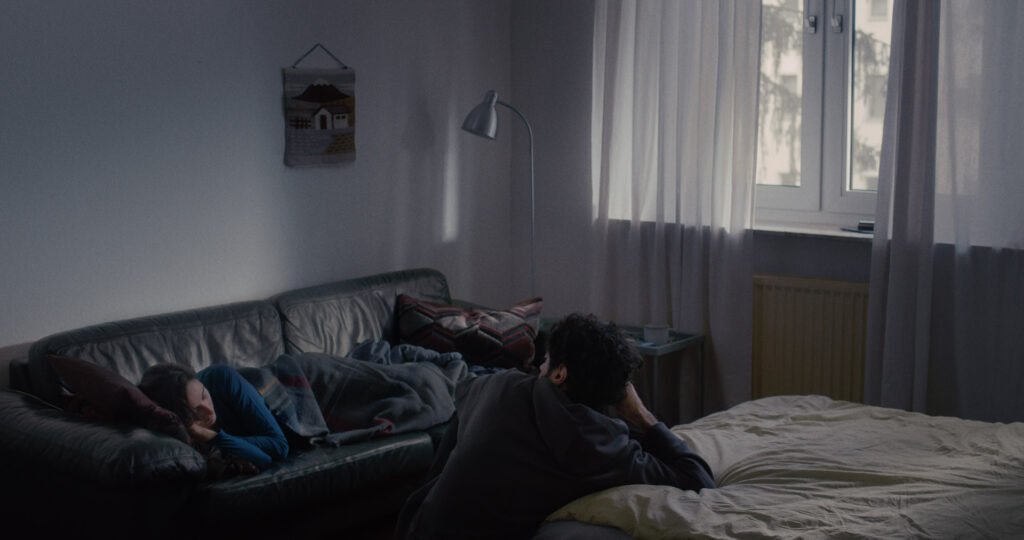
There’s this common fixation today on talking about home, but it’s also a really complex, fraught concept for many—whether it’s a place, a person, an idea, or simply nothing at all. Was the story informed by your own conceptualisation of home at all?
I moved very early from home. I was 16 when I moved from Iran, and I never went back. I lived in Hungary for eight years, and my whole goal was to somehow learn the language like a mother tongue as fast as possible. Then, I moved to Germany and did the same. I practiced all the time so I didn’t have an accent and so I speak like a German. In Germany, there is this word, “Heimatlosigkeit” [editor’s note: roughly translates to “homelessness”, but also on a conceptual, emotional, and philosophical level], which I heard for the first time when I moved to Germany—the idea that someone can be heimatlos. I found it such a ridiculous idea. However, it was something that followed me as a person living in exile, and it is projected on you, as much as you don’t want it.
For Iman, there is a similar thing because he also speaks the language perfectly. He has two jobs. But something is still not working, and his past keeps coming back to him. I’m not a big fan of this idea of home. It’s something that attacked me a lot in Germany, to be honest.
And there’s an obsession in Germany with “Heimat” [home].
Exactly—I remember that when I first heard the word, and I was already speaking German well, I started to analyse it in my head. But I do also have to say that making a film like this, with all the funding systems and everything, it works to [tie it to a concept like this]. However, my goal was actually to not go toward a portrayal of Heimatlosigkeit.
Iman speaks both German and Persian/Farsi in the film, mainly for practical reasons. I find it interesting how different languages have different potencies when it comes to certain emotions or ideas. What are your thoughts on this when it comes to Iman’s character and the story?
Going back again to this idea of Heimat, I did not want the film to be focused on this one language, or this one person who has this specific feeling. Choosing what story is in what language was an interesting thing because we tried to have some of the stories of the passersby [that Iman overhears in the film] spoken in German—I tried to put them in Hungarian. However, they were not really functioning. From my own experience of language, I somehow realised that the way I talk in Hungarian, for example, is so different than how it is in German when it comes to the way that information goes into my body. In German, I have to analyse it 500 times until it comes out. In Hungarian, everything comes out of the stomach, so to speak—it’s intuitive and very emotional.
I have to say that Farsi was the most difficult language to write, even though it’s my mother tongue. It was also the most difficult to direct because it’s something I haven’t spoken in so long. It also was somehow not in my everyday life. I had the most difficulty writing the dialogue, and then I was calling my family and practicing it with them.
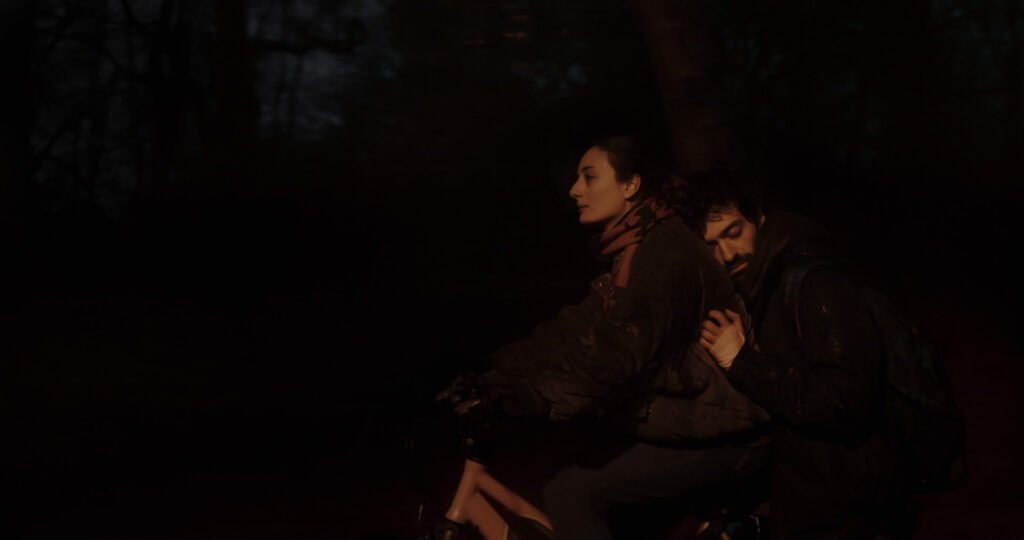
Let’s talk about these passersby scenes, as you refer to them, which are an unconventional but very compelling way to depict subjectivity. We’re often focused on Iman visually, but the aural and surrounding focus remains on the conversations and lives of other people. For instance, you have this early scene where we see this woman walking out of the building, and she gets into the car—we hear the conversation that’s happening as the camera looks out the window, and then later we see Iman cycling alongside the vehicle. I love this sense of perspective.
It’s actually the very first thing I wrote and the very first idea I had of the film. It came out of a conversation I had with a friend. She was talking about this physical numbness or pain she has, and she could not describe it, while I could not understand how it was for her, either. It was an interesting moment because somehow, something that was there emotionally for me was very physical for her.
Through this approach, I wanted to portray this character who actually doesn’t really know what’s happening to him, so he can’t talk about it. I really didn’t want to put him in a situation where he has to talk about it or have there be a moment in the film where something big happens. He gets to know that the world he’s built around himself is not functioning. My only choice was to bring in these passersby who are having the same ideas, thoughts, or moments to portray the feeling that he has. This scene you mention is somehow closest to me, but it’s also the scene I had to fight the most to do. It was difficult to understand how it was going to work while writing, but I’m very happy it’s in the film.
The separation of senses I find very interesting. And then we have this concept of lying or invention as a survival mechanism, a form of queer survival—but also more than that. It’s a way for Iman to take control of his reality and shape it, through mentions of a girlfriend, an injured hand, and so on.
It also comes a lot from the place I grew up in. It’s about being able to survive, and I think I brought it into the film. Even though he’s been in Europe for a long time, I don’t think it’s that easy to get rid of all the fears that you grew up with. It’s also the “correct” idea of how you should live your life: how you should be and that you should have friends, and that you should have girlfriends and family. What I really wanted was for these moments not to be big moments of lying, but for them to be moments that wouldn’t change anything if he were telling the truth. It’s for him to have a short moment of control over the life he’s built, as you said.
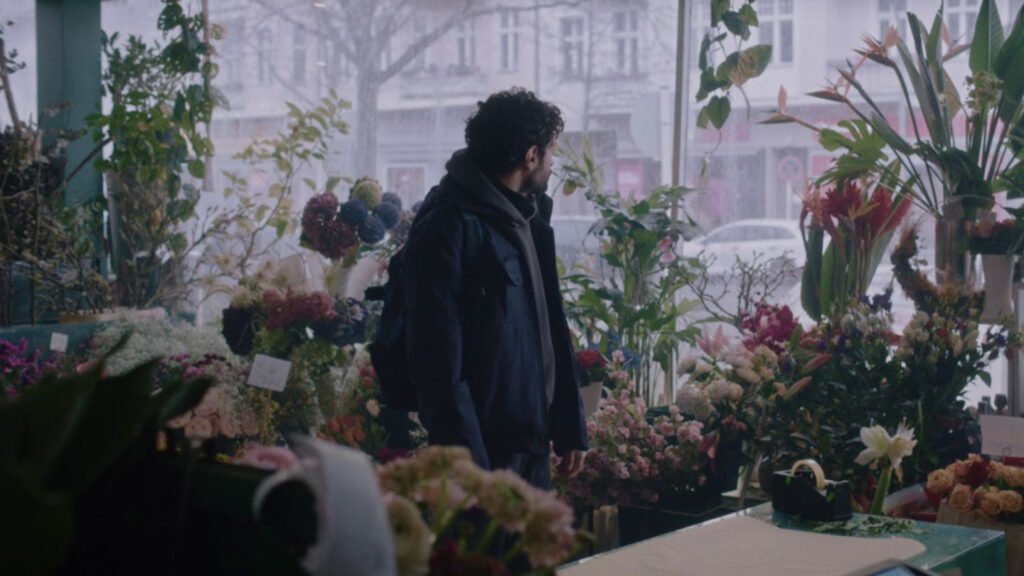
Your film made me think a lot about Mate Ugrin’s Petty Thieves [read our interview with the filmmaker and our review]. There are a lot of really wonderful parallels that I will let the viewer or reader discover for themselves, but they are also very different films. One thing that I think does traverse both films is the multifaceted nature of intimacy: purely sexual encounters, in one case, and a sort of friendship-lie platonic love on the other. For Iman, that could be seen with Maneli and the old man in his job as a caretaker.
In the end, everything that he has built in his life is about seeking intimacy in different ways as well as taking control of it. The old man is a bit similar to the sleeping truck drivers because he also doesn’t respond. Overall, what interested me was that he’s scared of the reaction to intimacy, and he wants to live the intimacy solely through what he gives. This changes a bit when Maneli arrives. When I wrote the synopsis, it sounded like Maneli comes and changes everything, but she doesn’t. I really tried to be honest by writing the script such that Maneli comes and everything changes, but it always feels so untrue to me that a person arrives and everything is suddenly different. I like the idea that she’s actually also a passerby and changes something small in his life, exactly like the old man who changes something small in his life.
Without giving too much away, I want to ask about the final scene in the film. It reflects particular fears and the social environment in Germany today.
While I was writing, I was also thinking about my own experience. I thought all the time that this is not something I can leave out of the story. It’s an important part of the story, but I was scared that everything we see before would be read in response to the end. I think the ending is just a short explanation of everything we see before. It was very important for me that we don’t define this character by this moment. It was also very difficult. It was the only thing I really insisted on shooting at the end, on the last day of shooting. It was also a very emotional moment for Pooyesh, because I really did not want him to live this for the rest of the shoot or have anything he does be a reaction to it.
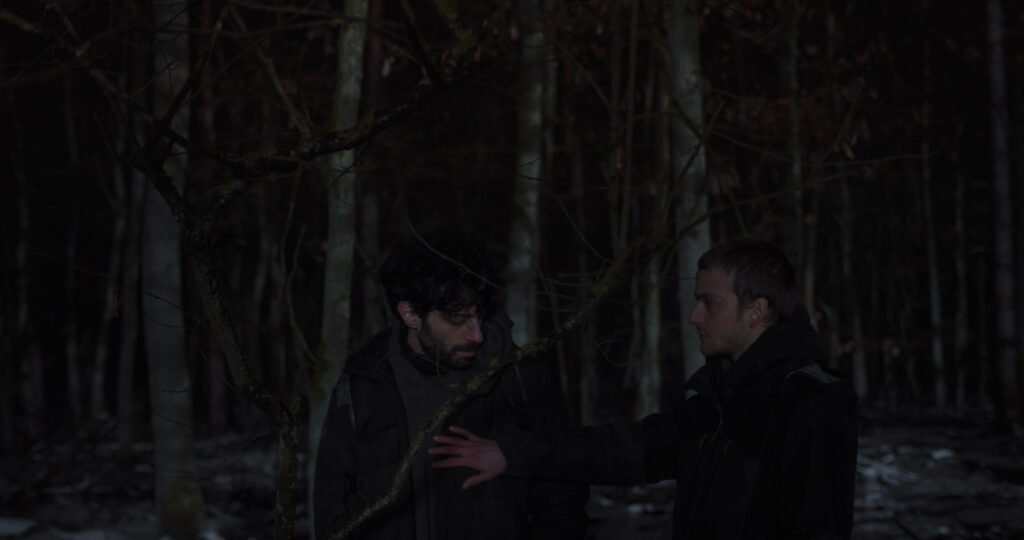
At Purple Hour, we’re interested in what queer cinema means to filmmakers and how their film is responding or situated within a body of queer work. Were you thinking about other queer films while making this, or how your film would be interpreted in this way?
Strangely, we heard one thing a lot: that this is “not a queer film”.
Fascinating. I will say I don’t agree at all. Do you know why this claim was made?
I’ve heard a number of times [from people in the industry] that the queer community would not be interested in this film, or queer festivals would be less interested in it—which is not true, because right now, we’re having a lot of good talk with film festivals. I think what I realised while getting feedback is that we are used to a specific image of what a queer film is, and unfortunately, a lot of times it is from a white or Western perspective. We barely know queer films from the Middle East, how they are, and how they work. They cannot function the same way as other queer films and European festivals work. It’s the challenge presented by narrowing down queer films to the sexuality part of it and how sex is represented—rather, [we could] focus more on how queer stories are told from queer people.
I moved from Iran and thought I would never be brave enough to do a queer Iranian film. I was scared to do an Iranian film at all. When I was writing the project, I knew that if I do this and it goes out, then I won’t be able to go back home. Still, it was a story I wanted to tell. When I met Pooyesh, it was a very long process to become at peace with what we are doing. I think it’s a problem of always reducing queer films to sexuality.
On that note, could you talk briefly about the casting?
It was a very long, exhausting process. I don’t know how to cast with the camera and stuff—I get sick of it. I was really not in the Iranian community for very long. When I started casting, I began to integrate myself into the Iranian community, and I knew Ava, who played Maneli, from my childhood in Iran. One night, I dreamt I cast her for the film. In the morning, I woke up and found her on Instagram after 14 years. I wrote to her, “Hey, I dreamt of you, and I hope you’re good.” I thought she was in Iran, but she told me that she moved to Belgium a few months ago, and that she’s a theatre actress. Pooyesh never acted before, but he was in a theatre piece—that Ava was in—as a dramaturg, and they were in Berlin. I met Pooyesh for one coffee, and I knew it was him.
*****
Lovers Sleep Alone is playing as part of the New Directors strand in the 74th edition of San Sebastián International Film Festival (18–26 September 2026).


