

Turning to the festival itself, what do you think is Mezipatra’s significance within the Czech cultural landscape? How does its role differ between Prague and Brno?
I would actually separate my answer into Prague and Brno, because I take part in both editions. What’s true for both is that the festival provides a wonderful opportunity for people to come together. It’s a place for queer people, but it’s also for anyone who wants to watch queer cinema and support cinema more broadly.
Something I was discussing with a colleague recently was the fact that we don’t need any additional special security arrangements or cooperation with the police for our festival. A queer film festival can simply be another cultural event. Sunny Bunny, Ukraine’s only queer film festival, experienced a provocation at one of its editions a few years ago and still needs additional police presence. The fact that we don’t have to think about these things is wonderful.
In Prague, the industry programme is continuing to grow. We organise panels and talks, and the programme is accessible because the industry events are free to attend. We also work with the OUTPITCH mentorship platform, which has been supporting filmmakers for several years. One of the films that received an award through OUTPITCH last year was subsequently screened as part of this year’s Ukrainian queer programme. It’s very rewarding to see the festival supporting filmmakers at the development stage and then welcoming their completed work back into the programme.
Brno, on the other hand, is a lovely community event. Because it’s smaller, there is a different atmosphere and a stronger sense of bringing people together. The accompanying programme is focused on helping people meet and connect. This year, for example, there will be an event specifically for queer mothers, where they can meet, bring their children and talk to one another.
Ultimately, the festival is about promoting cinema, but also about encouraging people to come together.
Would you describe Mezipatra as a safe space for the queer community?
Definitely. I was actually discussing this with a friend recently. Usually, when I go to a club or a party with friends, if one person needs to leave, the whole group tends to leave together. We went to the main festival party this year, and she arrived later and had to leave earlier. I stayed at the club, and neither of us was worried about the other being there alone. She also told me that it was the first time in a while that she hadn’t experienced strange looks from men in a club.
I’ve noticed similar situations with other festival guests. People arrive together, but then one person leaves earlier while the others stay. You don’t necessarily see that very often. I think this demonstrates how a safe space can be created throughout the festival experience. It starts with a screening and continues all the way to a party. Even though anyone can attend, it can still maintain that feeling of safety and belonging.
It’s lovely to see how the festival has continued to grow. I’ve already noticed a difference compared with previous editions. Is there anything in particular that you’re especially excited about this year?
This is actually my first year working as a member of the festival staff. I’ve attended as a visitor before, so being involved in its organisation is a completely different experience. What really excites me this year is the number of filmmakers attending our short-film screenings. I hosted a panel for the Ukrainian queer programme, which eventually brought together four guests. Another short film block also had four guests, and I hosted several other Q&As with individual filmmakers.
It’s really exciting not only to screen these films but also to welcome the people behind them and give them the opportunity to talk to one another. Rather than having one guest here and another there, we can bring several filmmakers together and create a proper conversation.
And you were also involved in the programming itself, weren’t you?
Yes, and that brought me a lot of happiness. We programme short films thematically, but that doesn’t necessarily mean every film in a specific block forms one cohesive narrative. They are still independent works brought together in a programme.
When I was preparing the Q&As, I had to think about what might connect these different films on a conceptual level. Sometimes the connection was quite abstract, such as the idea of deliberately showing or withholding information. I was worried that I might be overthinking the whole process, but then I received some really positive feedback. People told me that the questions flowed nicely, which made me very happy.
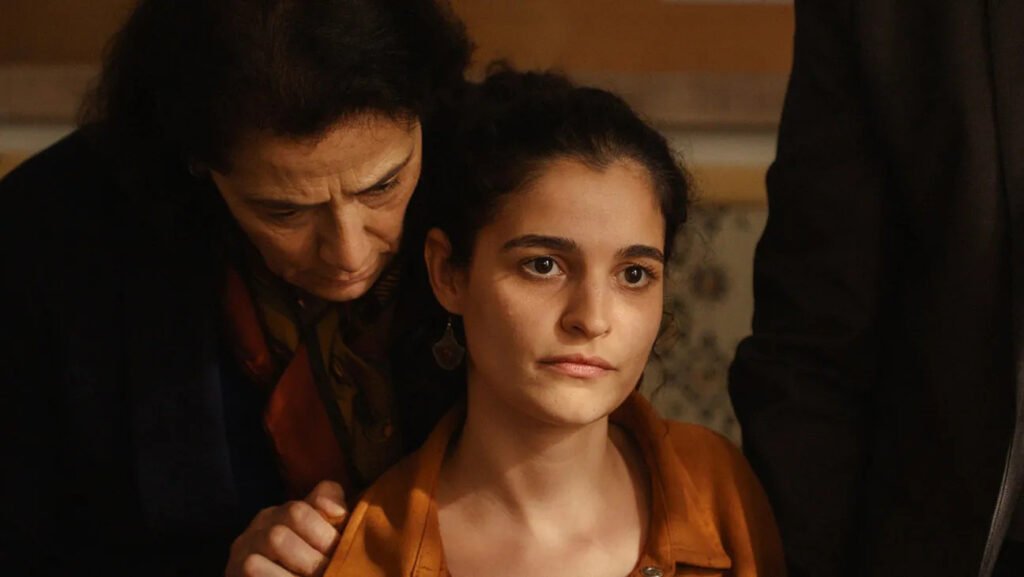 A still from In a Whisper (2026)
Does this mean that Mezipatra is moving away from a strictly theme-oriented approach to programming? Or do you still find that a common theme naturally emerges from the selection?
We do have a theme running through this year’s edition. It’s about growing up and the idea that you can come of age at any age. However, it wasn’t something we decided on beforehand and then used as a guideline for selecting films. It emerged organically. We watched a lot of films, discussed them, and gradually started noticing that the same ideas were reappearing in different ways.
For example, our opening film deals with a boy growing up. Club Kid follows a grown man who discovers that he has a child and suddenly has to become responsible. Leyla Bouzid’s In a Whisper (2026) also explores family relationships, while Coward deals with young men, including boys who are sent off to war and are forced to grow up very quickly.
There are several other examples throughout the programme. So the theme is definitely there, but it takes time for us to recognise it. We don’t necessarily start with a slogan and then look for films that fit it. Instead, we watch the films, discuss them, and eventually realise that a particular idea has been emerging throughout the selection.
Finally, are there any particular titles from this year’s edition that you would recommend to audiences? Is there something you would tell everyone not to miss?
My first recommendation would be the Our Voice in Focus block of short films, which is our gay short film programme. We worked with a camera metaphor when developing the title. The block opens with Jasper De Maeseneer’s Shutterspeed (2025), a film about a photographer who behaves manipulatively and is predatory towards young boys. Then, we have a film about intimacy coordination on a film set, another about two actors who are in a relationship and argue over who is the better actor, and a very tender and touching film about the experience of touching someone for the first time. The ideas of the camera, perception, seeing, and being seen connect these otherwise very different films. We didn’t necessarily set out to create that connection. It emerged naturally as we were programming the shorts, and I’m particularly happy with how everything came together.
I would also recommend Club Kid. I had a really good time watching it, and I’m introducing it. I’m planning to stay for the screening because I want to experience it on the big screen. Finally, I would mention a real classic: Nowhere (1997) by Gregg Araki, which we’re showing tomorrow as part of our retrospective section. It’s a remarkable film from the 1990s that remains incredibly relevant. At its core, it’s about the struggles of growing up and coming of age, and I think those themes are still just as moving and truthful today as they were almost 30 years ago. We’re also very happy to present a recently restored 4K version of the film.
*****
Held in the Czech Republic, Mezipatra Queer Film Festival runs 5–12 November in Prague and 13–20 November in Brno.


